We have written about Bruce Elwell on this blog once before, looking at a piece he wrote under the pseudonym “Barbarians for Socialism” (here). Elwell, former member of the American chapter of the SI, who later became a longtime union organizer, was a brilliant writer and theorist, and continually published during the 1970s and perhaps after. However, one would not know much about all the writing he did as it’s virtually impossible to find. It does appear, though, that Yale’s Beinecke Library has acquired much of Elwell’s work as part of their acquisition of Donald Nicholson-Smith’s papers (see here).
Elwell stands out amongst the members of the American SI in the post-SI decades in that he appeared to stay politically active in New York and because his writing, across the few examples we have seen, is concretely grounded, witty, and clear. It is perhaps time someone does a small book collecting his works for wider publication.
Bill Brown has listed out a number of Elwell’s works in a very helpful bibliography he pieced together. The instant piece is not among those listed.
This piece is a poem published for the Lower East Side literary journal Maelstrom. In reading it, the criticisms against the Left, which Elwell would refine and sharpen over the next few years, are quite evident.
Maelstrom was a small-circulation publication that billed itself as “a non-profit journal of all the arts produced by cooperative labor.” Physical copies of this issue of the journal are scarce but JSTOR has digitized some of the issues, including this one, here. We found our copy of this for just $18 though.
I’ve been reading through a lot of old C.L.R. James pamphlets recently. In his vast bibliography one finds many pamphlets amidst a remarkable number of articles, transcribed speeches, and books James produced during his time. Collecting his work has been a focus here for decades and one interesting piece of that has been tracing back the context of the specific publishers who reprinted the pamphlets and their political contexts. James’s pamphlets tend to be republished by radical projects immersed in struggles of their locale and time. The instant pamphlet is no different.
The murder of Walter Rodney, historian, Marxist, and revolutionary, likely won’t be a foreign piece of history to readers of this blog, though for those new to the subject and interested the documentary Walter Rodney: What They Don’t Want You to Knowis a good starting point.
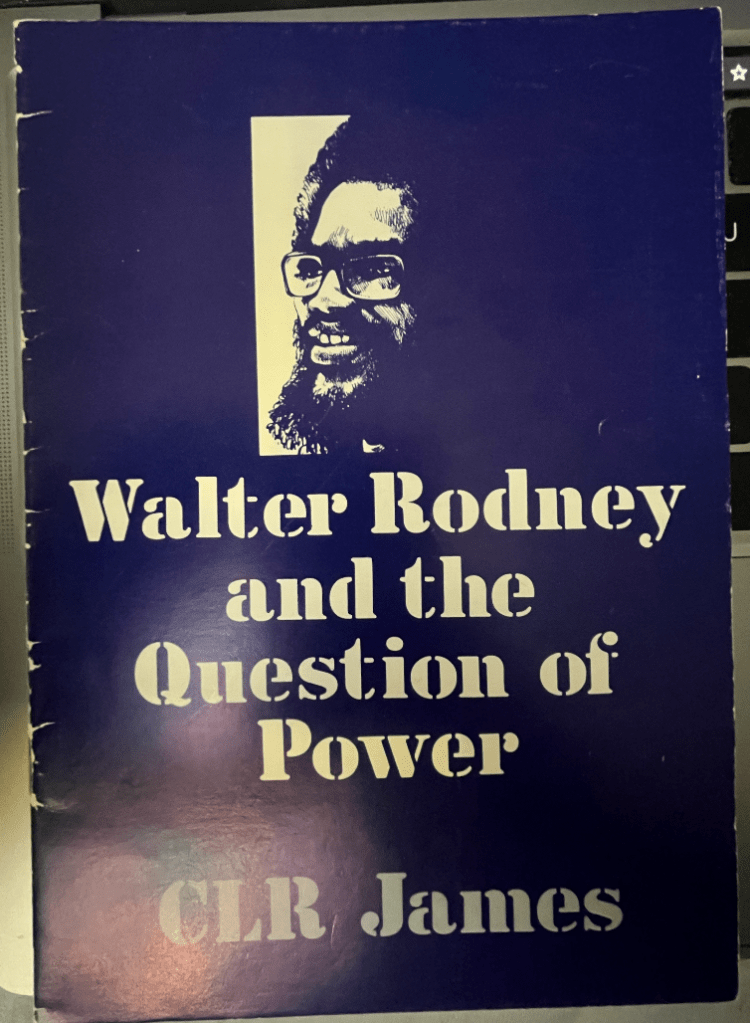
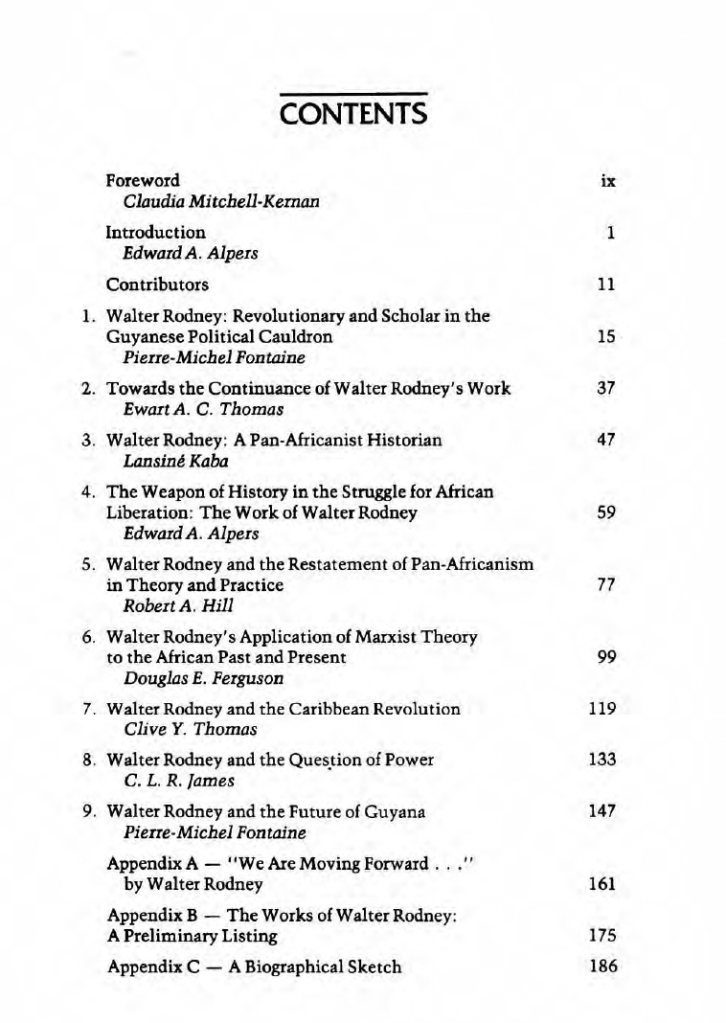
Months after his murder in the fall of 1980, the Center for Afro-American Studies at UCLA convened a conference in tribute to Rodney entitled “Walter Rodney, Revolutionary and Scholar: A Tribute,” that included speakers (all men, I believe) such as Robert Hill, Pierre-Michel Fontaine, and C.L.R. James, among others. This pamphlet is a a transcript of James’s talk, entitled “Walter Rodney and the Question of Power.” (A book of the conference talks was published by the University of California Press in 1981 and and is scarcely findable in the book trade, but is available for download here).
Table of Contents of the 1982 book of talks from the UCLA conference
To my knowledge, the instant pamphlet is the first and only time the Question of Power talk was published again as a standalone piece.
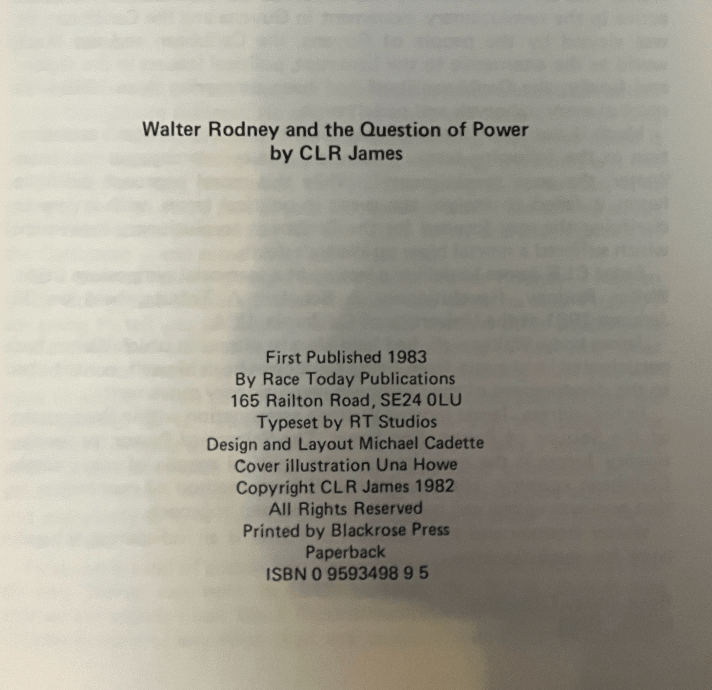
First page of the Walter Rodney and the Question of Power pamphlet.
The publisher, Race Today Publications, was a critically important Black marxist project out of England that began at the tail end of the 1960s. Race Today’s leading theorist was Darcus Howe, who was James’s cousin and acolyte, as well as an activist known for being part of the Mangrove 9, and a prolific writer. (For those interested in the relationship between Howe and James it’s worth reading Paul Field and Robin Bunce’s 2013 work Darcus Howe: A Political Biography generally, and specifically Ch. 1 fn 1, p. 14. That work was published again, in 2017, as Renegade: The Life and Times of Darcus Howe. Both editions by Bloomsbury). Race Today Publications was, as is obvious, the publishing arm of Race Today aside from the magazine of the same name that they produced into the 1980s.
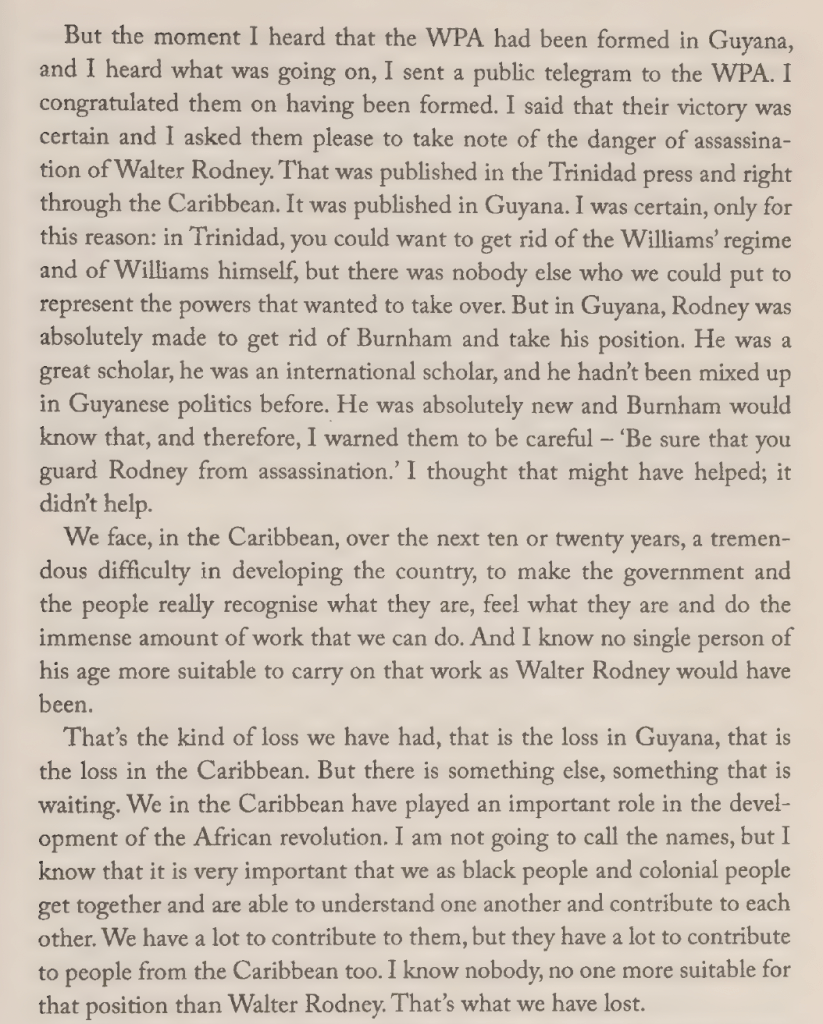
In trying to understand the history of this pamphlet I found it very helpful to read the transcript of an October, 1980 talk that James gave just a week after Rodney’s assassination, at a memorial organized by the Committee Against Repression in Guyana. The transcript of the talk has its title as simply “C.L.R. James on Walter Rodney.” In that talk one can understand the personal relationship between these two towering figures, and also understand how concerned James had been that Rodney would be assassinated, and how he had tried to sound alarms beforehand.
A portion of “C.L.R. James on Walter Rodney,” which is printed in the book Here to Stay, Here to Fight: A ‘Race Today’ Anthology, pp. 244-248)
James’s essay Walter Rodney and the Question of Power is a somewhat less personal and more theoretical reflection on Rodney’s role in political struggle. Here, James is reading Rodney’s life through the lens of Lenin. But in the talk James is clearly trying to deliver the painful political lessons he took from Rodney’s assassination: “I am going to deal with what Walter did not know and what he should have known and what you will have to know; if you do not pay the proper attention, you will pay the consequences for it. Then…I will show that this catastrophe took place because of what Walter did not know. Finally, I will tell you what to do henceforth so that you will never find yourselves in the situation in which Walter found himself, so that you prepare yourselves and everybody around you for similar situations in order to be able to handle them.”
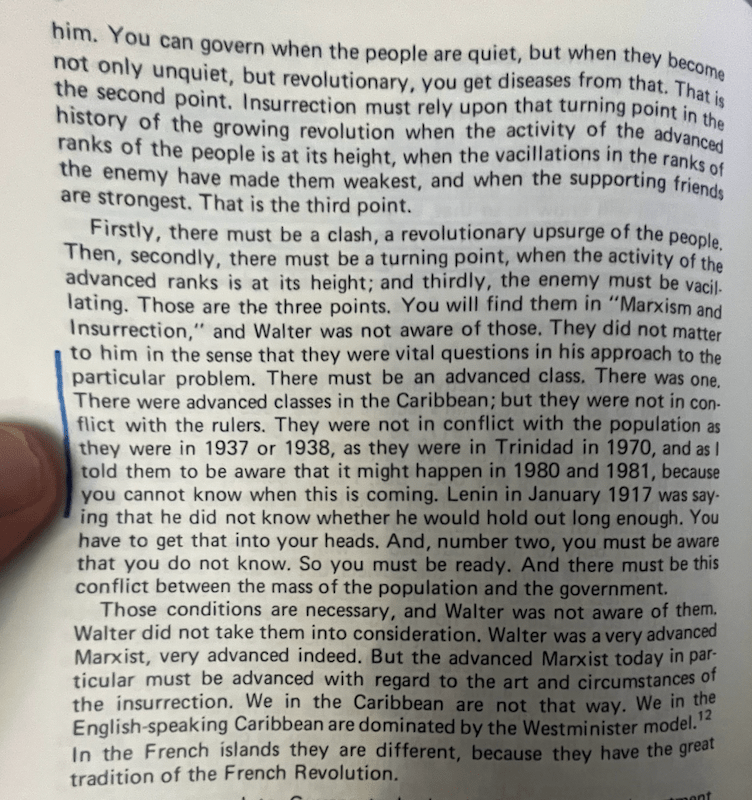
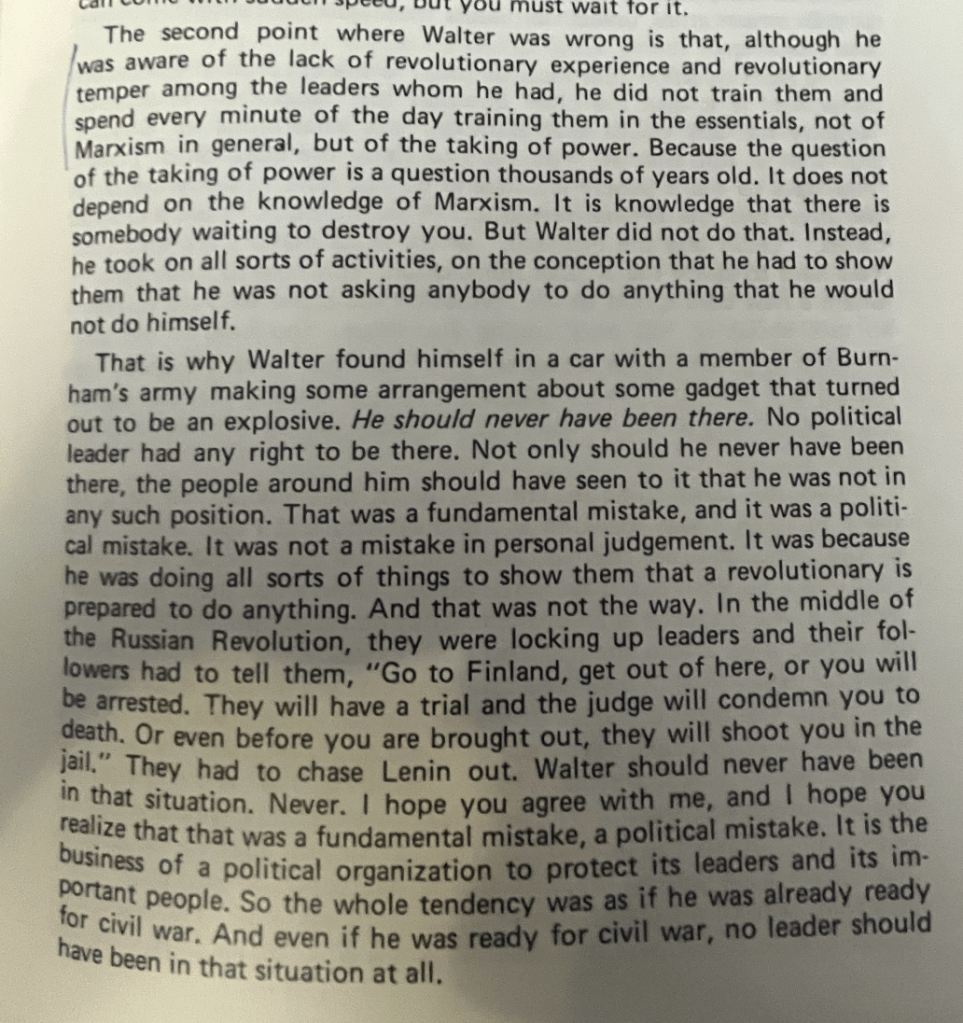
Reading Rodney through Lenin, specifically his 1905 lecture “Marxism and Insurrection,” James argues that Rodney had failed to “study exactly the taking of power,” and failed to analyze adequately grasp the political moment:
Section from p. 6 of Walter Rodney and the Question of Power
Look specifically at Rodney’s actions with the Working People’s Association, James asserts: “A revolution is made with arms, but a revolution is made by the revolutionary spirit of the great mass of the population. And you have to wait for that […] There is no calculation. It comes, as Marx says, like a thief in the night. So you had better be ready. […] Walter became too nervous, too anxious about it. He did not wait for the revolutionary people and the revolutionary class to be in conflict with the government before he could start question of insurrection.” James goes on:
Section from p. 9 of Walter Rodney and the Question of Power
Ultimately, this essay is an analysis by James of how to assess a revolutionary moment or lack there of. It is also a strong example of how James is able to use his close readings of Lenin and Marx in ways that can contradict more common readings (for example he argues at some length here, using Lenin, that a party is not critical for a revolution).
This pamphlet is surprisingly uncommon in the used book trade. Our copy is marked up from a previous owner and, at best, a reading copy. But it’s also the only copy I’ve seen sold for some years. OCLC locates 45 institutionally held copies.
(Note: Thanks to Conor C. for reading this pamphlet and discussing it with me in the process of putting this little post together).
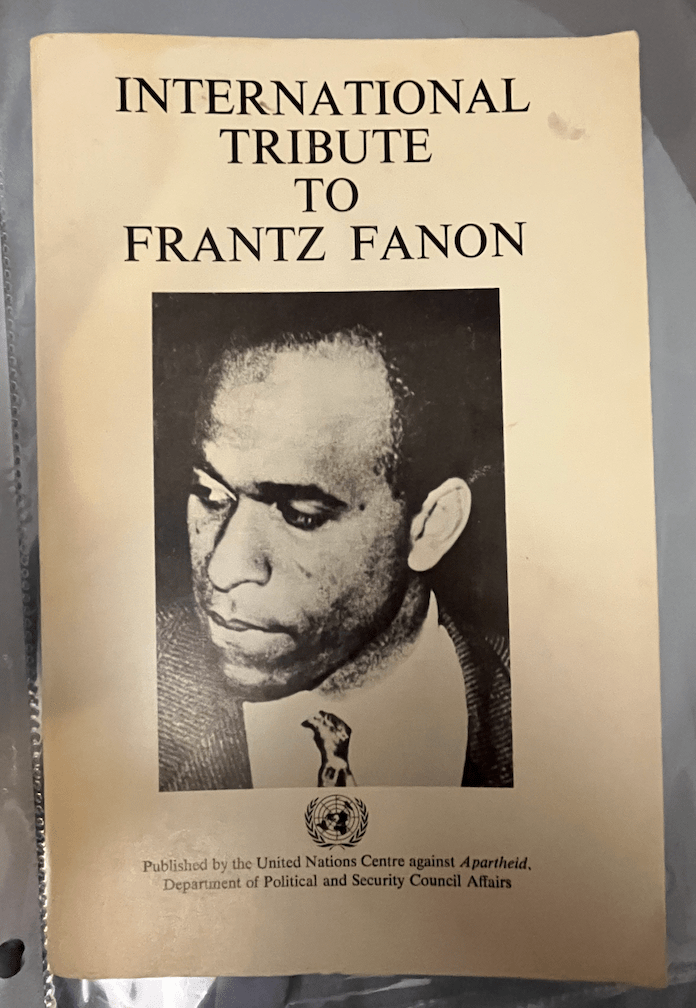
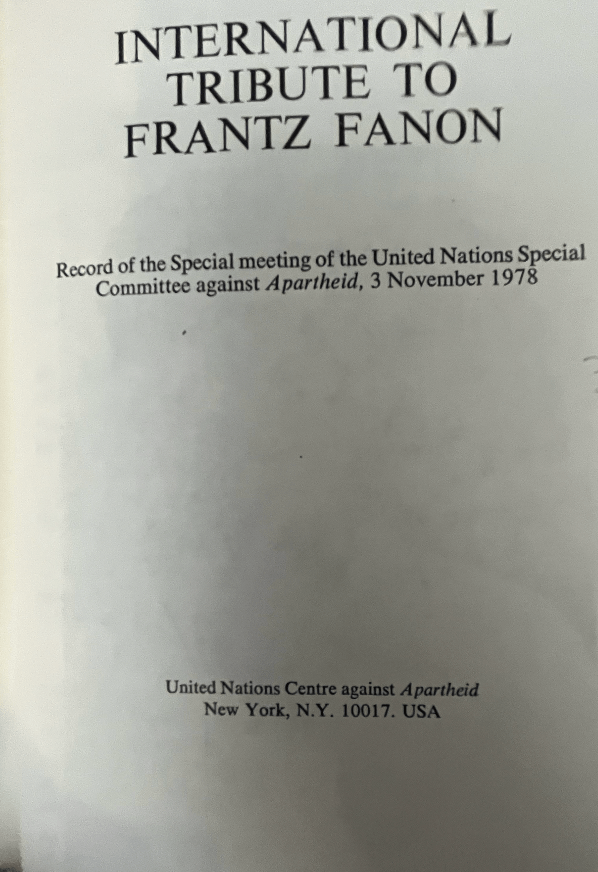
In November 1978, nearly 17 years after his death, the United Nations Centre Against Apartheidheld a day-long conference in tribute to Frantz Fanon. Fanon died young at just 36 years old, but the incredible impact of his writing and life have only seemed to grow year over year. The day-long event was part of a series put together by the UN Special Committee Against Apartheid, as Committee Chairman (and Nigerian ambassador to the UN) Leslie O. Harriman explained in his introduction to the instant pamphlet,
"The tribute that is being paid today to the late Fanon is part of a series of observances which the Special Committee has sponsored during the International Anti-Apartheid Year to honour outstanding people of African descent such as W.E.B. DuBois, the Reverend Dr. Martin Luther king and Paul Robeson, who have done so much to reestablish the black man in his pride, dignity and rights; to muster international support for the abolition of colonial and racist domination; and to bring the weight and influence of the African diaspora within the fold of African unity and solidarity" (p. 1).
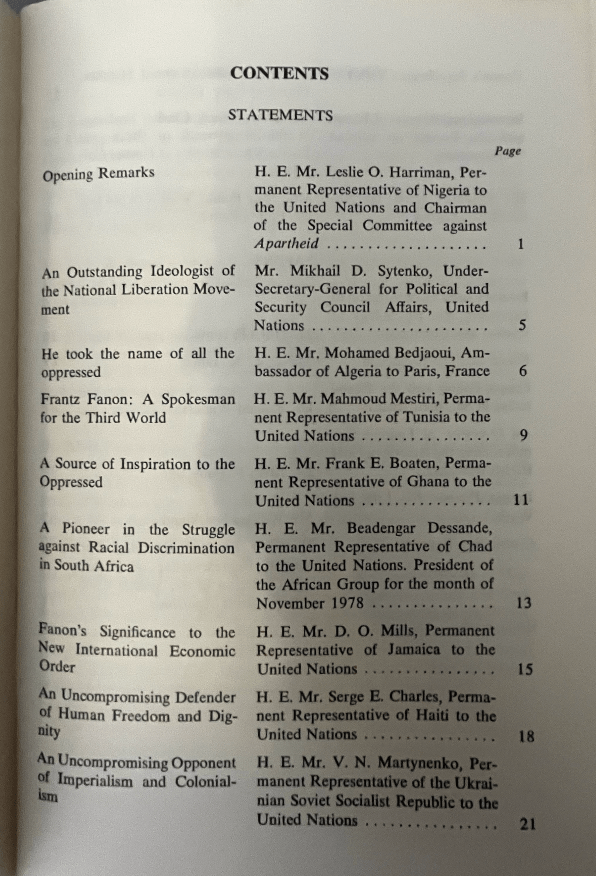
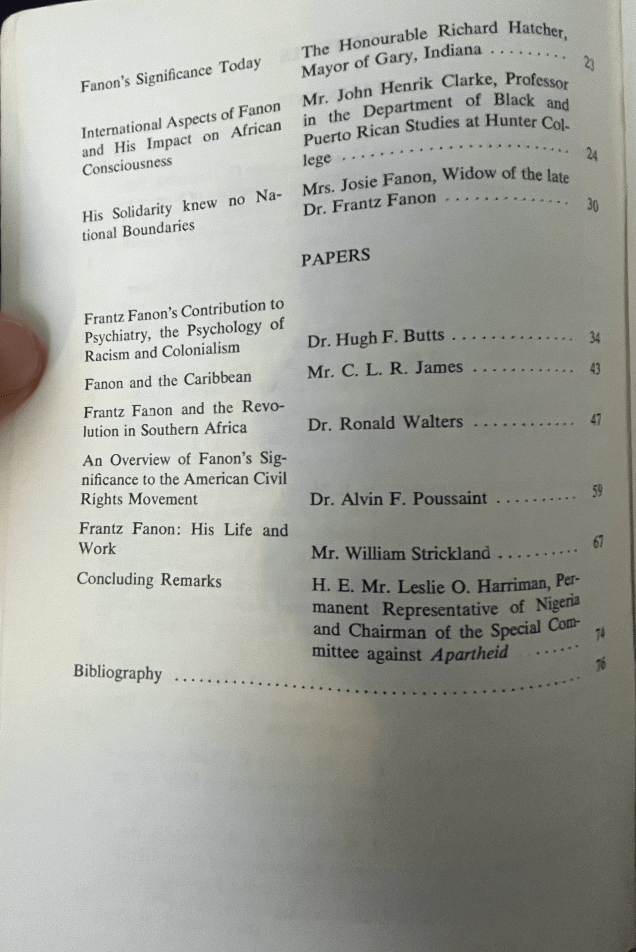
Following the conference the Department of Political and Security Council Affairs of the UN Centre Against Apartheid published the proceedings in this pamphlet.
Here is the table of contents:
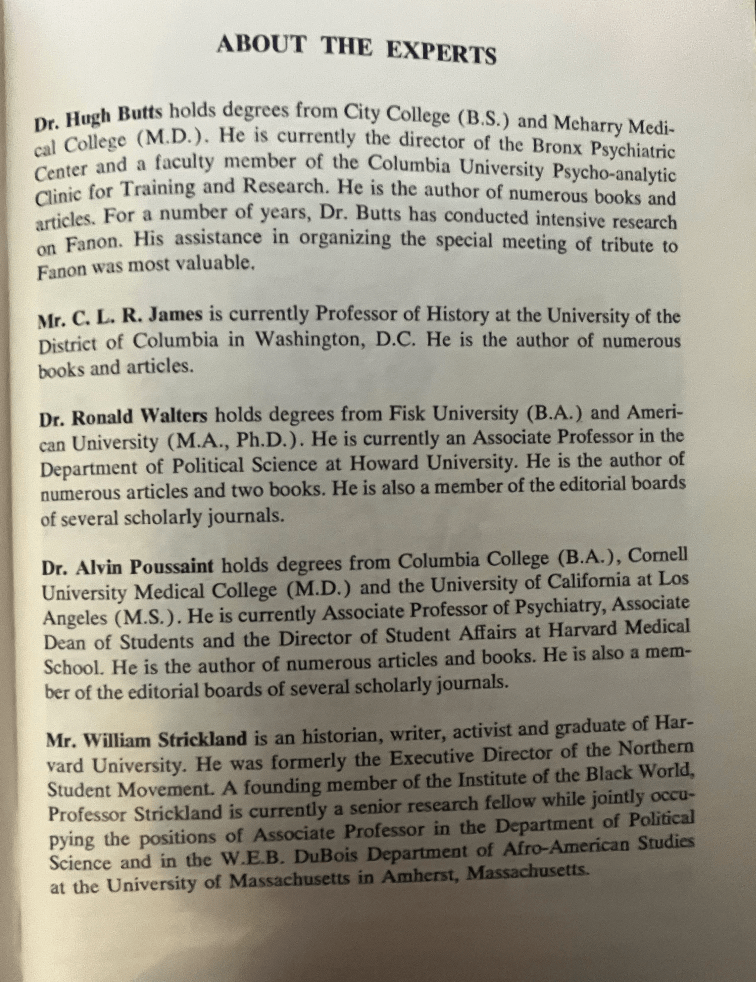
James was invited to participate as an expert along with several other academics. His bio for the pamphlet is notably modest given his own participation in a variety of relevant struggles and the remarkable amount of writing, much of it groundbreaking, that he had published:
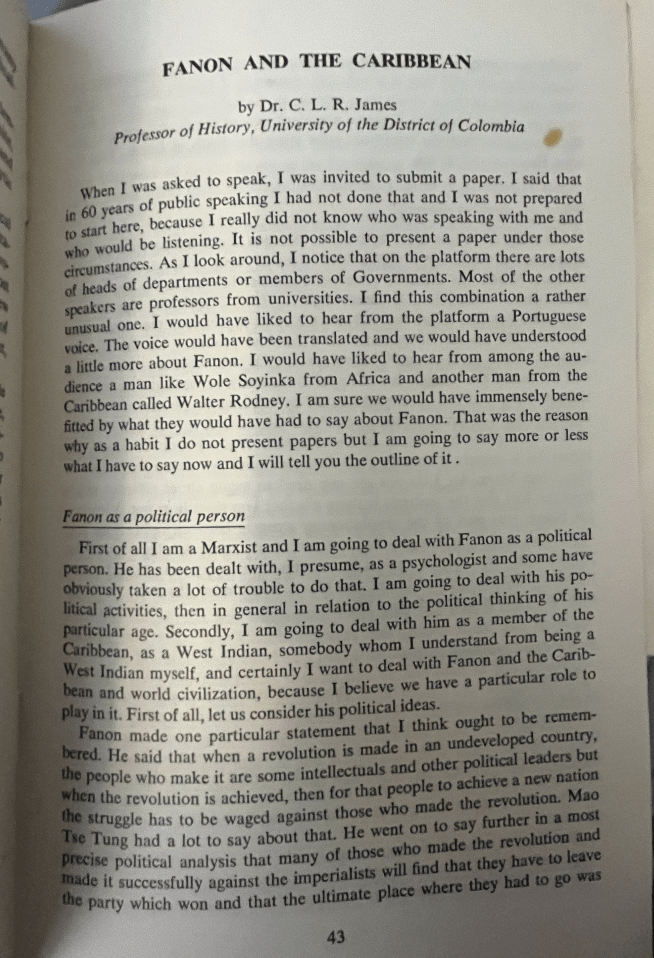
In his short contribution to the pamphlet, “Fanon and the Caribbean” (available here), James begins by expressing some bewilderment and dismay about the composition of the conference participants:
"When I was asked to speak, I was invited to submit a paper. I said that in 60 years of public speaking I had not done that and I was not prepared to start here, because I really did not know who was speaking with me and who would be listening. It is not possible to present a paper under those circumstances. As I look around, I notice that on the platform there are lots of heads of departments or members of Governments. Most of the other speakers are professors from universities. I find this combination a rather unusual one. I would have liked to hear from the platform a Portuguese voice. The voice would have been translated and we would have understood a little more about Fanon. I would have liked to hear from among the audience a man like Wole Soyinka from Africa and another man from the Caribbean called Walter Rodney. I am sure we would have immensely benefitted by what they would have had to say about Fanon. That was the reason why as a habit I do not present papers but I am going to say more or less what I have to say now and I will tell you the outline of it."
James reads Fanon’s life politically in this short essay, in the process noting that Fanon was a pupil of Aimé Césaire, who James had a relationship with. For this reader the portion of James’s essay that I found to stand out most, perhaps in relation to current times, was this:
"Secondly, there is a lot of talk about violence. I can not understand how people in the world that we have lived in for so many centuries argue about violence. When was there no violence? Fanon’s violence was a profoundly philosophical conception. It came originally from Hegel and Hegel has a wonderful passage where he analyzes the relation between the master and the slave.The master incorporates what the slave produces, but the slave by having to work on the material develops himself and becomes a personality and ultimately the struggle is a struggle to the death between the master and the new slave who has developed himself by working on the material for his master. That is a famous passage in Hegel. Marx took it over and it is one of the most powerful themes in Das Kapital. When Fanon develops this theme he is merely elaborating on that profound political conception of Hegel and Marx. So, I do not see any need to argue about violence apart from the fact that the violence is there whether you want it or not. Violence for Fanon was part of the revolutionary struggle between oppressors and oppressed; and if he thought that violence meant some development of the person who was using it against those who were oppressing him, he was merely in the tradition of Hegel and Marx, in my mind the most powerful political tradition in the Modern World."
This pamphlet is surprisingly scarce in the book trade and it is not fully available online, but the James essay is available at the Marxists Internet Archive, here. OCLC lists nearly one-hundred holdings worldwide, which makes sense given this is a UN publication. Our copy is in good shape though has had a tough run-in with a cigarette and maybe a splash of coffee it seems.
Marty Glaberman will likely be well-known to readers of this humble blog. Of his many publications, “Mao as a Dialectician” is perhaps one of the least well known but a notably important contribution. The piece, original published in an article in Fordham University’s International Philosophical Quarterly amounts to a takedown of Mao’s dialectics. In sum, per Glaberman:
“It is impossible to say that Mao Tse-tung in any way continues dialectical materialism. The departures from the philosophical method of Marx and of Lenin are much too great to be accepted as incompetent popularization on the one hand, or striking originality on the other. It is, of course, true that Mao, like most people, has a philosophy. A positive presentation of what that philosophy is is beyond the scope of this paper. But what is most apparent is that his philosophy is servant to his politics. It is not the source of whatever contribution he has made to history. That Mao has made original contributions to the modern world cannot be denied. What must be denied is that they have anything to do with philosophy.”
Glaberman accurately points out that concretely defining a methodology of “dialectical materialism” is hard for a specific reason: “Marx used dialectical materialism but was unable to find the time to write an exposition of his philosophy, or, rather, his method.” He thus devises an approach: “I have attempted, therefore to use as a guide a kind of synthesis of Hegel and Marx and Lenin which seems to me to correspond with a reasonable view of dialectical materialism. This will have to stand or fall on the measure of fruitfulness it provides in the analysis of Mao.” (Folks interested in a critical approach to diamats may want to look at Harry Cleaver’s works Reading Capital Politically (2000 [1979]) and The Fragile Juggernaut(2025)).
The entire text of “Mao as a Dialectician” is readily available online (here, for example).
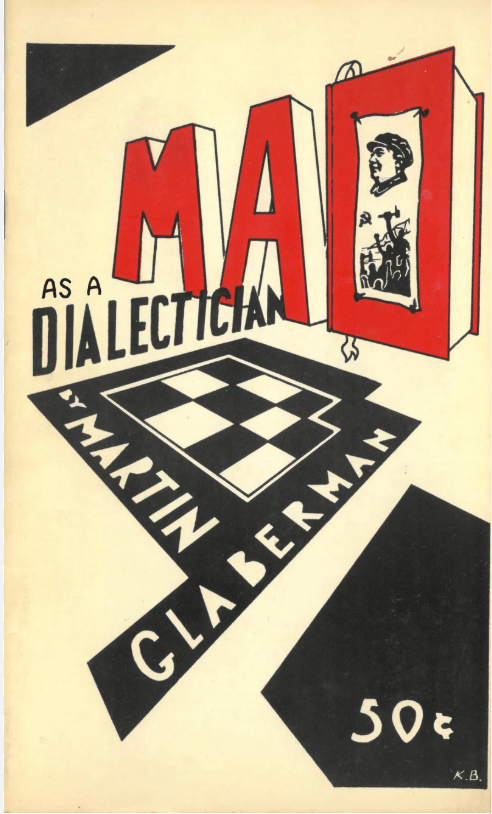
After its publication in the Fordham philosophical journal, Glaberman, in 1971, published an edition of it himself via his Bewick Editions press.
Cover of the 1971 Bewick version of the pamphlet
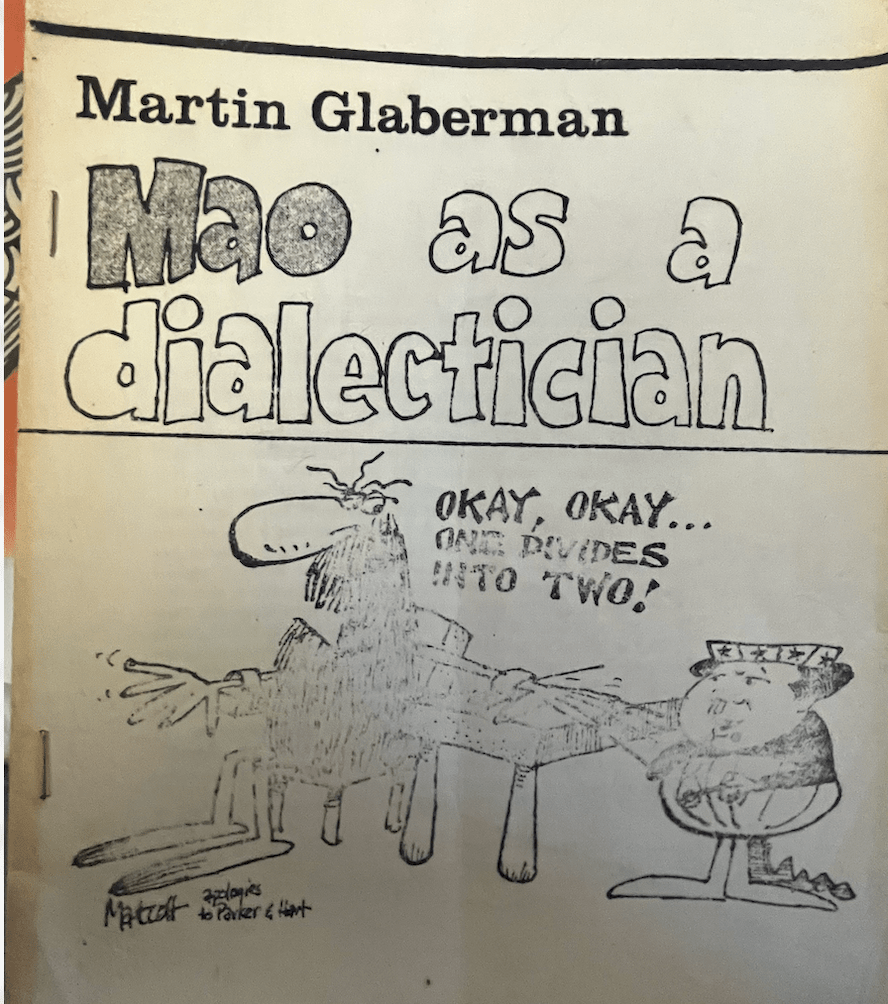
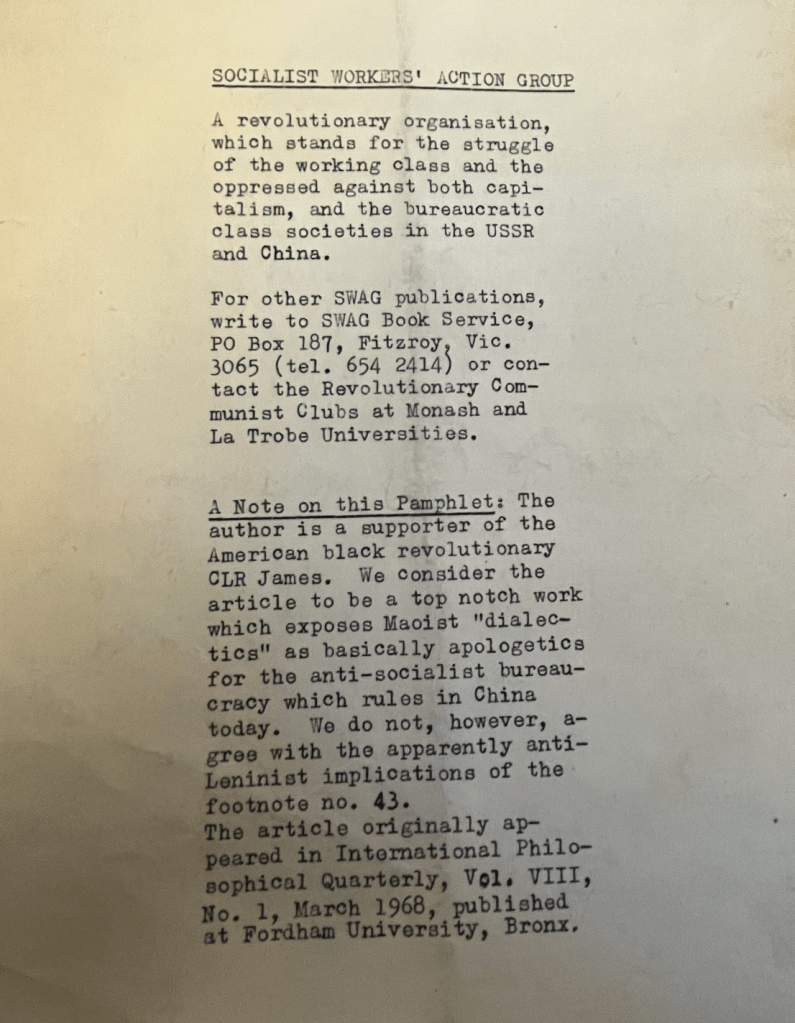
While the Bewick Editions version of the pamphlet is common, we’ve only seen the instant version once (our copy). It was published by a small Australian Trotskyist group called Socialist Workers’ Action Group (SWAG), which existed for three years between 1972 and 1975. The inside text of the pamphlet is just mimeo’d directly from the Fordham journal, but the cover and backside have original drawings and text. Here is the back cover:
The “note” makes sense in a context of intra-Marxist splits and factions and the ongoing wars around both the class nature of the Communist states as well as the virtual deification of Communist leaders and dictators.
We locate no holdings of this edition of the pamphlet. Our copy contains a former owner’s handwritten notes, so not in great shape but certainly a great piece of Glaberman and Marxist ephemera.
Aurora was a two-person situ-influenced-anarchist group out of Madison, WI composed of the late Bob Brubaker and Scott Polar Bear. While they were prolific there is also very little written about the group and their projects, though they were an important piece of the late 1970s and early 1980s anarchist scene in the U.S.
Aurora had a tense and eventually broken relationship with the Madison underground paper Free for All and split off, with others, to publish the situ-inspired anarchist newspaper No Limits. They published posters similar to those of the Zerzans’ Upshot project, and, among other things, published editions of work by More to Come, John Zerzan, and an abridged version of On the Poverty of Student Life.
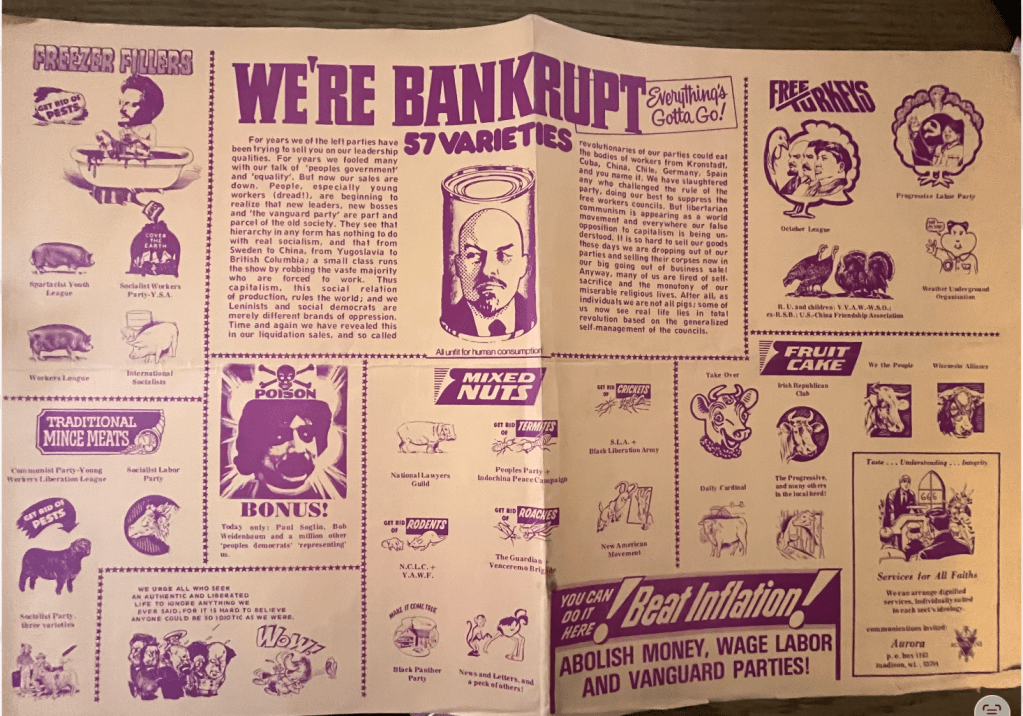
The instant poster is a two-sided collage the reprints and repurposes various graphics. In context of the environment of inflation and austerity of the late 1970s/early 1980s, the creators turn their eyes toward the bankruptcy of the left – liberal, socialist, and armed sects and groups. On one side is the Lenin “57 Varieties” graphic that, to the best of our knowledge, originated in the Solidarity (UK) As We Don’t See It pamphlet. The text bloc in the middle ends with: “Anyway, many of us are tired of self-sacrifice and the monotony of our miserable religious lives. After all, as individuals we are not all pigs; some of us now see real life lies in total revolution based on the generalized self-management of the councils.” On the top right they target some of the New Communist groups (OL, PLP etc) as “turkeys” and on the top left go they go after various Trotskyist factions.
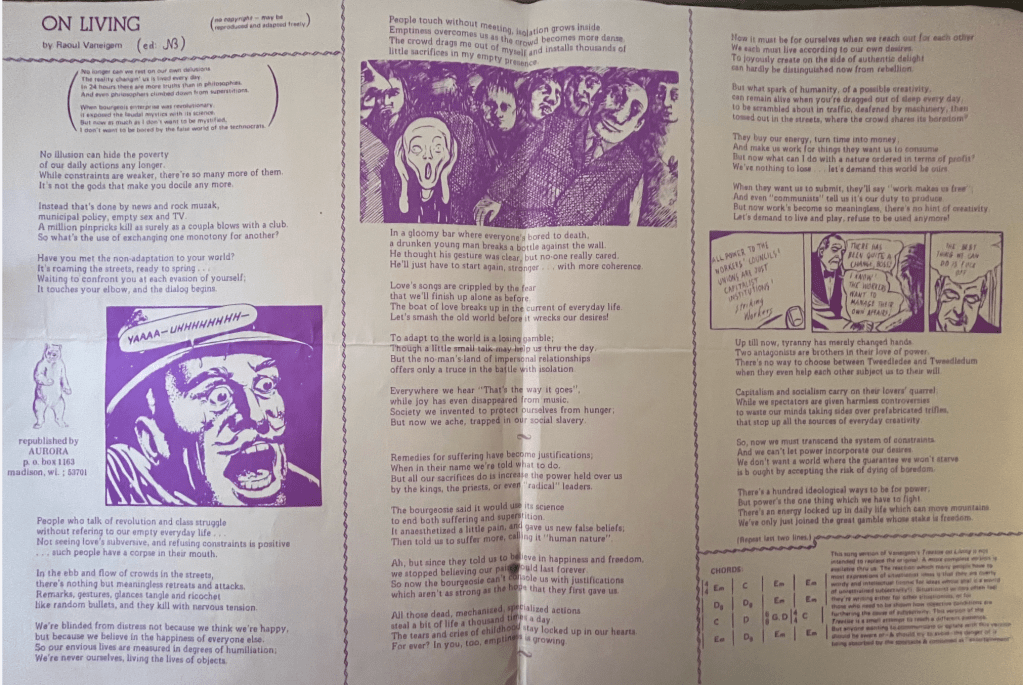
On the opposite side of the poster the authors reprint, as poster, the “On Living” pamphlet originally published by the California-based pro-situ group Reinvention of Everyday Life.
While there are likely institutional holdings of this poster, we don’t locate any. We acquired our copy (not in the best condition but not in the worst condition!) from a former participant in the Free for All group.
Printed Matter runs annual art book fairs in New York City and Los Angeles and I sometimes go to the New York one. For those unfamiliar, Printed Matter is a long-running artist bookshop in Manhattan and is a fantastic space for folks interested in a myriad of international, often below-the-radar, artist projects. I get there once every couple of months and the constant rotation of titles along with various exhibits and talks make it a consistently worthwhile trip.
I find the art book fairs less exciting though. It may be the nature of these kinds of events where there’s a ton of people, not a lot of space, and an unbelievable amount of stuff for sale, sometimes from counter-cultures and movements I personally experienced/participated in at what feels like outrageous prices. Sometimes it’s the grouchy and entitled people who make it difficult – like the woman who snapped at a Printed Matter worker not scanning her ticket quick enough this year while (almost) no one in line said anything, or, last year, the guy who almost punched me in the face after he stormed out of the space, smashing past me, huffing and puffing about who knows what. It may also be that I’ve never felt much comfort with “art” as such and have been inspired more by the anti-art work of Henry Flynt, the art strike effort of decades past, and the brilliant writing of Gustav Metzger. There was some of that kind of thinking present at the art book fair, but not a lot. For those inclined and able, though, one could spend over a thousand dollars for a poster from the Anti-University in London.
That said, the folks at Printed Matter who put the fair together do a truly heroic job and the workers are incredibly patient throughout the day with a lot of people. And a lot of great artists and publishers and second hand sellers (and some not so great) put a lot of time and attention into their tables, and there is a geographical diversity that is really neat. Finally, this year had many tables that drew attention to the ongoing genocide in Palestine, which was really solid.
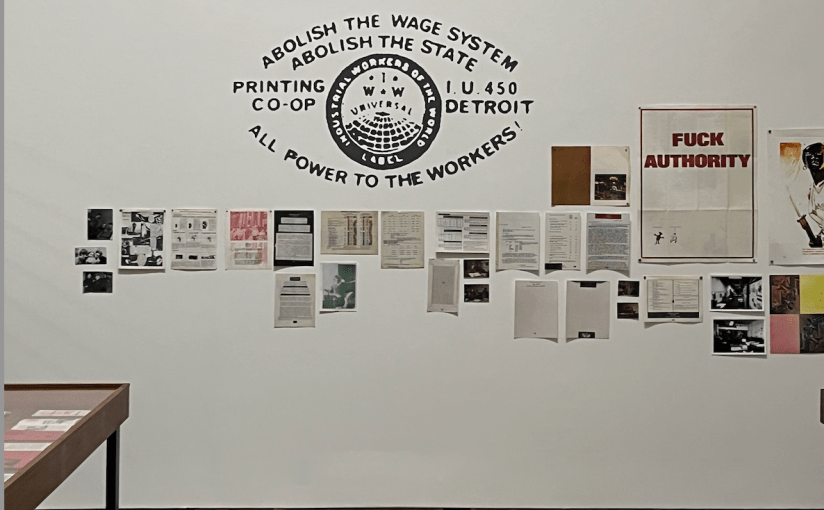
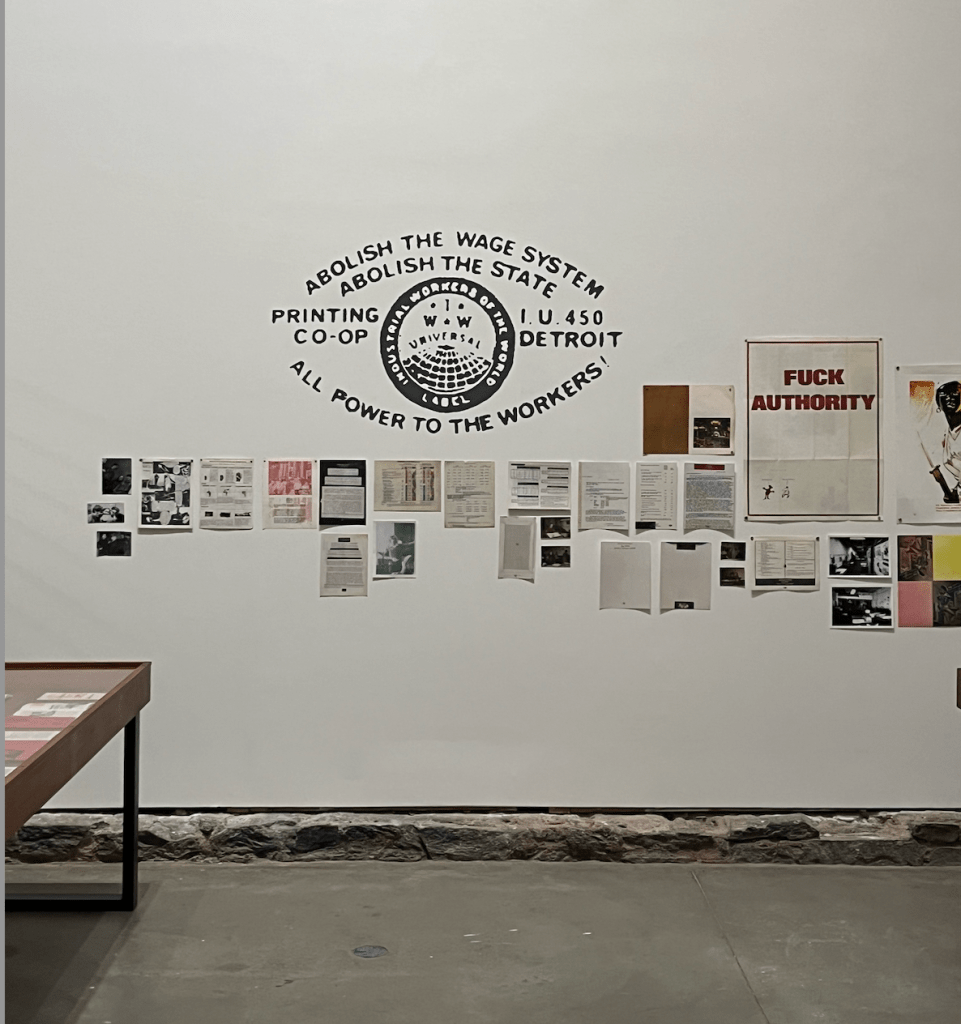
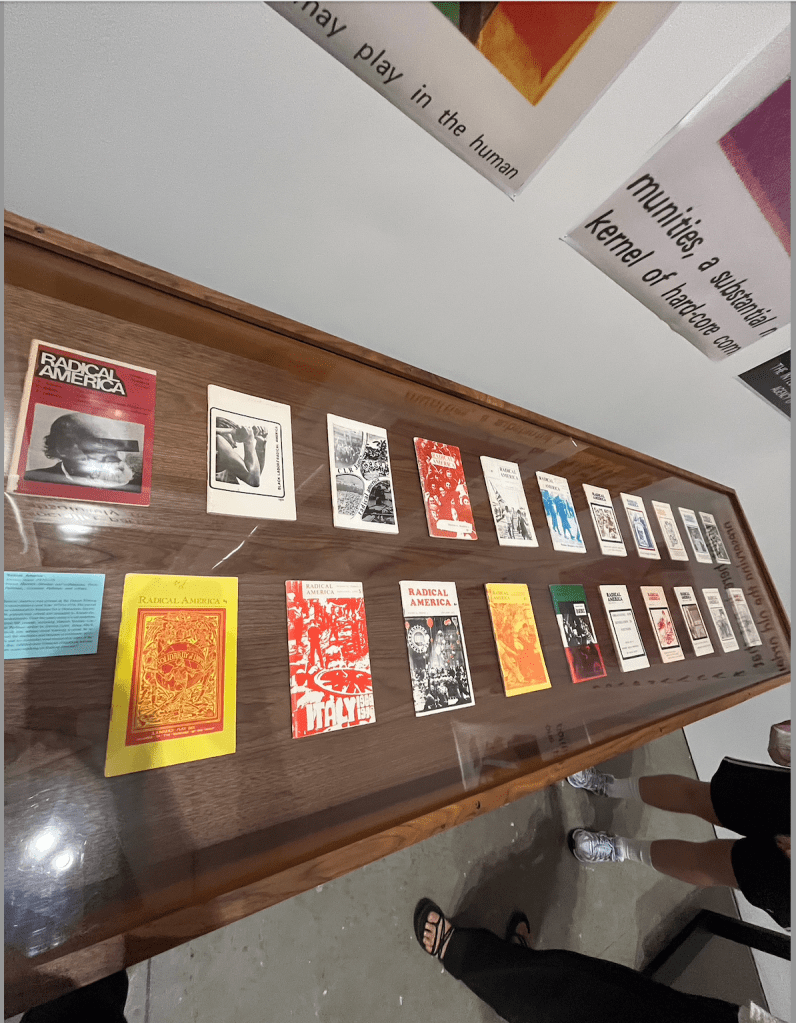
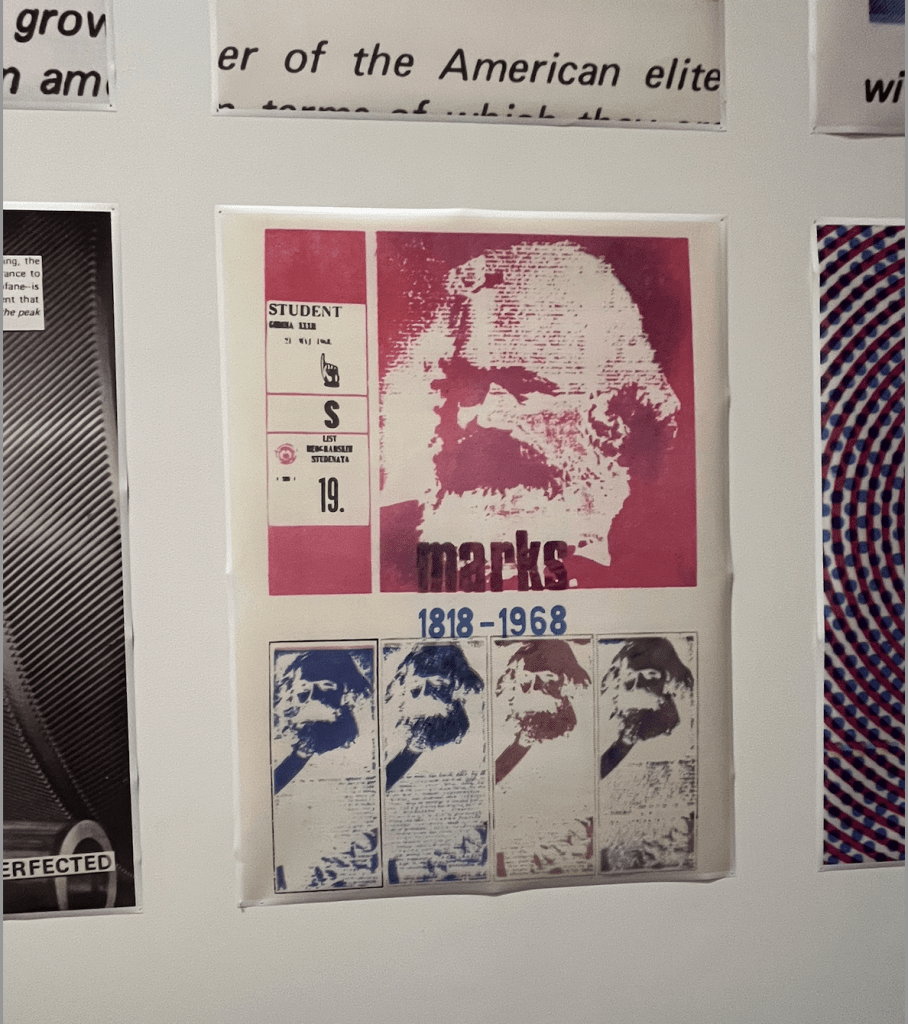
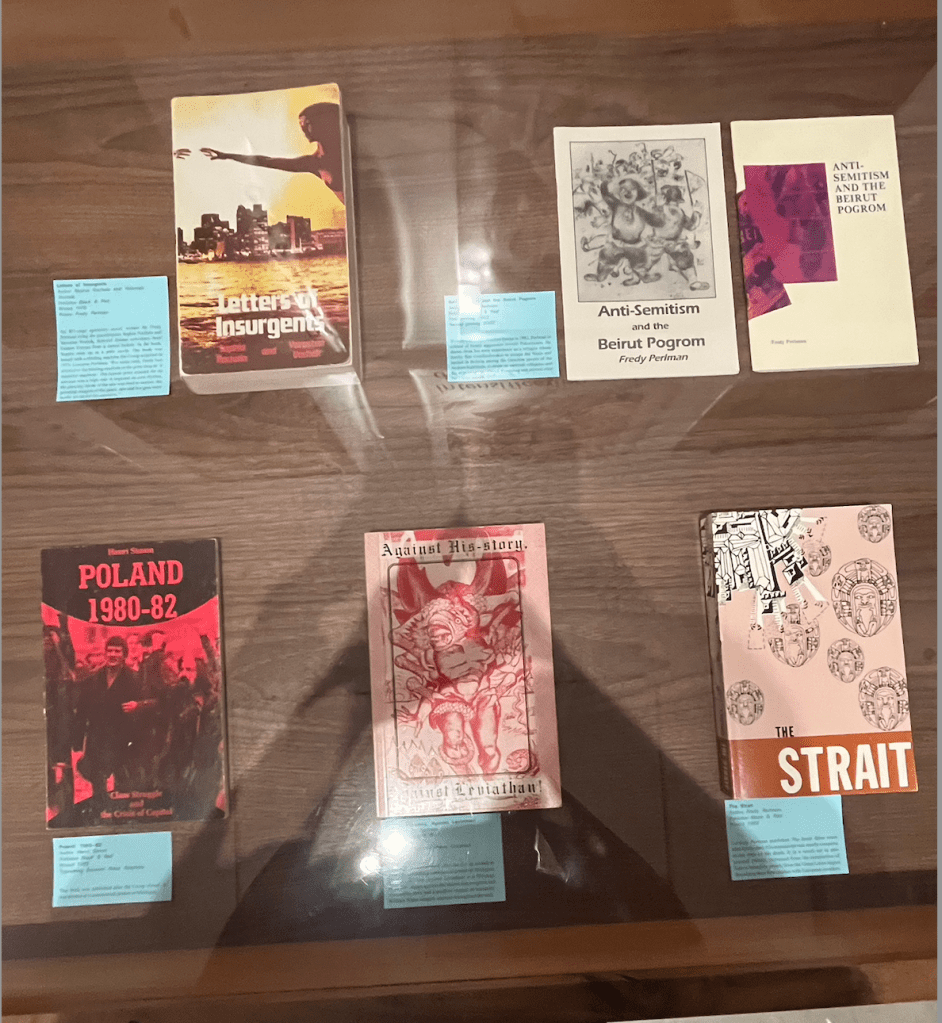
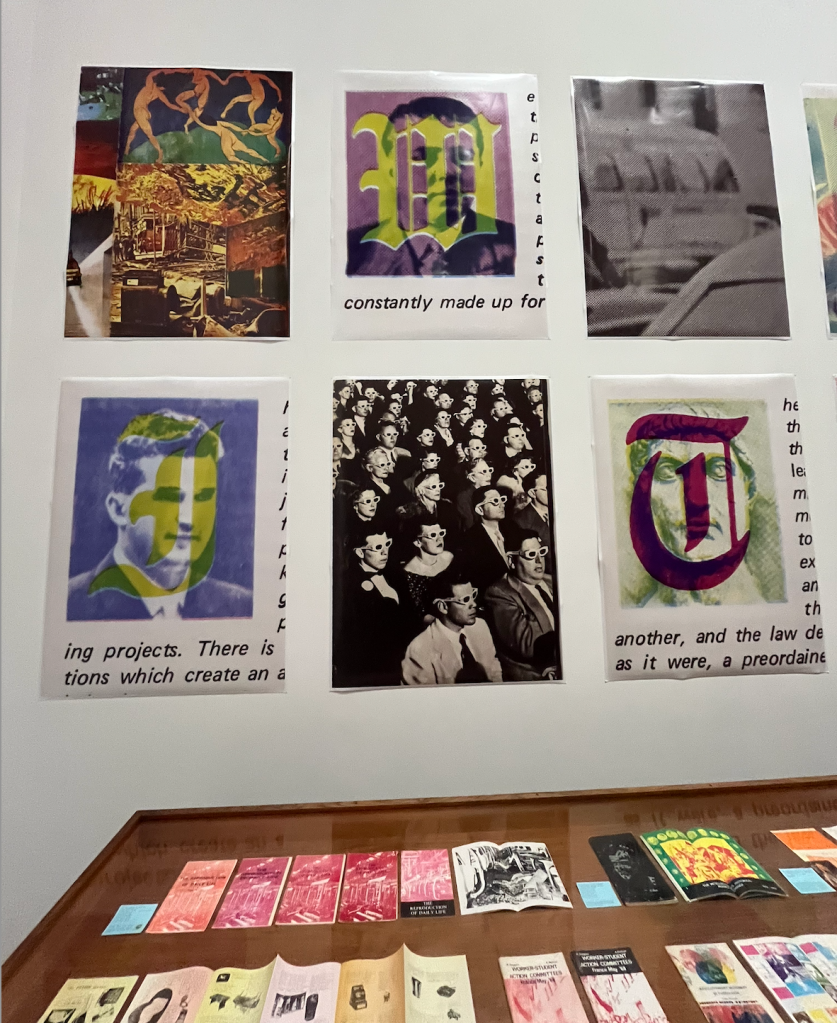
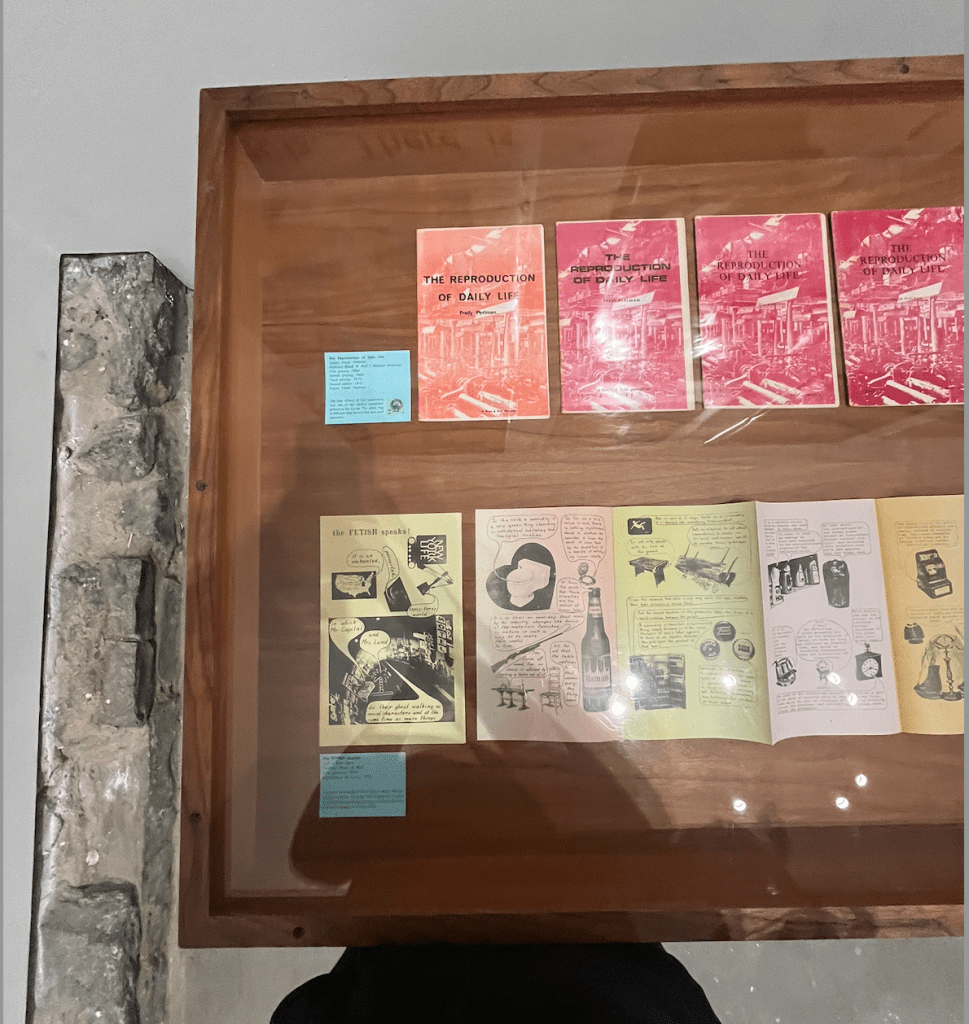
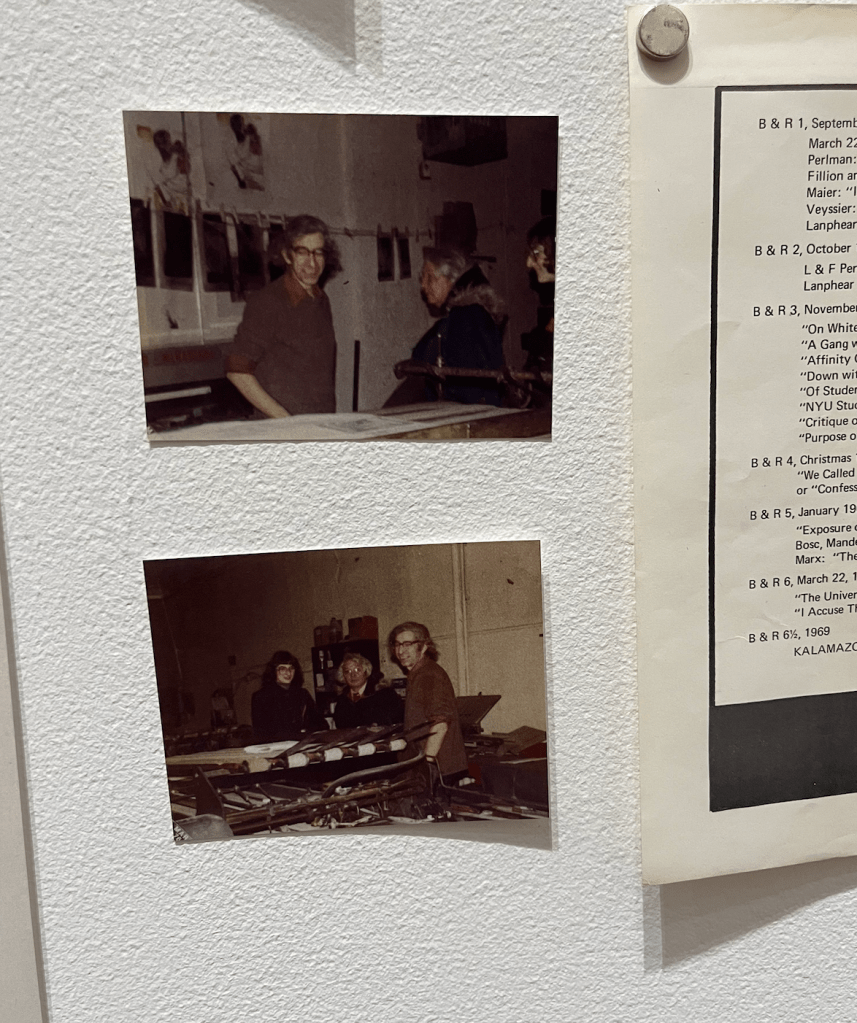
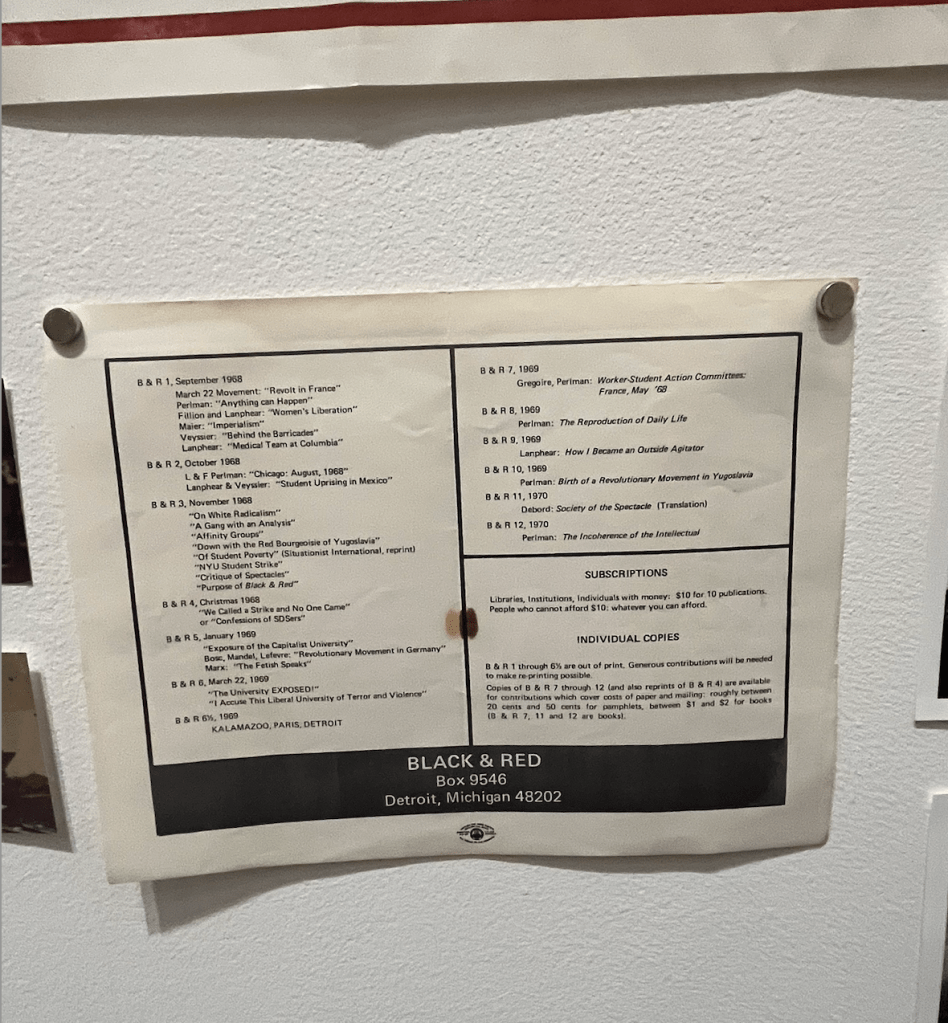
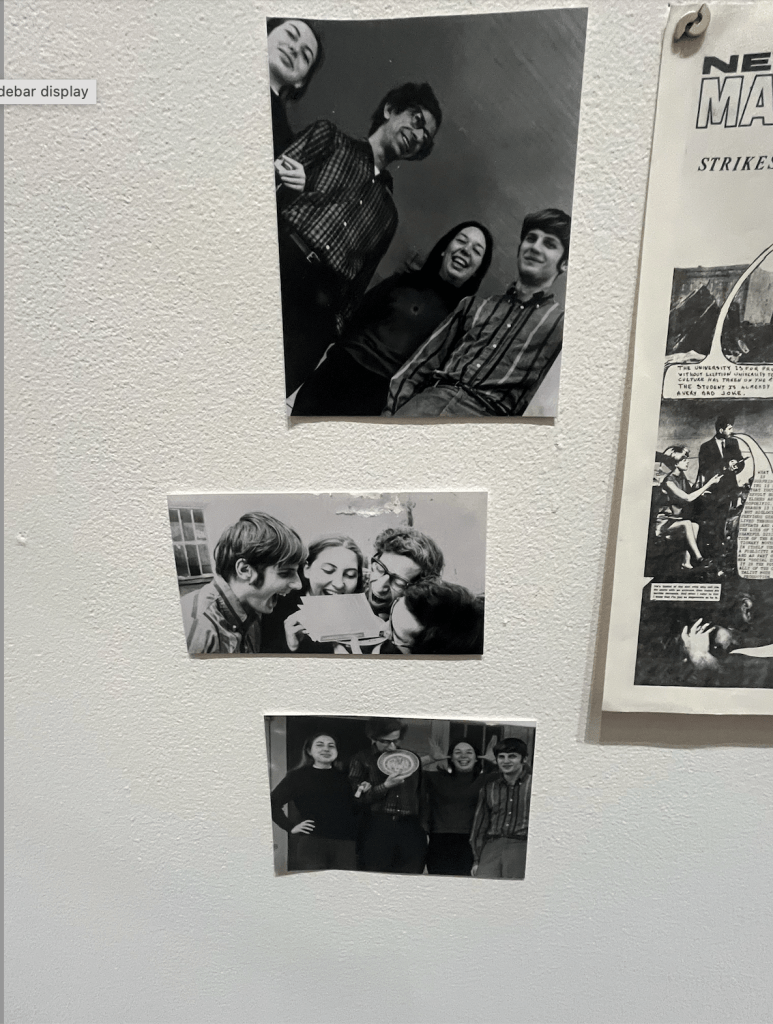
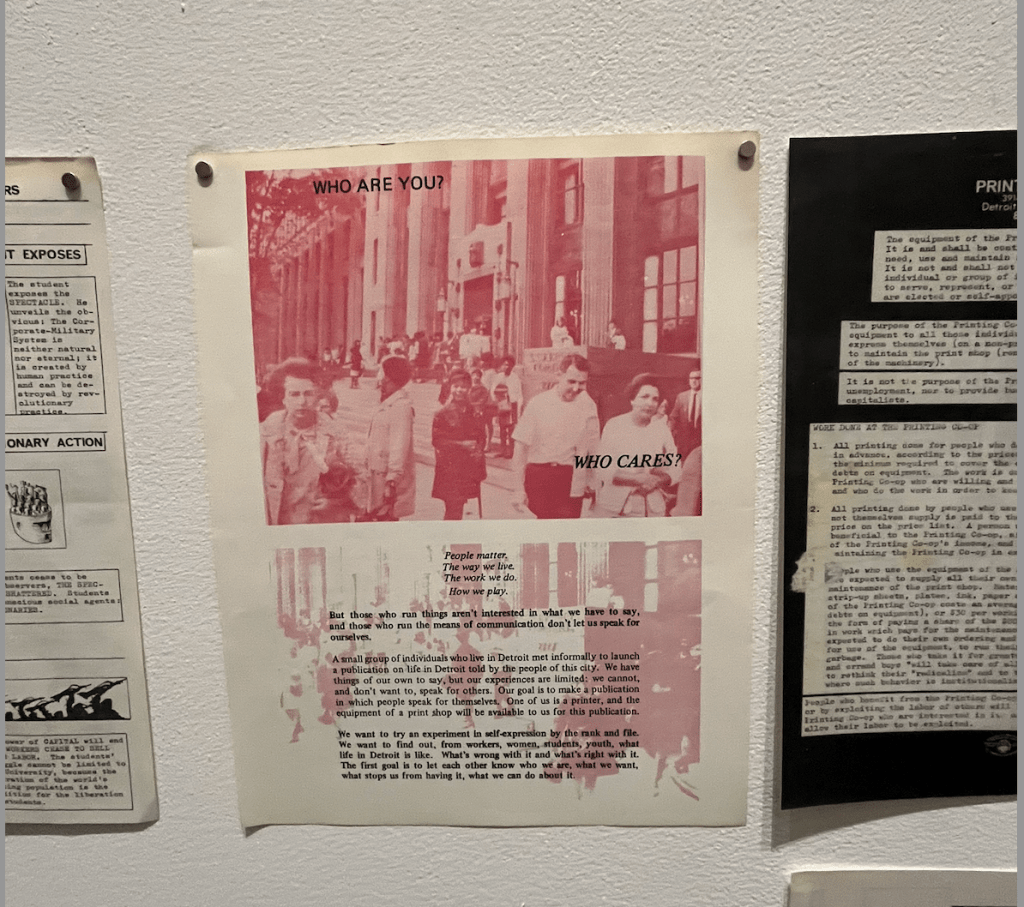
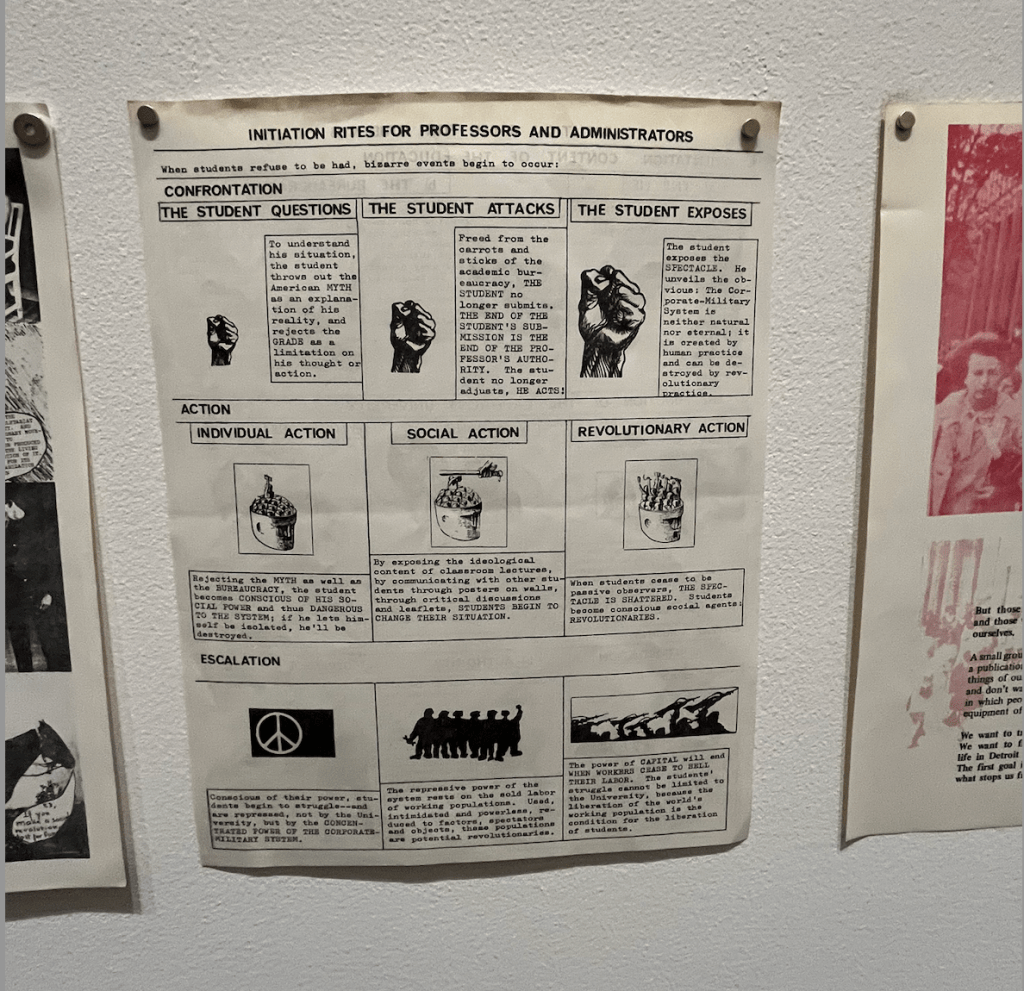
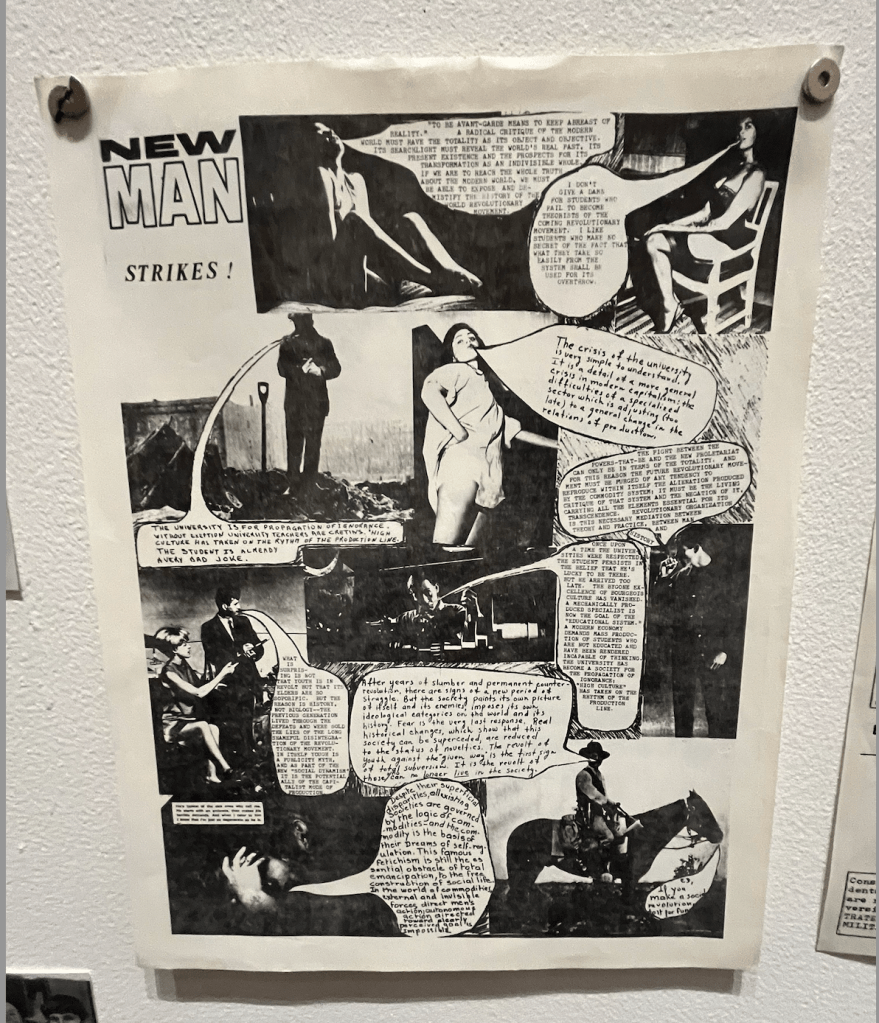
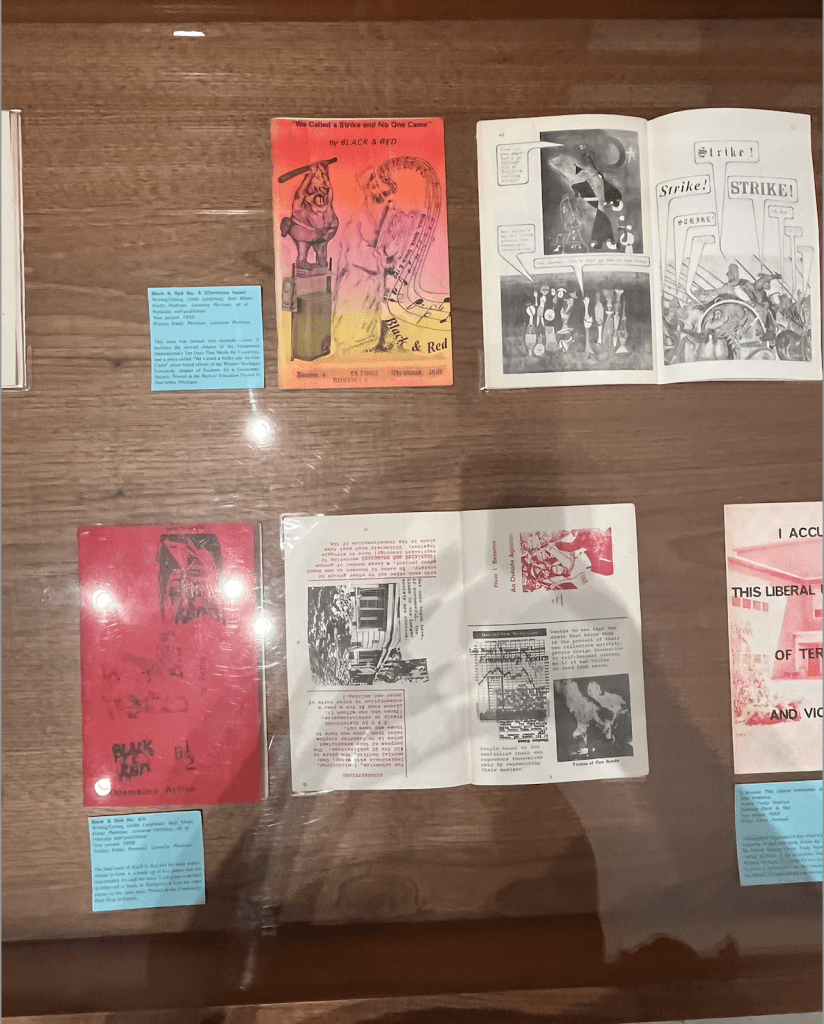
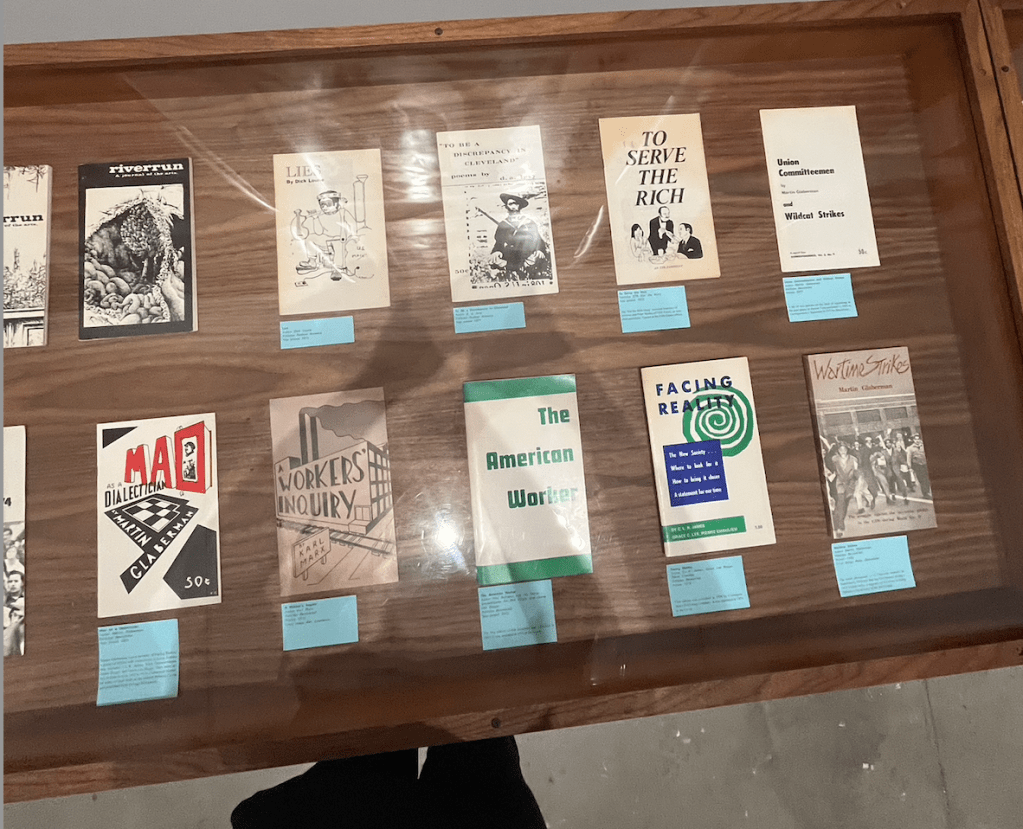
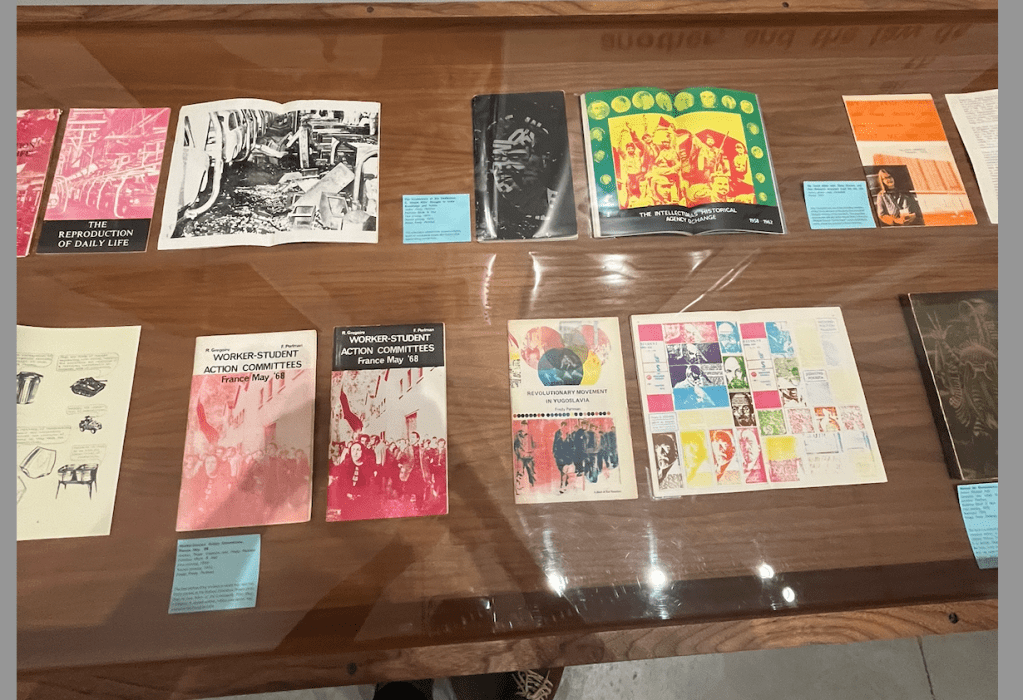
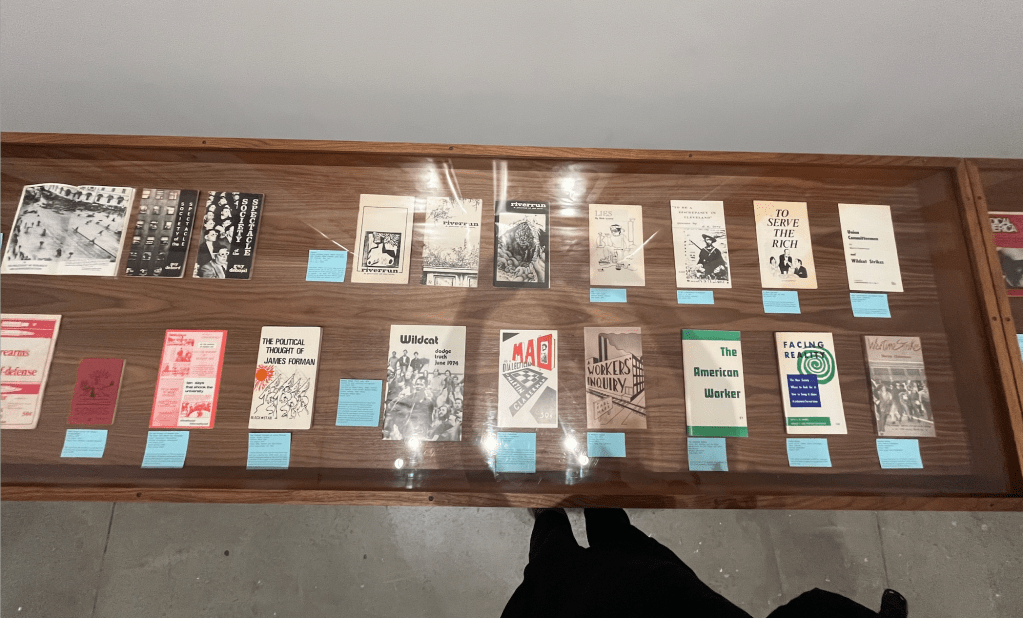
My main interest in attending this year’s fair was the one-room exhibit on the Detroit Printing Co-Op put together by Danielle Aubert and based on her remarkable book The Detroit Printing Co-Op: The Politics of the Joy of Printing (we briefly mentioned that work in the past, here). The exhibit on the Detroit Printing Co-Op, which has taken place at least a couple of other times in other parts of the US, was in a very large room at the fair, which was held at MoMA PS1 in the (almost unbelievably, at least to me), gentrified neighborhood of Long Island City in Queens.
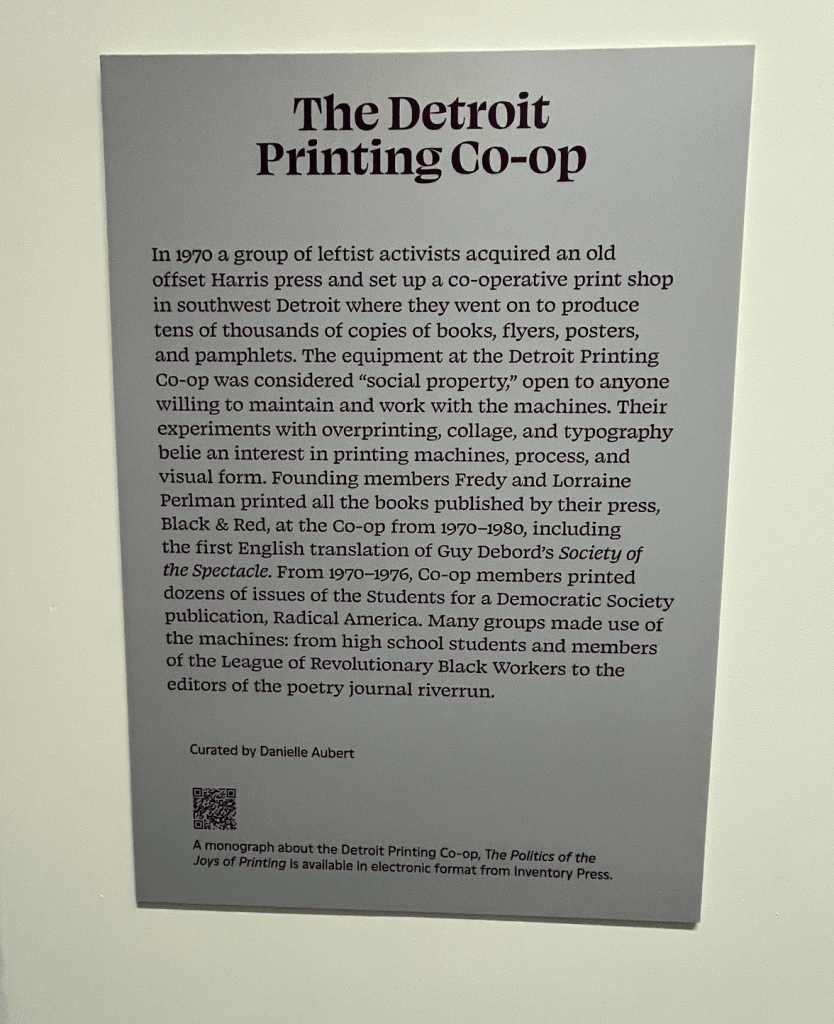
The Detroit Printing Co-Op grew from and was immersed in the radical struggles of the 60s and 70s and printed many important works, including the anarchist and situationist journal Black and Red, many issues of Radical America, and the first English translation of Debord’s Society of the Spectacle. I am mainly making this post for people who cannot get to the exhibit and might otherwise be interested so they can see what it was like. Photos below.
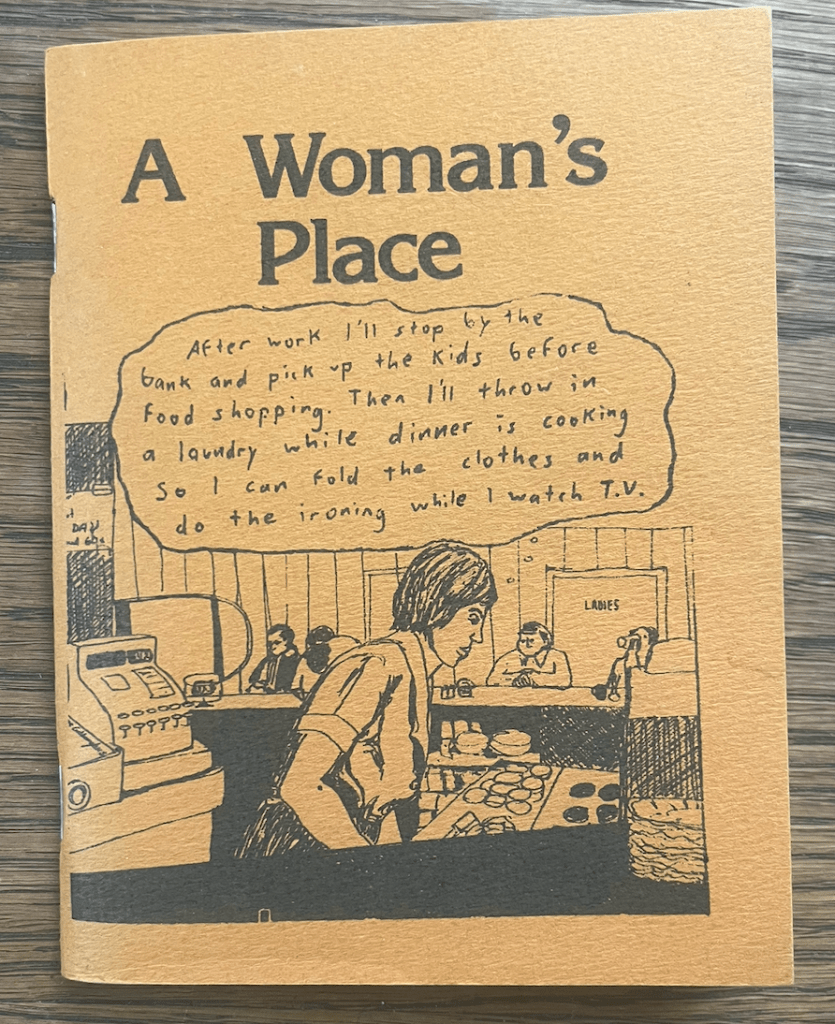
Selma James and Filomena Daddario’s 1953 pamphlet A Woman’s Place has a somewhat classic status in Marxist and feminist literature. The pamphlet was written by Selma James and Daddario’s name was also added for the publication. It was first published by Correspondence in 1953 and was republished in James and Dalla Costa’s pamphlet, published by Falling Wall Press, The Power of Women and the Subversion of the Community, which has been reissued by various left and feminist presses over the years. The pamphlet was reissued by Friends of Facing Reality Publications in 1970. To our knowledge, however, aside from the Correspondence and FFR editions, this is the only other standalone edition of A Woman’s Place.
A Woman’s Place is both a product of its time and also a pamphlet that has continued to be relevant year over year. Perhaps the most clear limitation of the piece is its heteronormative framing, where all women are framed as straight and all couples as heterosexual couples. That said, at the time of publication the piece was a groundbreaking analysis of the intersecting roles of marriage, the housewife, and the nuclear family in post-war capitalism. True to its roots in the Correspondence group, the essay flows from both James’ own experience and what she heard speaking with other women. There are themes of everyday resistance, self-organization, and autonomy throughout.
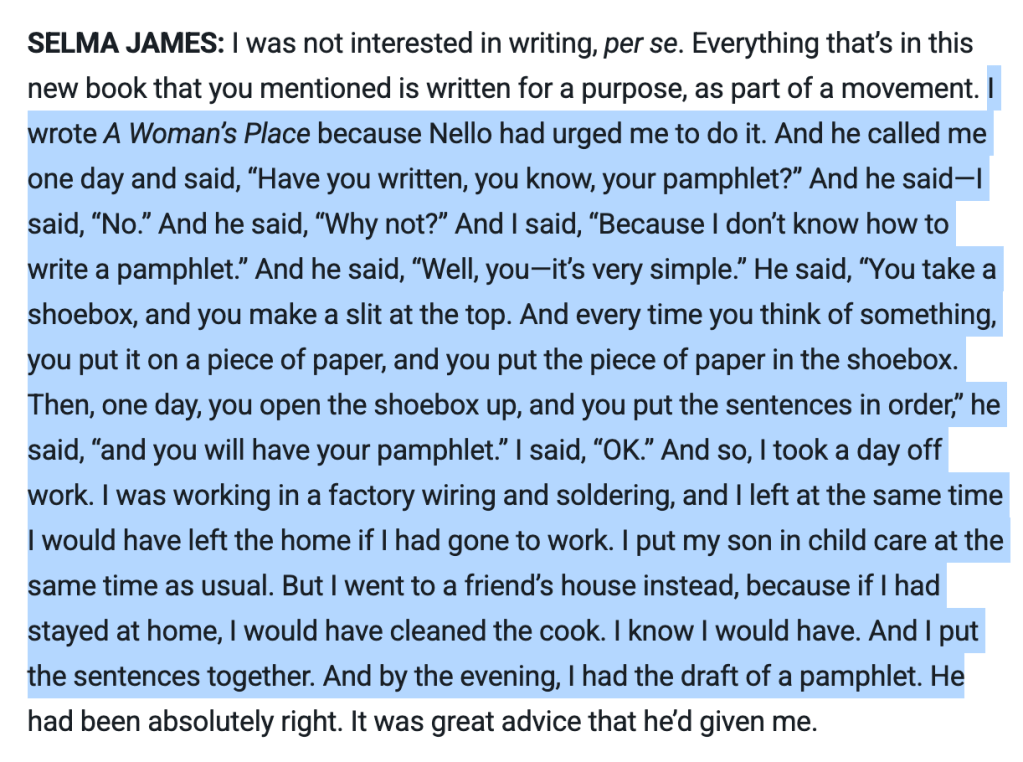
In a 2012 interview on Democracy Now!, James gave the basic history of how the pamphlet came to be:
Portion of James’ 2012 interview with Amy Goodman
Nello is, of course, CLR James.
In her recently-published monograph on Wages for Housework, historian Emily Callaci provides more context and detail about the origins of the essay. We quote at length here for those who do not have the book but are interested in this history (also we recommend buying the book).
“The Johnson-Forest Tendency divided members into three categories, or “layers” – the leaders were the first layer, the bourgeois intellectuals were the second layer, and the working class were the third layer. In a meeting they called the “Third Layer School,” they flipped the hierarchy by having the rank and file members of the group (the third layer) teach the “intellectuals.” As a housewife and a worker, Selma James was a member of this third layer, and in 1952, she traveled to New York to educate Grace Chin Lee, Raya Dunayevskaya, and other movement intellectuals about the everyday lives, desires, and revolutionary potential of working class housewives.
C.L.R. had never heard anything like it. Like many on the left, C.L.R. was not accustomed to thinking of housewives as political. The conventional party line of the Socialist Workers Party has been that housewives were politically backward and needed to join men in the workforce in order to become politically conscious. C.L.R. asked her to write a pamphlet about the “woman question.” As was his typical practice he instructed that nobody was to interfere or offer input: this young comrade was to write it on her own, in her own words.”
Callaci then quotes James giving the ‘shoebox story’ that she also gave in the Democracy Now! interview quoted above, but goes on to note that “Years later, she concluded that he likely invented the “shoebox method” on the spot, to encourage her to trust her instincts” (pp. 10-11). Callaci continues,
“She followed this advice. The day that Selma James opened the shoebox to put her thoughts together, she took a day off work, dropped her son off at school, and went to her friend’s house where she could write, undisturbed by all of the housework that needed doing in her own house. By the end of the day, she had drafted her first political pamphlet. […]
James wrote and edited “A Woman’s Place” in conversation with her neighbors. sharing her drafts and making changes based on what they said. She co-signed the pamphlet with her friend and comrade Filomena Daddario, James signing her name as Marie Brandt and Daddario signing as Ellen Santori. She sold copies to co-workers at the factory where she worked. It was the most popular pamphlet ever published by the Johnson-Forest Tendency, and the only one to ever sell out” (p. 12).
Little information is available about Filomena Daddario but Calacci notes that she was “a young Italian-American woman from Queens who loved jazz.” and also a participant in the Correspondence group.
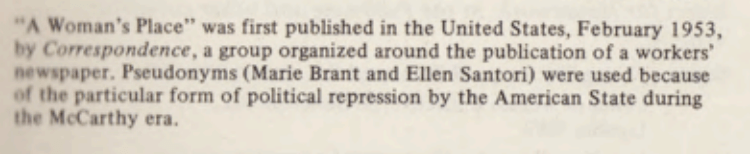
In the instant edition of the pamphlet, the publisher used Selma James’ legal name while keeping Daddario’s pseudonym as ‘Ellen Santori.’ The reason for the pseudonyms in the original is explained in the Falling Wall press pamphlet cited above. Specifically:
The publication of the pamphlet by Nameless Anarchist Group is a bit peculiar in that James is not typically associated with anarchists. In their edition of the pamphlet the publishers introduce it with an explanation that clarifies their purpose for printing it:
There is very little information available about Nameless Anarchist Group. They were based in Ypsilanti, Michigan and an affiliate member of the Anarchist Communist Federation of North America. Andy Cornell makes no reference to them in his critical workUnruly Equality: U.S. Anarchism in the 20th Century. The instant pamphlet is the sole publication identified with the group in OCLC and Archive.org only locates mentions of them from issues of the ACF’s paper North American Anarchist. In issues of NAA they are listed as, for a time, the group behind the federation’s internal bulletin. By rules of the ACF affiliation structure, there would have been at least 3 members. And they were a participant in the national Reagan for Shah effort in the early 1980s. One of their members’ name was Charlie. Aside from that, and their contact info (which could be a fruitful lead with access to more locally-based resources in Ypsilanti than we have), there is no other info online (note: if you were involved in this group or know more about them please reach out!)
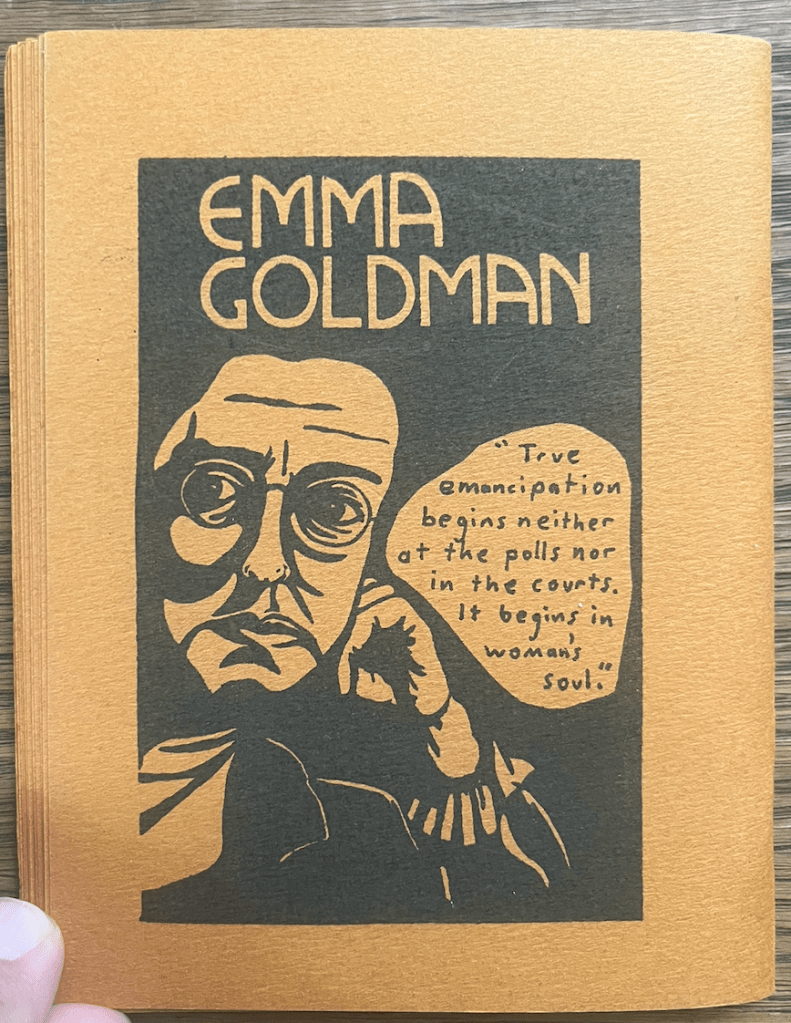
The pamphlet is really very stunning. It’s beautifully printed on a brown cardstock paper with illustrations throughout. The last pages include contact information and, on the back cover, a drawing of Emma Goldman (presumably lifted from elsewhere) and a quote from her 1911 piece “The Tragedy of Women’s Emancipation.”
The full quote from the Goldman essay is: “The right to vote, or equal civil rights, may be good demands, but true emancipation begins neither at the polls nor in courts. It begins in woman’s soul.”
This 1979 edition of A Woman’s Place is surprisingly rare, perhaps even more so than the 1953 or 1970 editions. OCLC locates two holdings (NYU and Labadie at Michigan).
There’s been a bunch of solid publications coming out of late and I wanted to highlight a couple of them that may be of interest to readers of this blog and that I picked up over the past month or so.
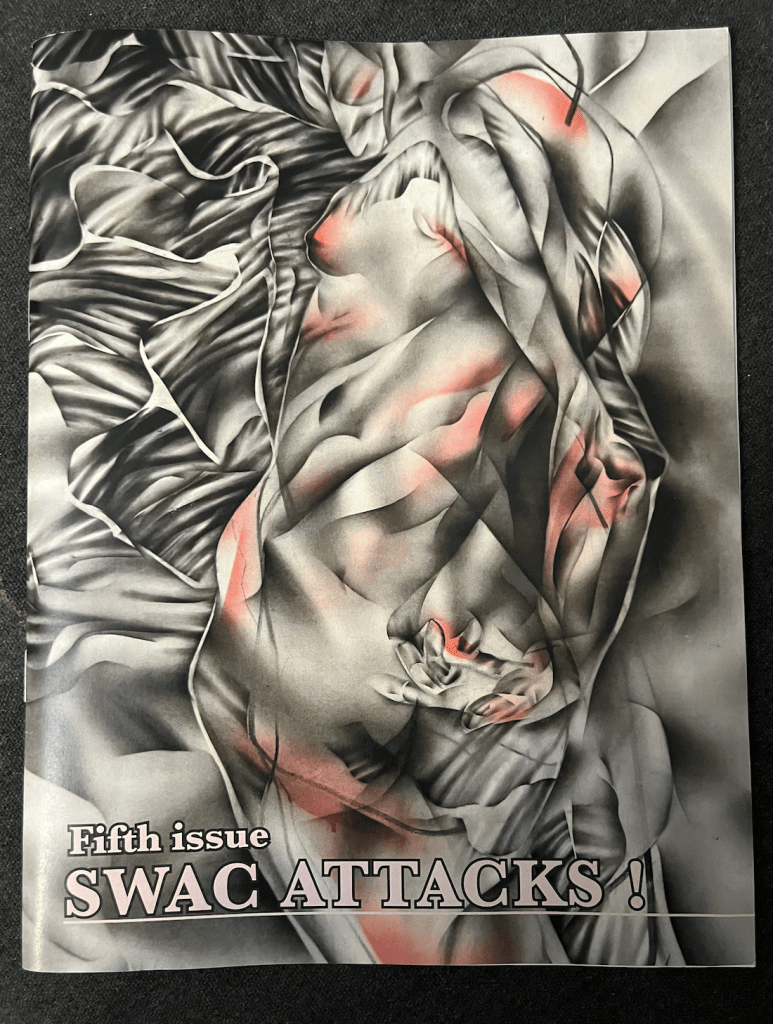
SWAC Attacks! – Fifth Issue.
During a trip to Montreal this past weekend I stopped at Bibliotheque DIRA, the incredible activist archive space upstairs from Libraire L’Insoumise, Montreal’s anarchist bookstore that I cannot recommend enough. While at DIRA, one of the extremely kind folks there handed me a copy of the SWAC journal.
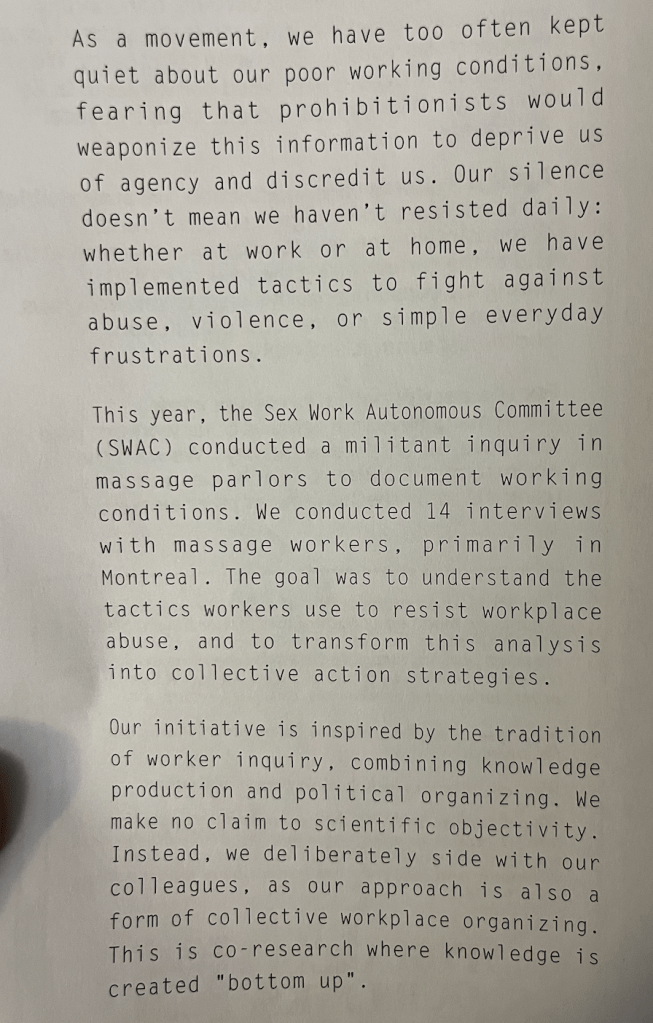
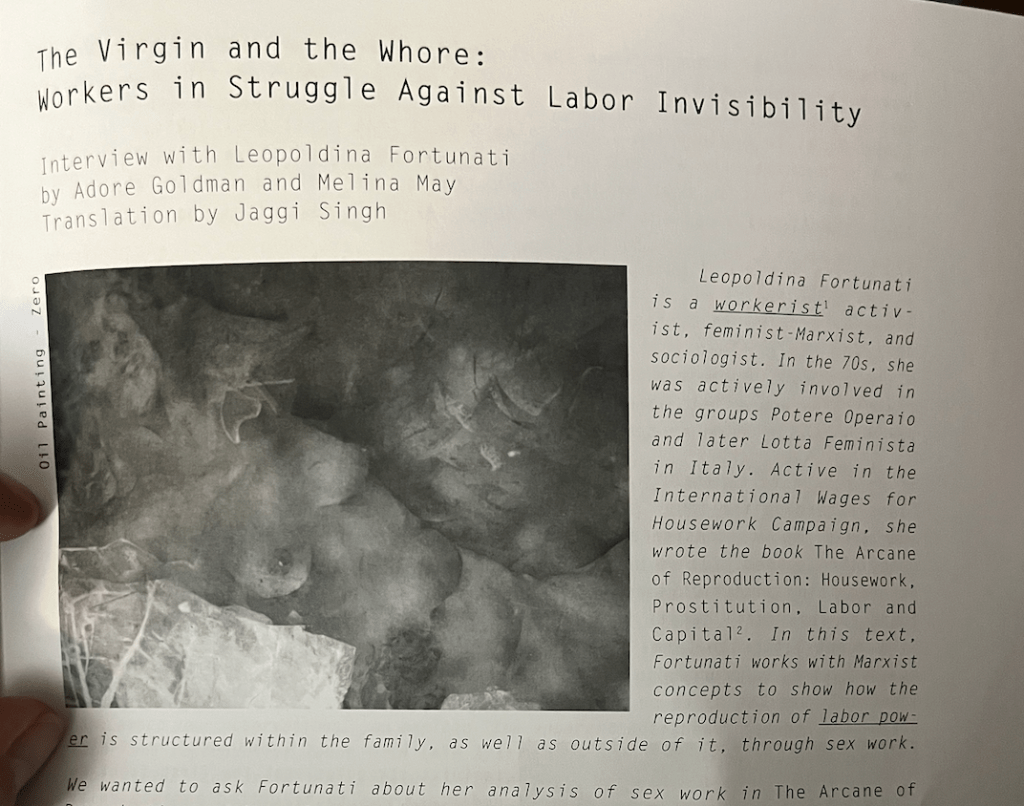
The Comite Autonome du Travail du Sexe / Sex Workers Autonomous Committee (SWAC) has published five issues of their annual journal and the fifth issue (and likely the others, I haven’t read them yet) has a ton of really important info on the experiences of sex workers in Montreal. Specifically, the issue includes a militant inquiry into massage parlors based on interviews with more than a dozen workers. There is also an inquiry into working conditions in Montreal’s strip clubs based on interviews with three workers.
Also of significant interest to readers of this blog is the illuminating interview with Leopoldina Fortunati, author of The Arcane of Reproduction among other works.
Folks interested in reading the journal can find a PDF of it online at SWAC’s website – here.
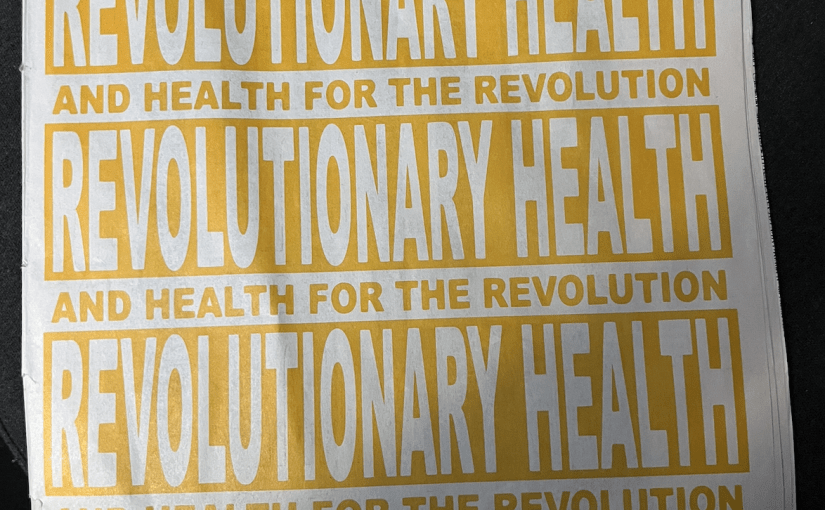
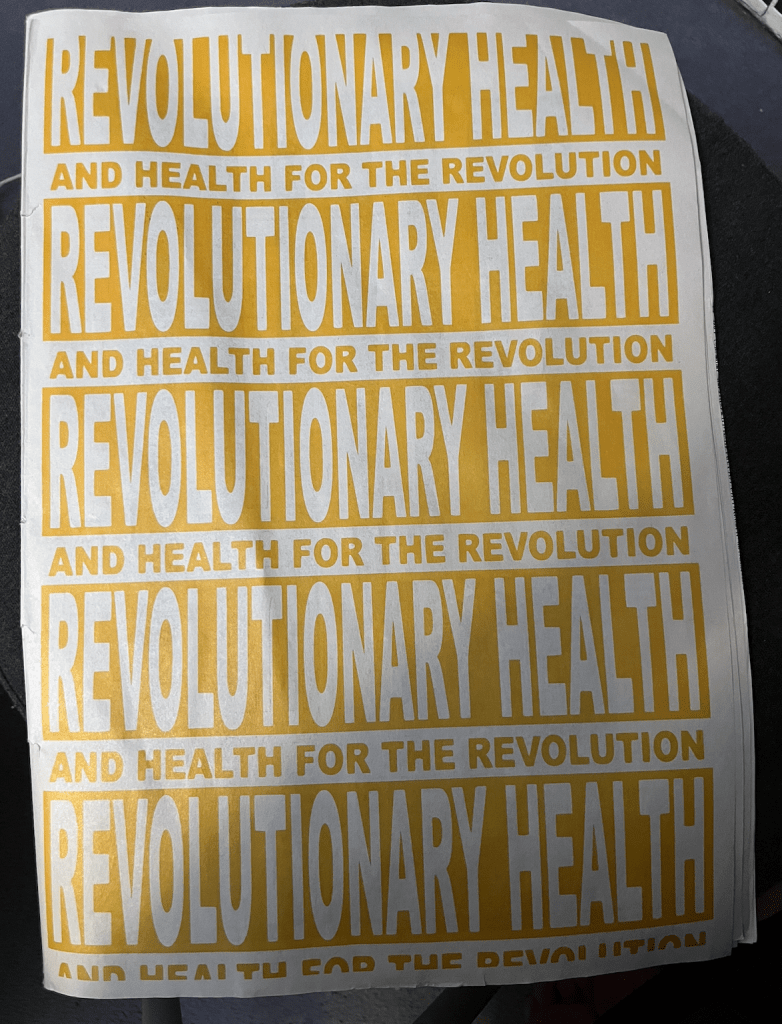
Revolutionary Health and Health for the Revolution – Fourth Issue
Revolutionary Health and Health for the Revolution (RHHR) is a large-form newspaper. The background of it, from their first issue: “Influenced by the Midnight Notes collective, by the struggle against work, payment, money, colonization, sexuality as a work from the feminist perspective, and the ongoing Zapatista struggle against the neoliberal world, we decided to bring into attention these important perspectives that are forgotten or neglected in our political realities.”
I first encountered RHHR when I picked up a copy of their third issue at last year’s anarchist bookfair here in NYC. I found a copy of this issue at P.I.T. in Brooklyn.
The journal includes a number of pieces by George Caffentzis, Silvia Federici and others (including Federici’s piece ‘Capitalist Development and the War on Reproduction, Palestine, and Beyond’ (originally published in The Commoner). Caffentzis’s timely (and unfinished) piece “Trump and Money: From Status to Contract and From Contract to Deal,” even in unfinished form is provocative and worth reading. There are multiple other pieces, most reprinted, in the journal from other writers as well. For folks interested in reading this issue or the other issues of RHHR, PDF’s are available on their website here.
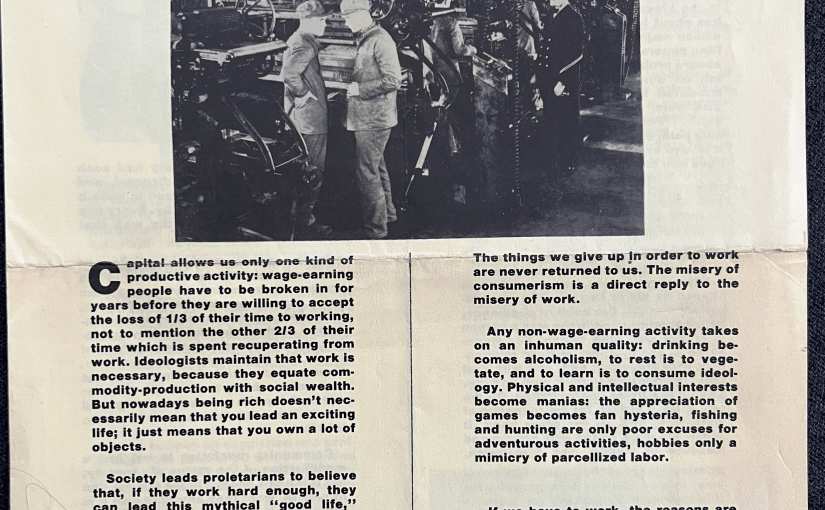
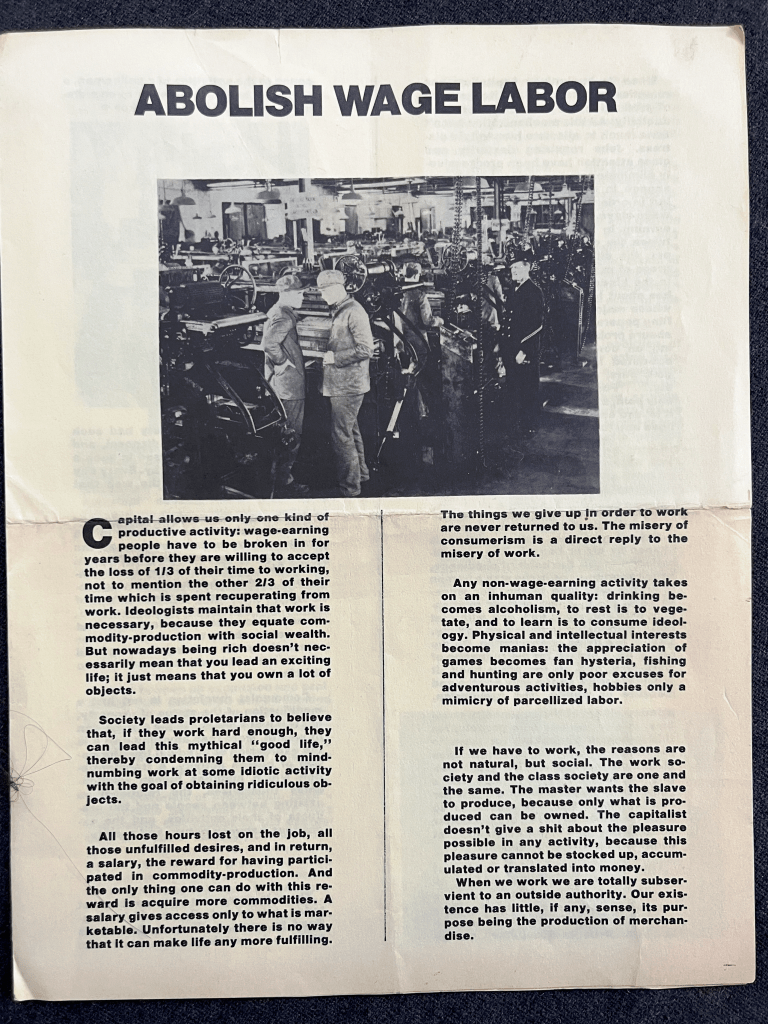
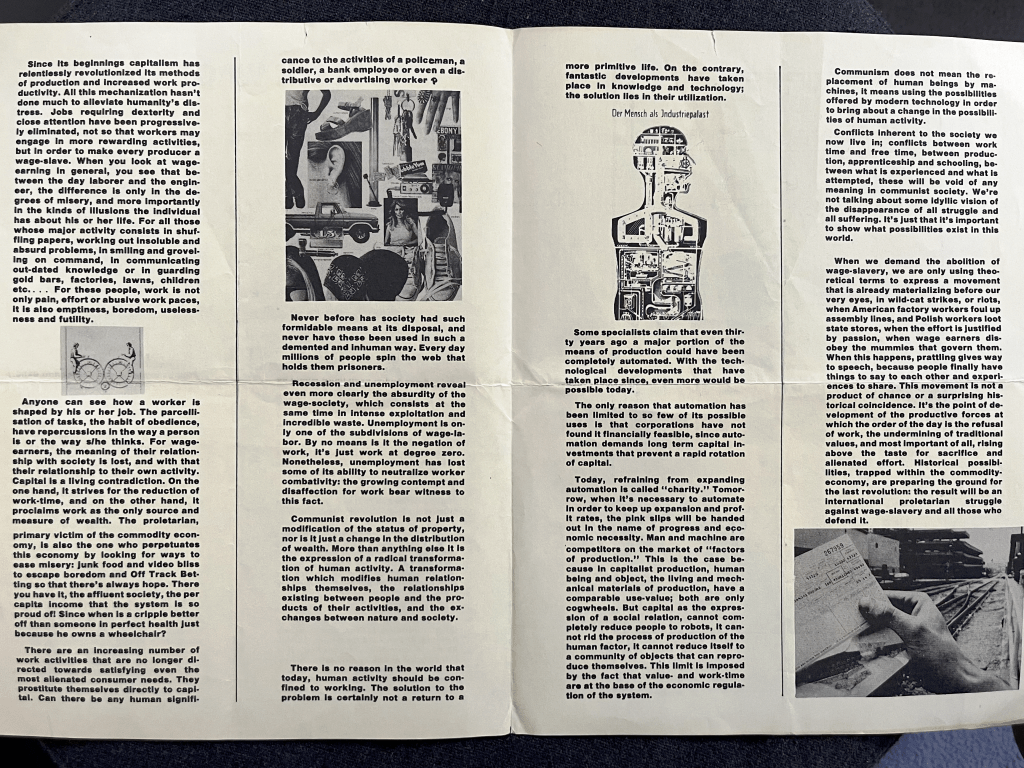
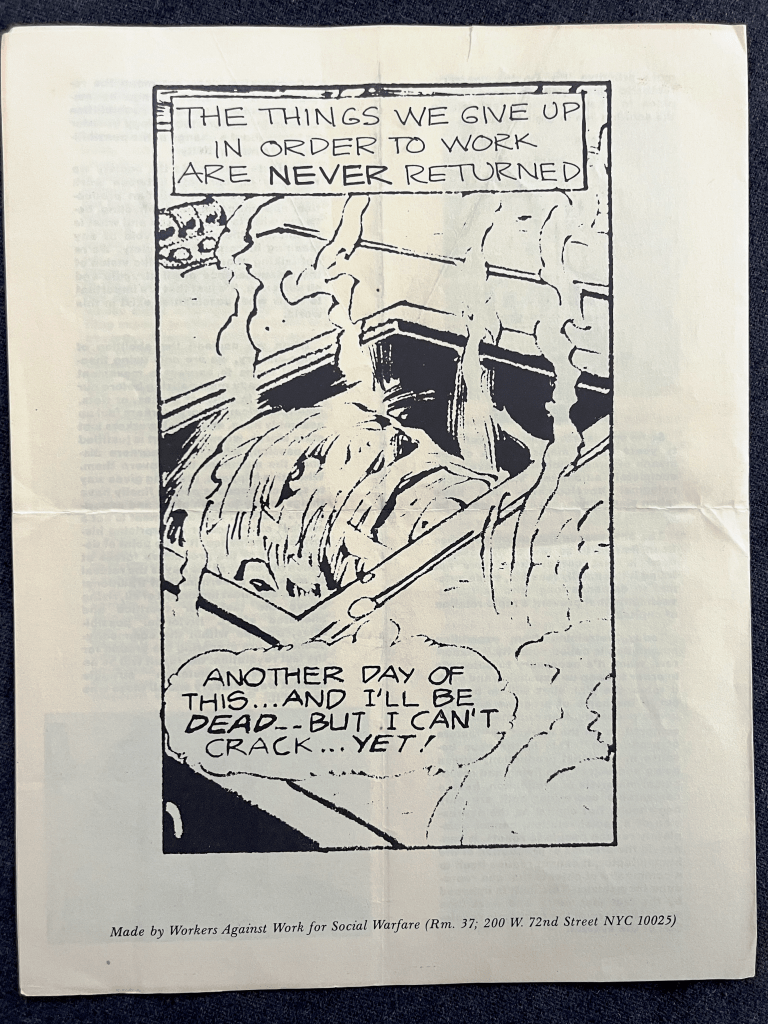
Short 4-page pamphlet against work issued by “Workers Against Work for Social Warfare.” Apparently a one-off of this group (or individual) who do not seem to have published otherwise under the moniker. OCLC states that it was published in 1980 which seems reasonable given this paragraph:
“When we demand the abolition of wage-slavery, we are only using theoretical terms to express a movement that is already materializing before our very eyes, in wild-cat strikes, or riots, when American factory workers foul up assembly lines, and Polish workers loot state stores, when the effort is justified by passion, when wage earners disobey the mummies that govern them.”
For an anti-work pamphlet it is perhaps more reliant on orthodox Marxism than is often found in these kinds of writings (e.g. “This movement is not a product of chance or a surprising historical coincidence. It’s the point of development of the productive forces at which the order of the day is the refusal of work […] Historical possibilities, trapped within the commodity-economy, are preparing the ground for the last revolution: the result will be an international proletarian struggle against wage-slavery and all those who defend it.”)
The pamphlet is a mishmash of the situ-inspired anarchism that increasingly circulated in the 1970s and early 1980s, along with the more orthodox Marxism noted above. There is a somewhat anomalous embrace of technology as liberatory that was less common in some of this anarchism (e.g. “There is no reason in the world that today, human activity should be confined to working. The solution to the problem is certainly not a return to a more primitive life. On the contrary, fantastic developments have taken place in knowledge and technology; the solution lies in their utilization”). It’s a bit theoretically confused, perhaps, but the anger is real, and it comes through.
We located almost nothing about the authors, so if you know background info please write! The address in the pamphlet for correspondence is Room 37 at 200 w. 72nd Street. That building was razed earlier this century, but in the 1970s it was home to offices of Amnesty International and some solidarity groups, though not that specific room.
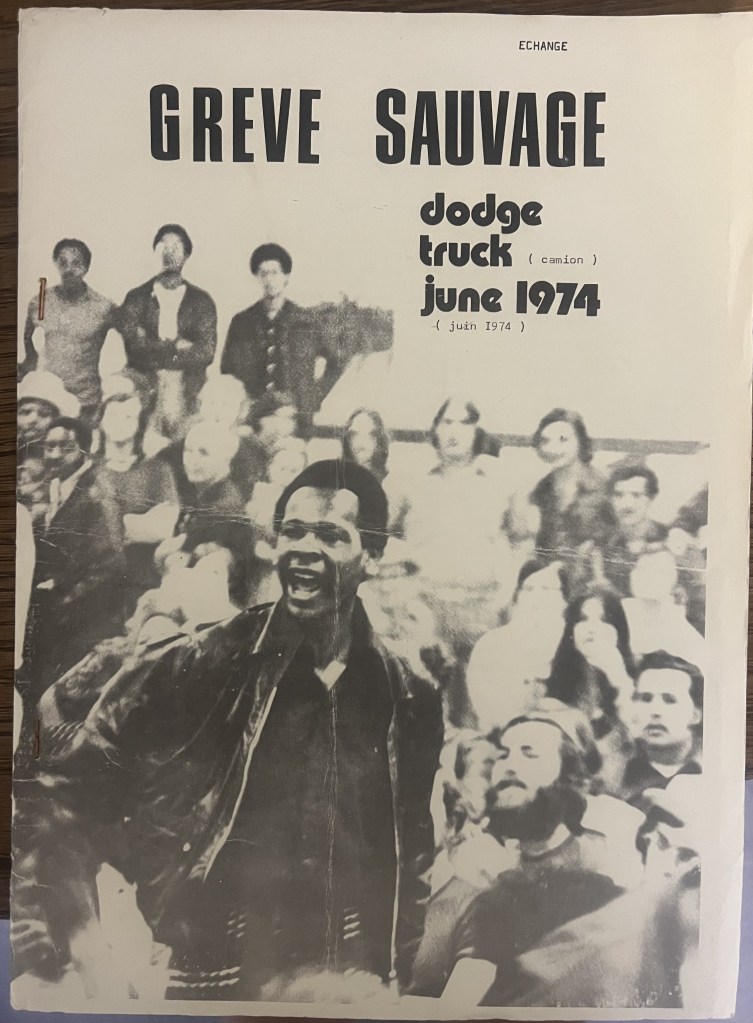
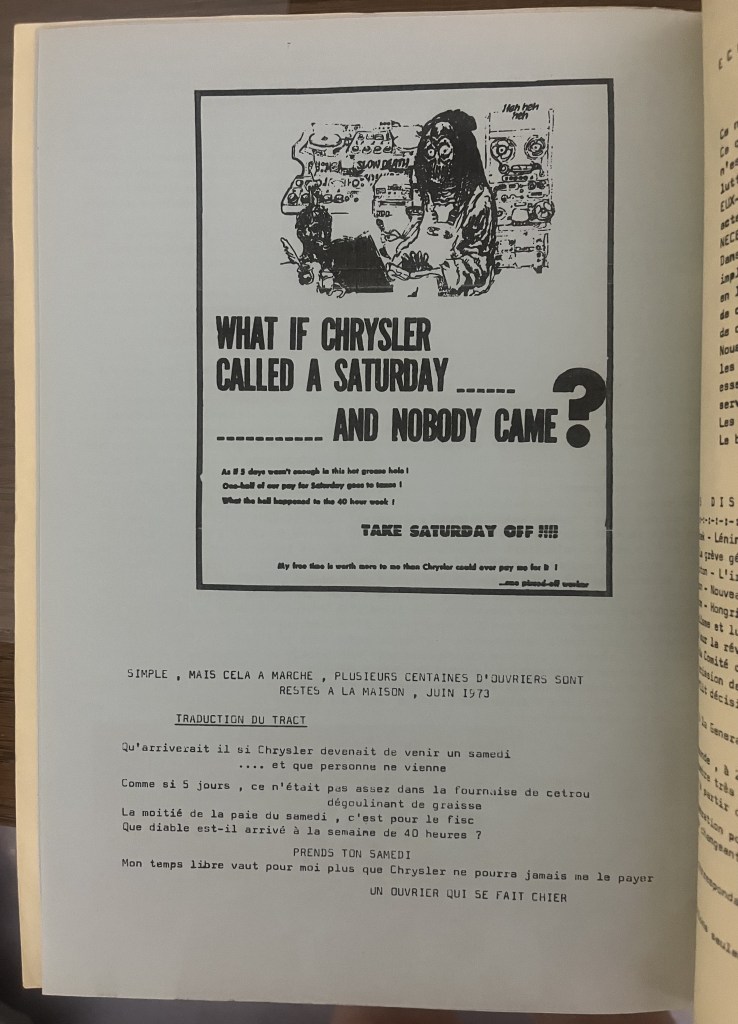
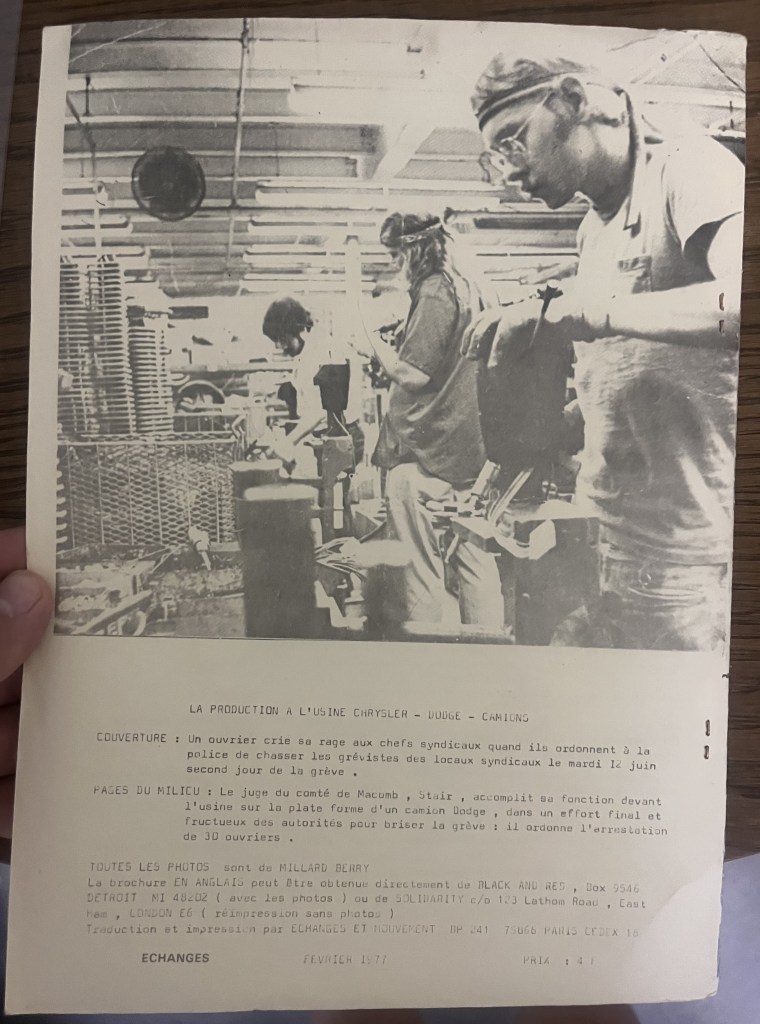
This is the French translation of Wildcat: Dodge Truck June 1974written by Millard Berry, Ralph Franklin, Alan Franklin, Cathy Kauflin, Marilyn Werbe, Richard Wieske, and Peter Werbe. The booklet, according to the 30-year retrospective piece, was “written and produced by several of the people who became the core of the Fifth Estate collective the next year when it was transformed into an overtly council communist, and then, anarchist publication.” The initial pamphlet was printed via the Detroit Print Co-Op distributed by Black and Red (Lorraine and Fredy Perlman’s publishing project). The photos throughout – which are universally stunning – were taken by Millard Berry.
Cover of the English edition distributed by Black and Red
In the late 1990s when I first got involved in anarchist politics, the English version of pamphlet was common to find in any given infoshop, but nowadays this seems less common (in no small part because there are fewer explicitly anarchist infoshops than there were decades ago).
Wildcat is a reflection on a worker wildcat strike in June 1974 (hence the title), but is also a very concise strategic analysis of working class power from an autonomous and, at points, situationist-influenced lens. The wildcat took place in context of increasing militant actions at auto plants in Detroit, and in context of widespread militancy in the the first half of the 1970s.
There are many useful observations in the essay, but in re-reading it I was struck by the very insightful observations about the role of groups associated with the New Communist Movement (NCM) particularly the Revolutionary Union. In an increasingly well-known story, hundreds and probably thousands of Leninist and Maoist militants moved into traditional working class positions during the 1970s in order to move the class toward more militant confrontations. This pamphlet offers a reflection in which the Leninist model of organizing conflicted with the revolt against work by workers themselves in an auto plant in the midwest US during the early 1970s. The essay reflects on the strategy of wildcat walkouts versus taking over and holding the shop floor during strikes: “In addition, by holding the production process hostage, the natural organization and informal communication networks are still intact. One of the most significant advantages to resistance inside the factory is that it leaves the workers on the inside and the company, union, or any others seeking to destroy or dominate the struggle for their own ends, on the outside, where they all belong.”
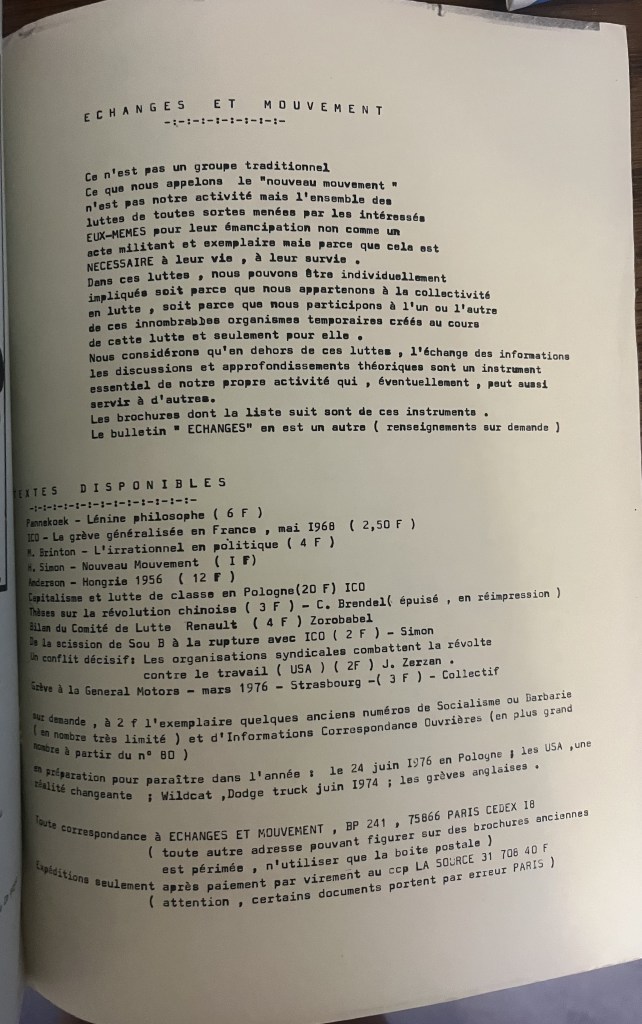
The French edition of the pamphlet was published a couple of years after the English edition by Echanges et Mouvement. Readers of this blog are probably familiar with Echanges – it was started in 1975 by militants associated with Solidarity (UK), Informations et Correspondance Ouvrieres (FR), Daad en Gedachte (NL), and the Belgium group who published Liasions. Henri Simon, who recently passed away, carried on its work for decades. The French edition mirrors the English edition almost page for page but (obviously) with French text instead of English text.
Activists in France have scanned a PDF of the French edition, here. The booklet is rare – I’ve seen only one copy for sale in recent years. OCLC locates one copy of the Echanges edition and four copies of the Echanges edition as distributed by Spartacus.



![Selma James and Ellen Santori (Filomena Daddario). A Woman’s Place. February 1979 [1953]. Nameless Anarchist Group.](https://nyarchivesat.org/wp-content/uploads/2025/09/screenshot-2025-09-05-at-10.58.16-am.png?w=825&h=510&crop=1)