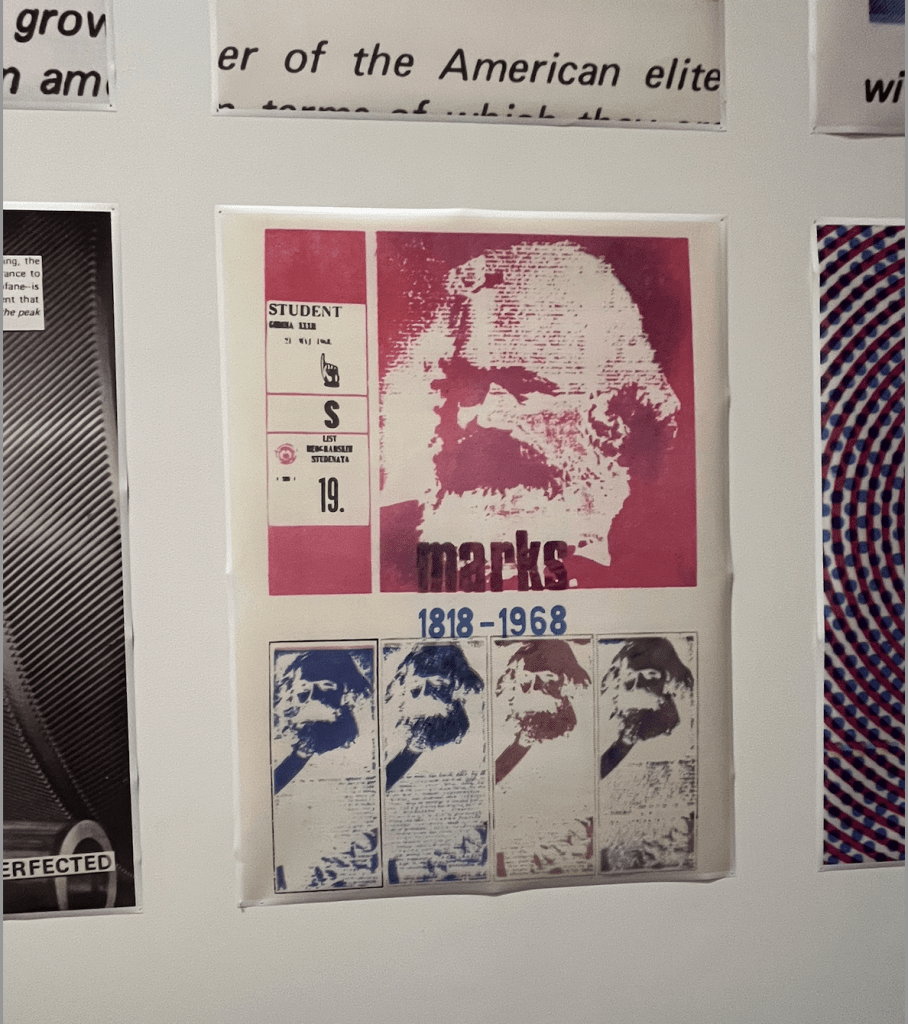
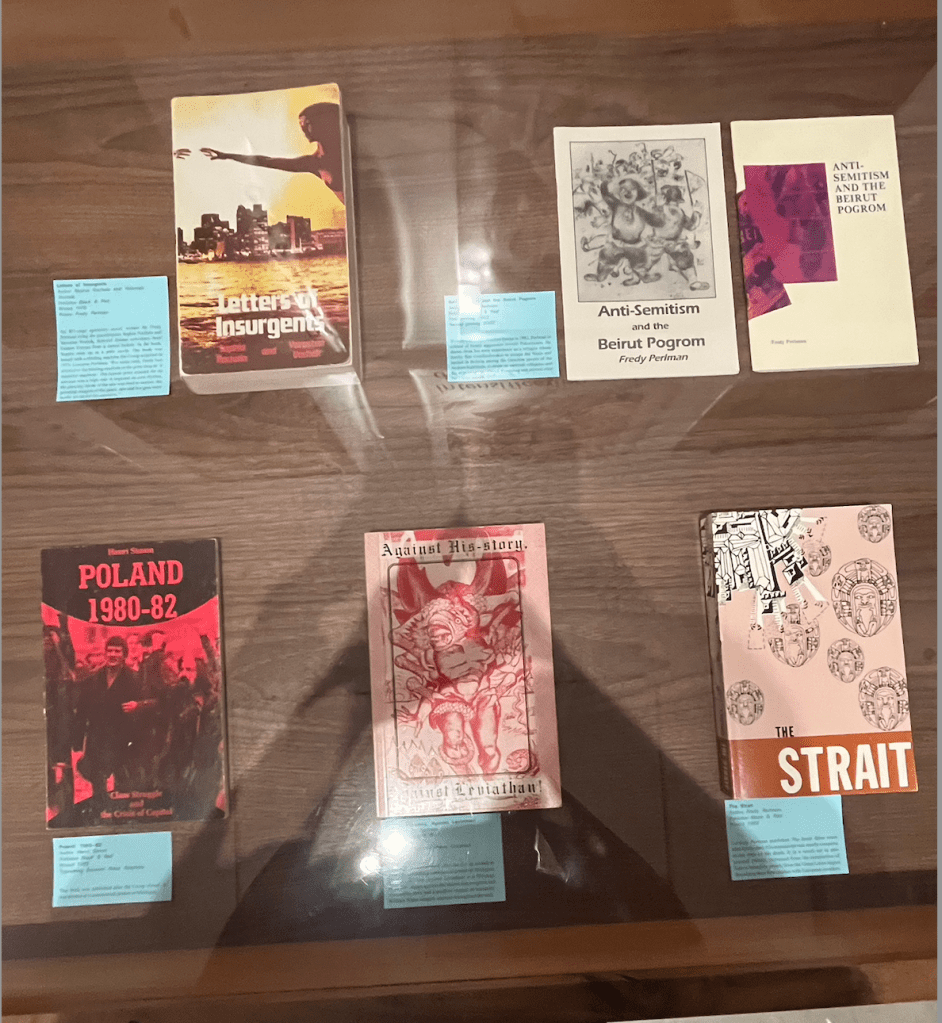
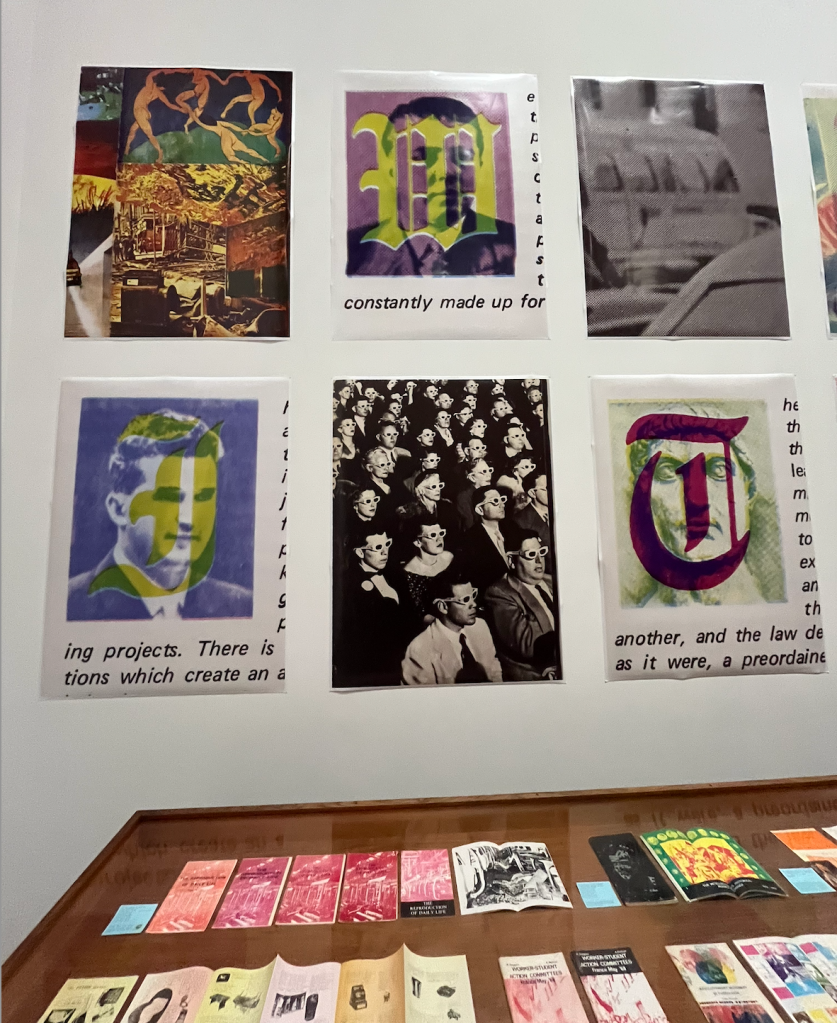
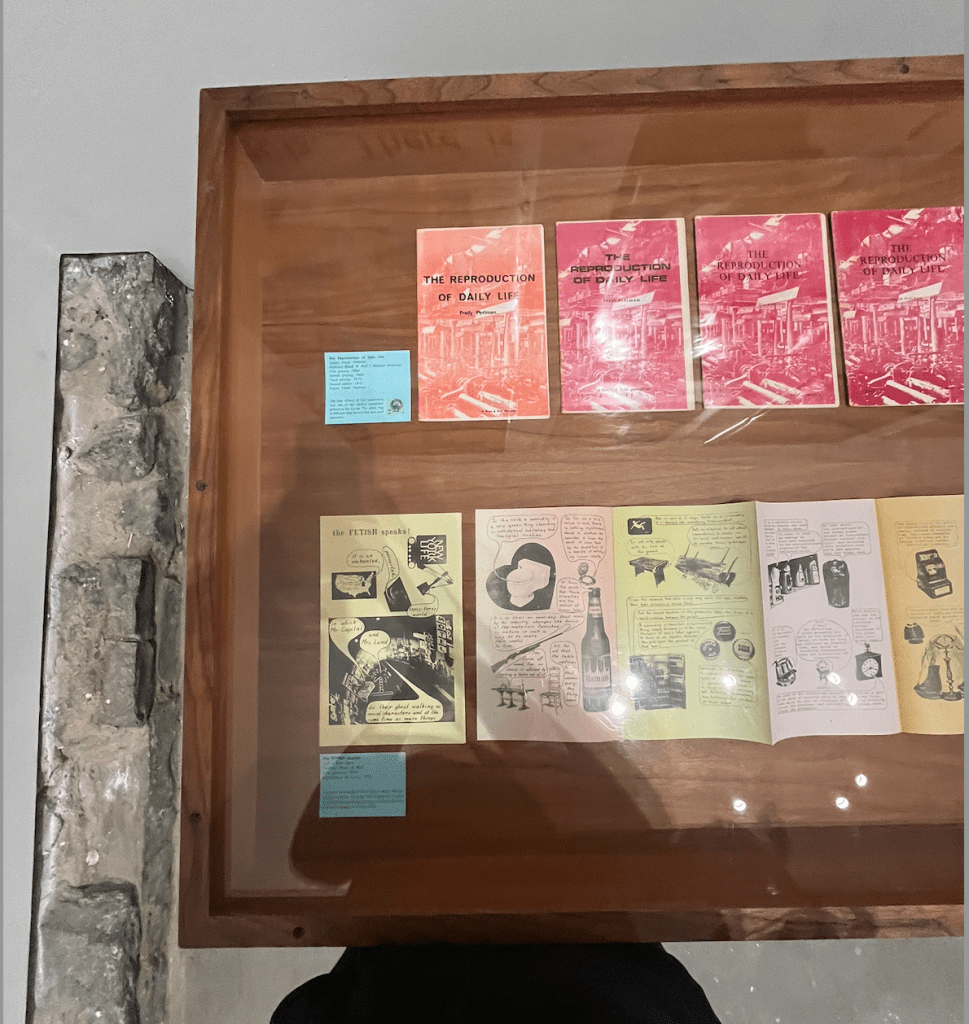
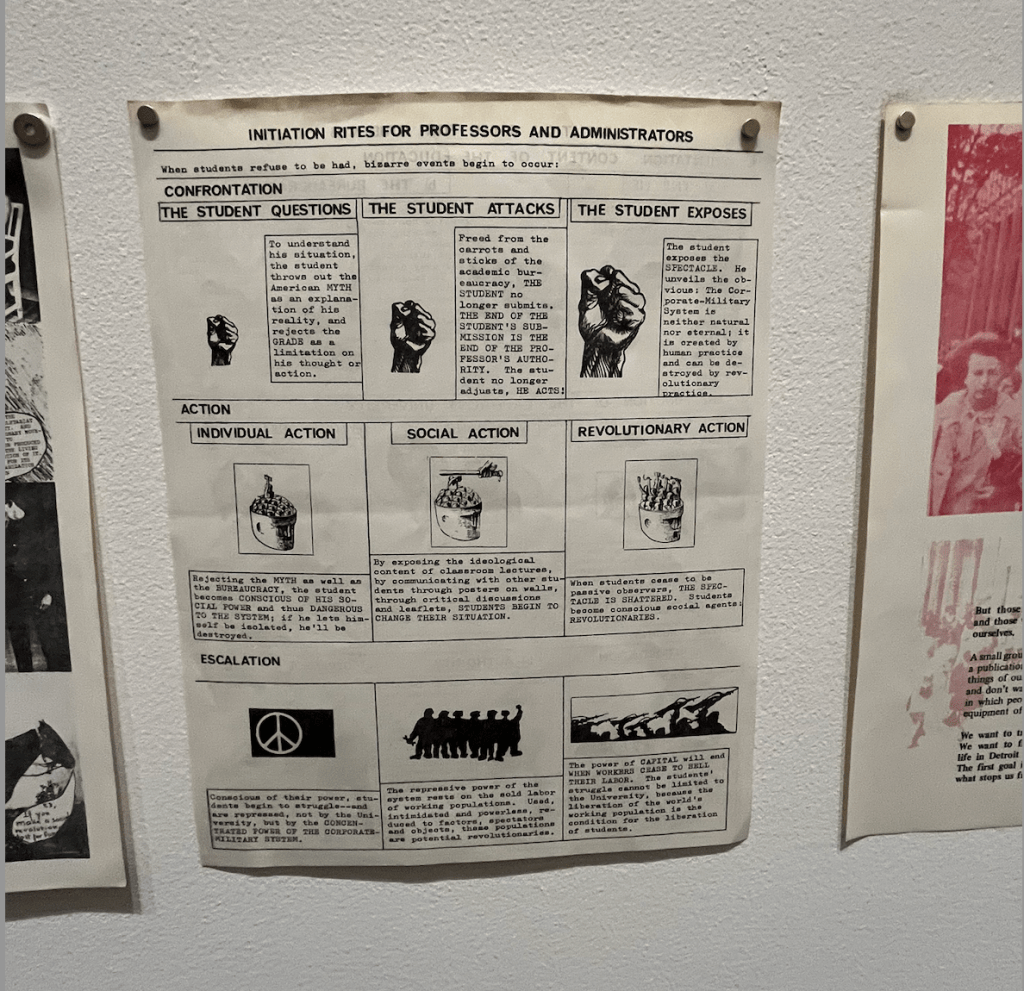
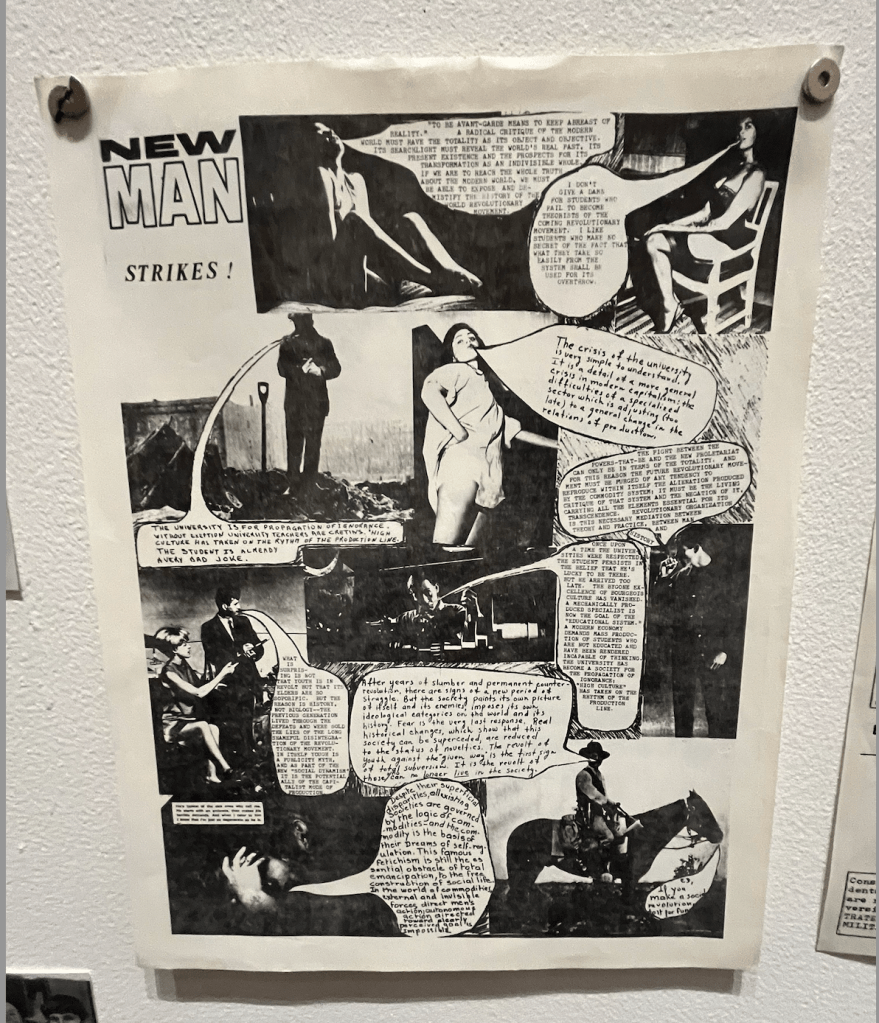
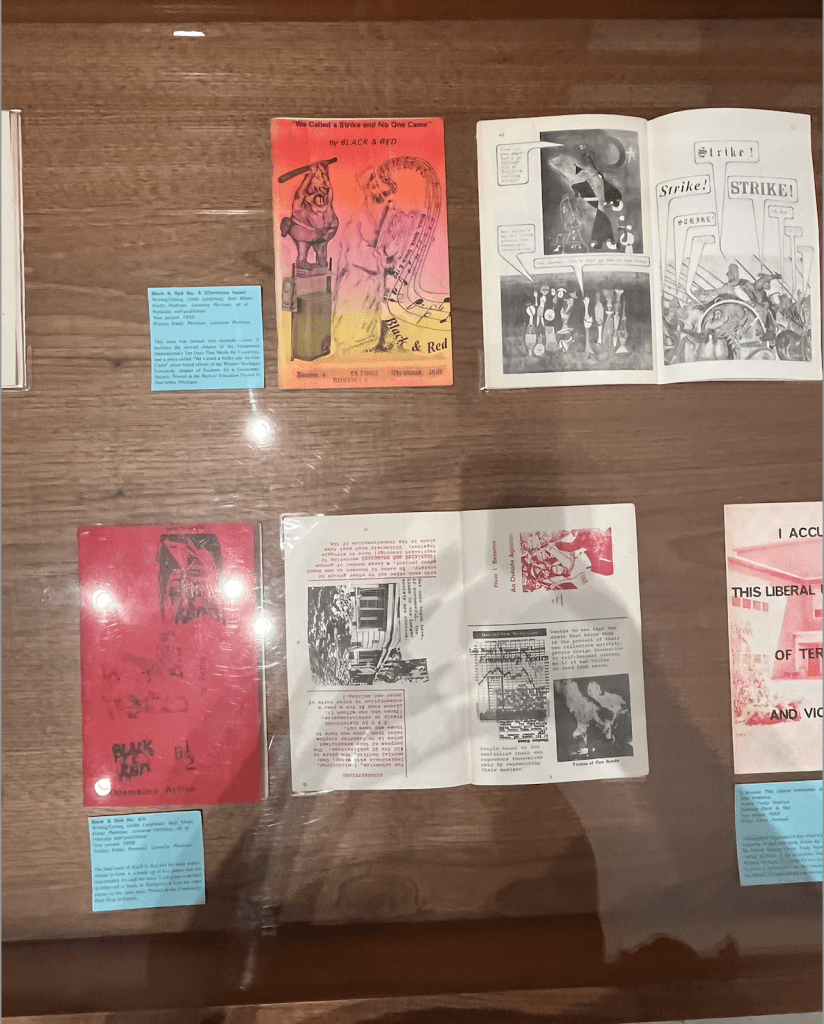
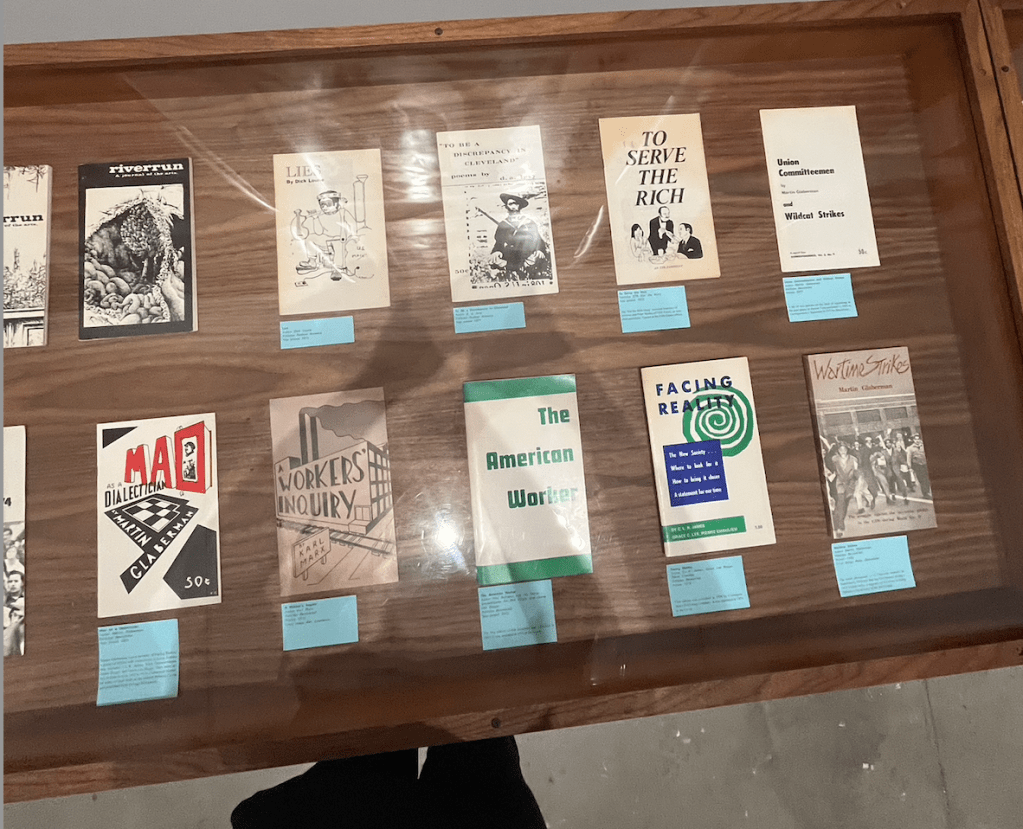
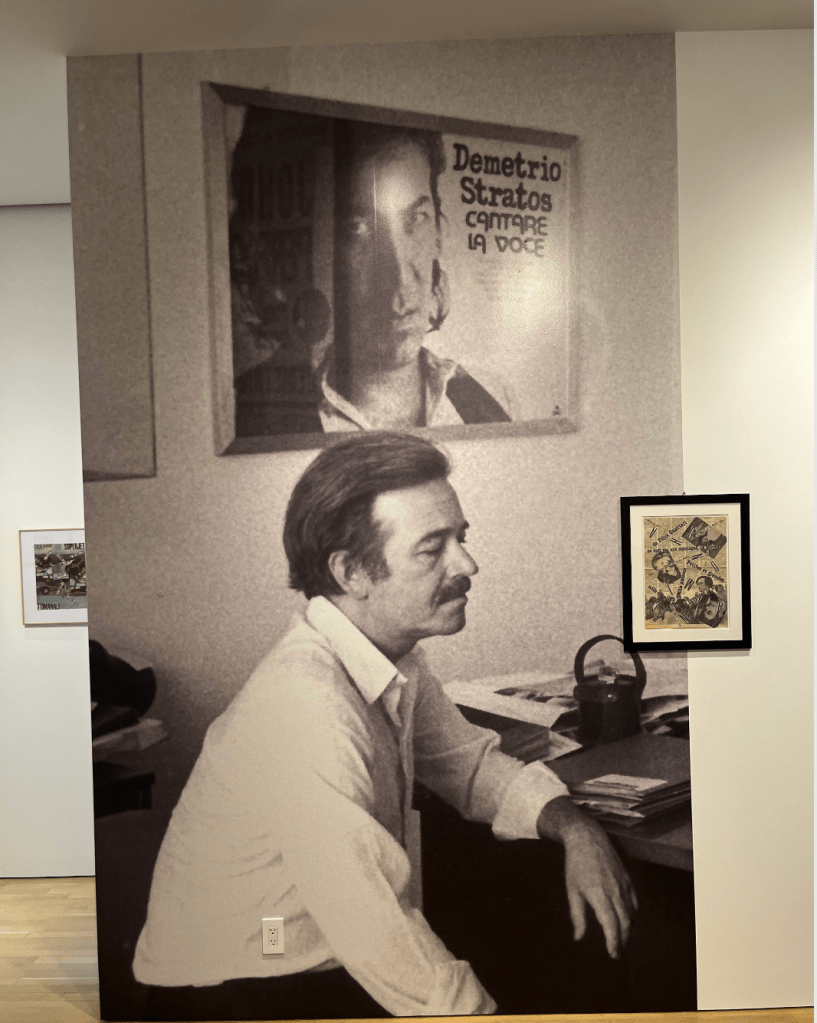
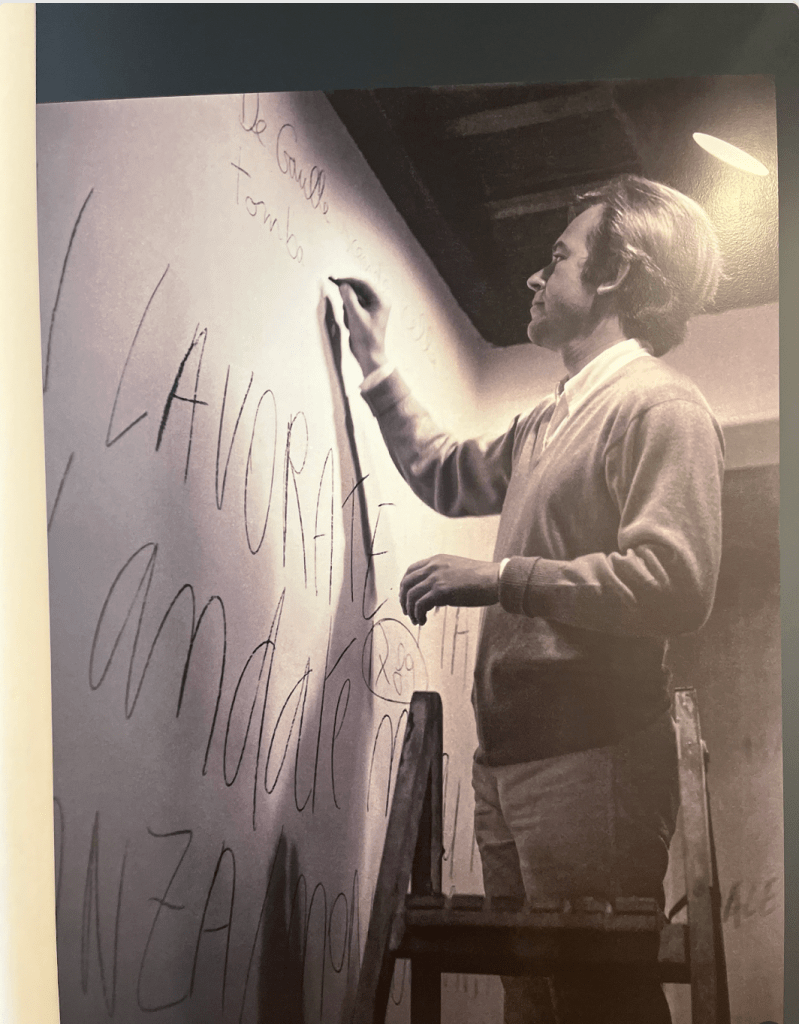
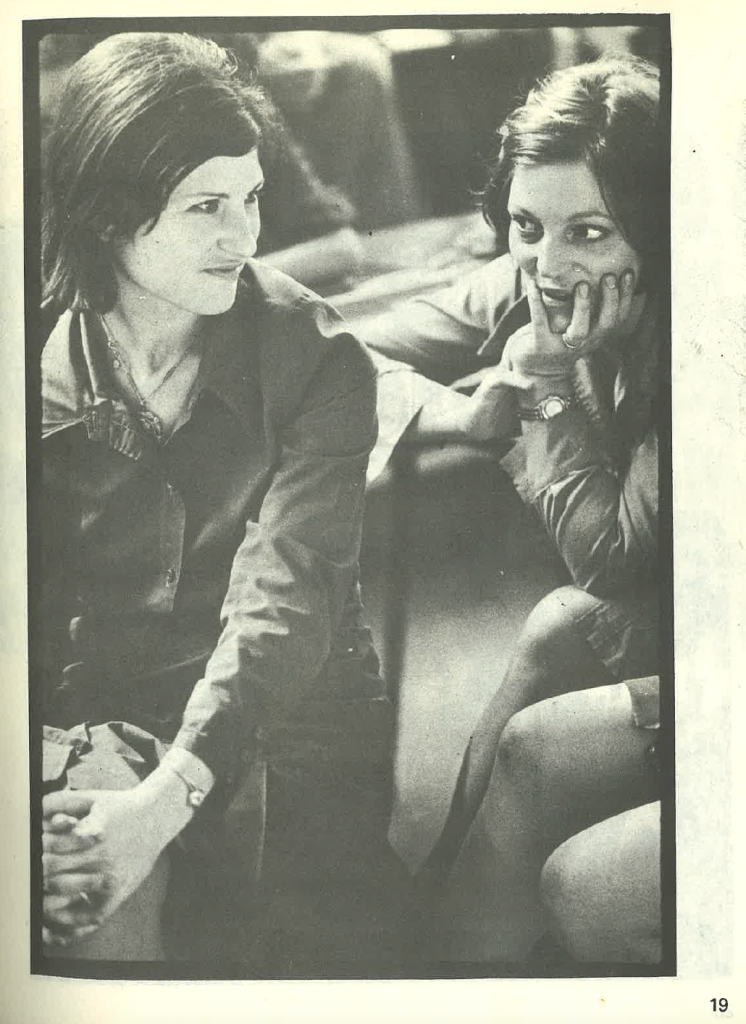
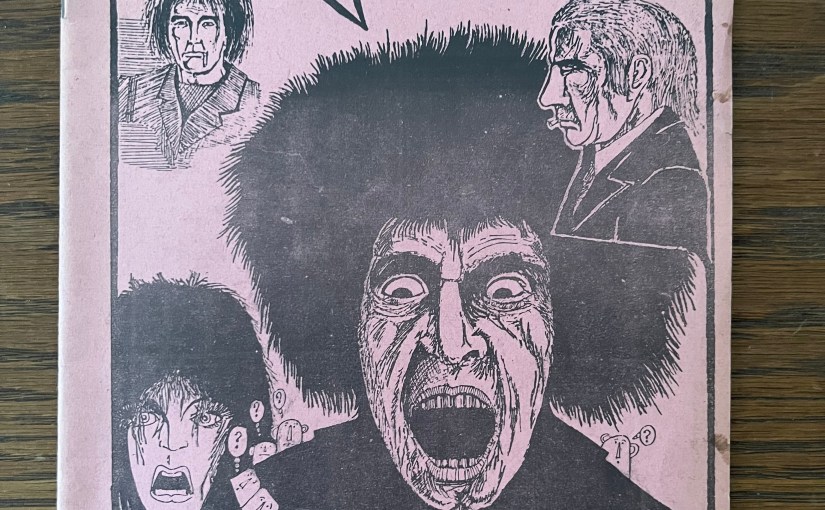
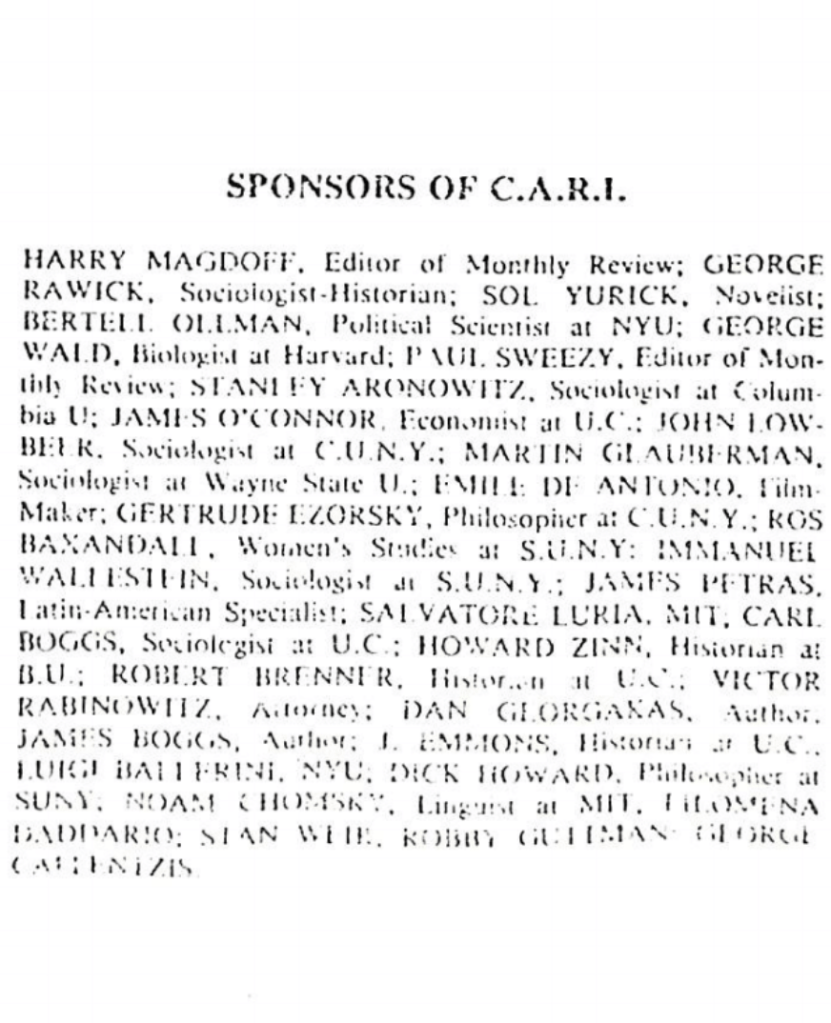
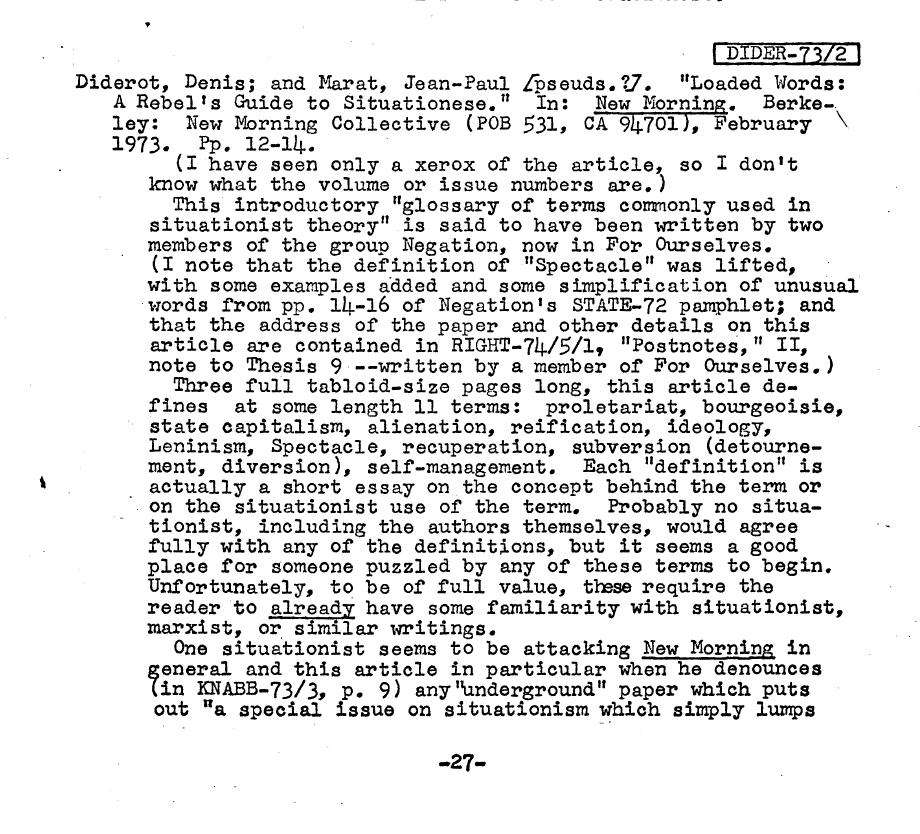
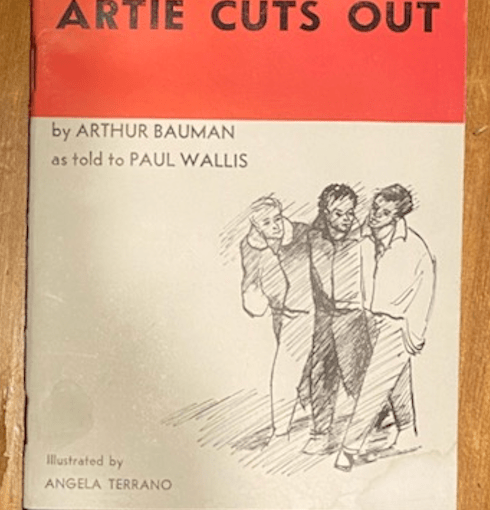
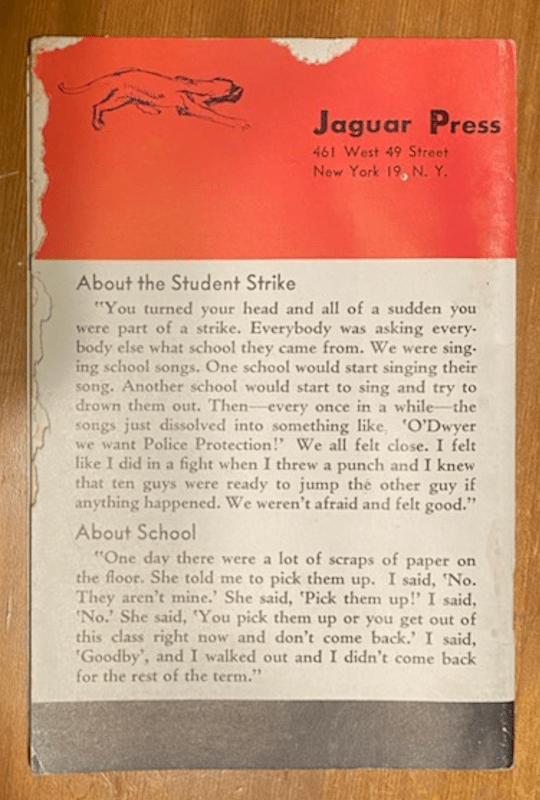
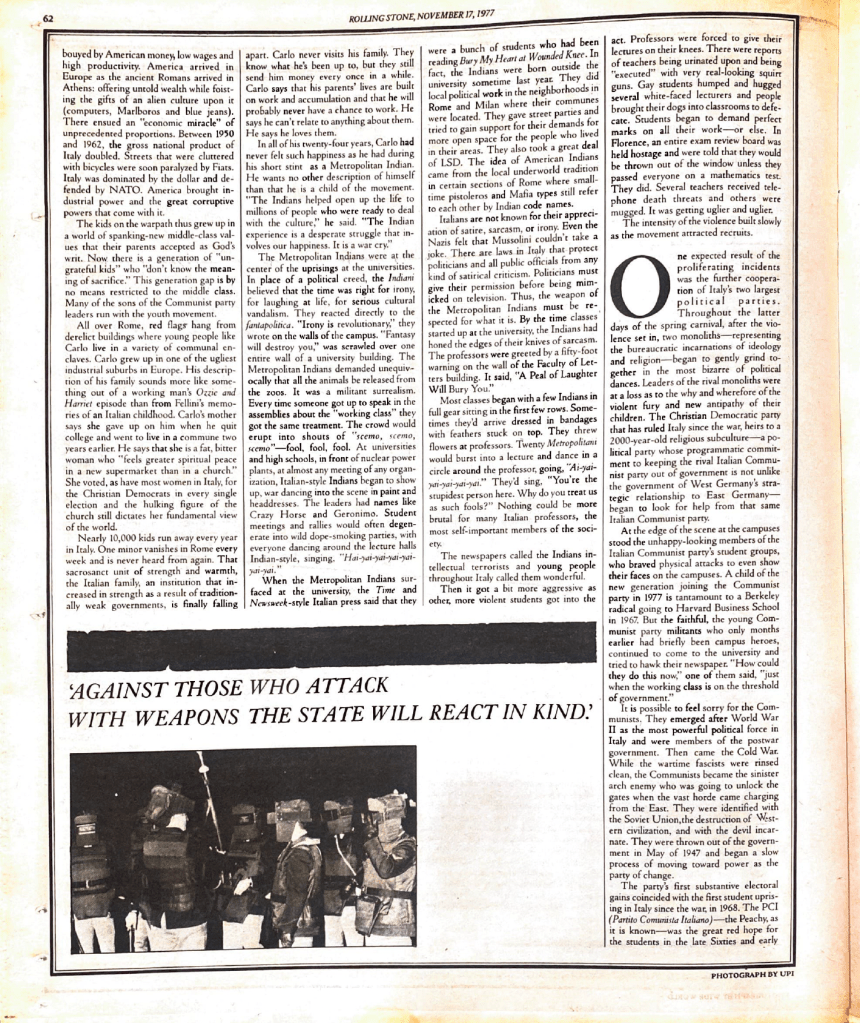
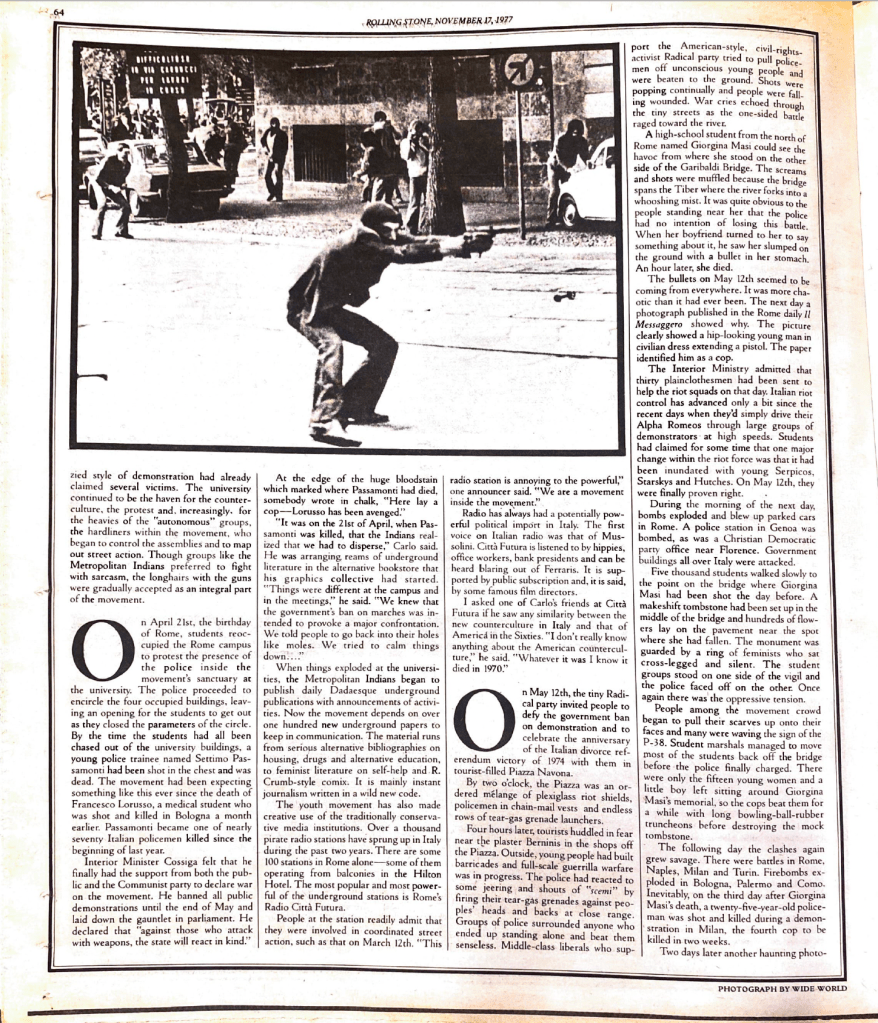
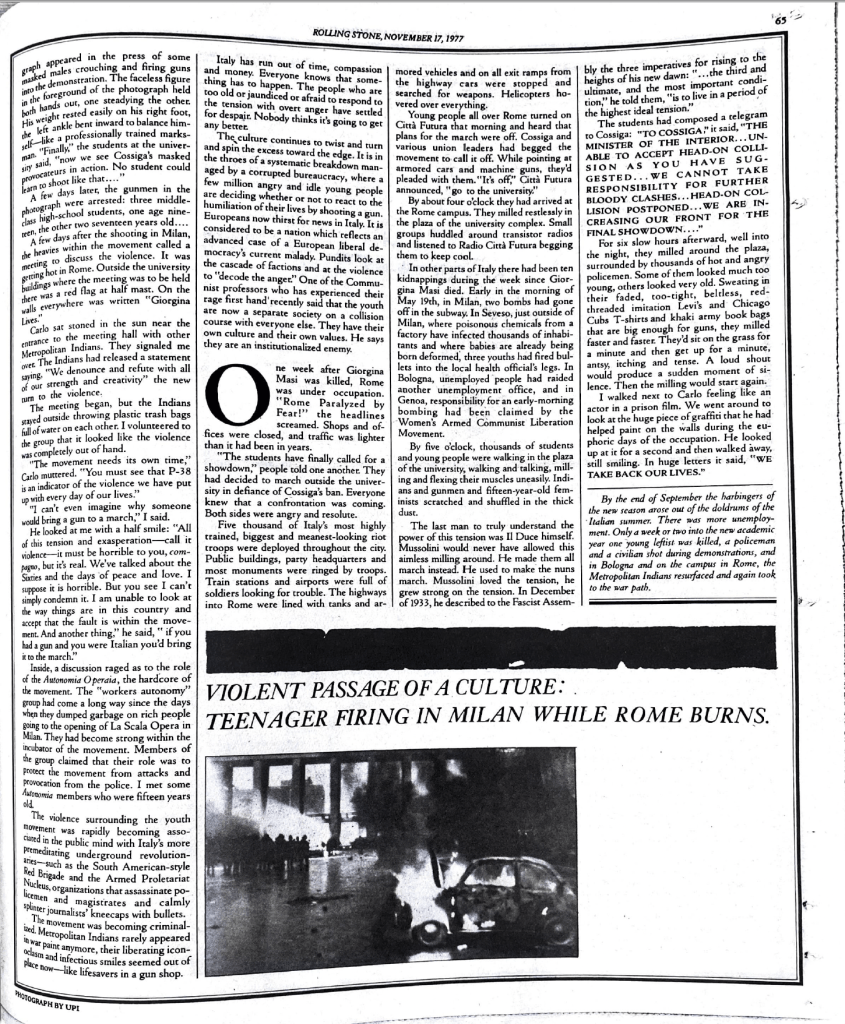
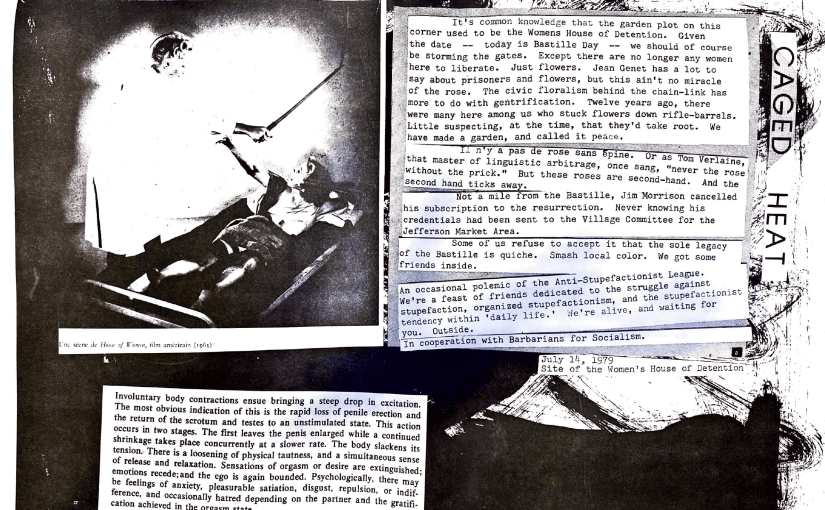
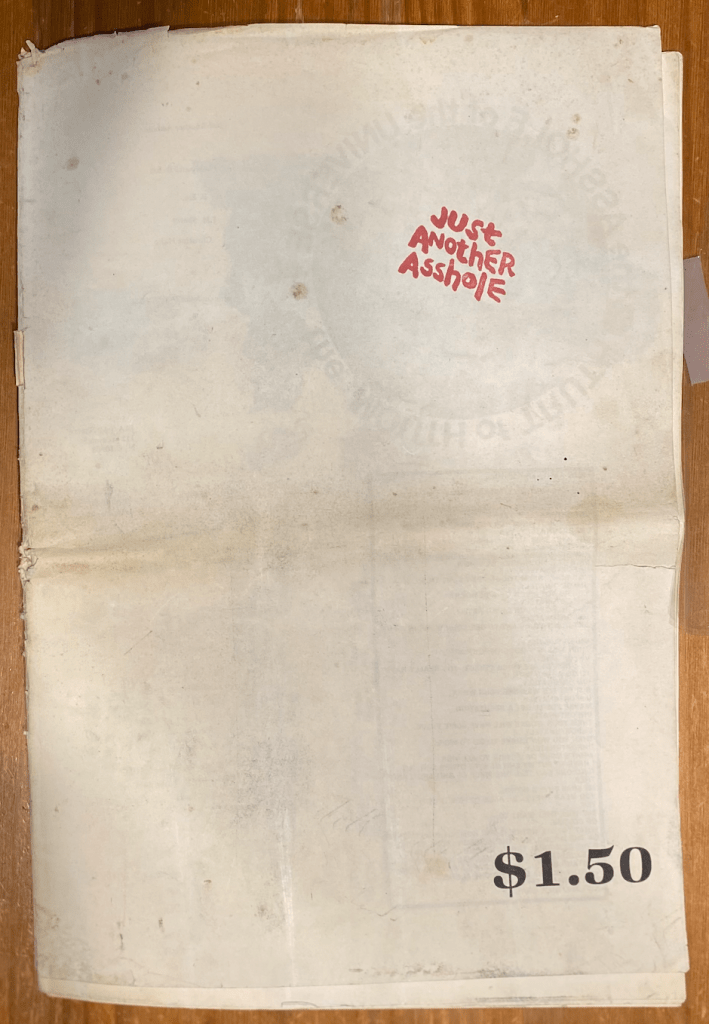
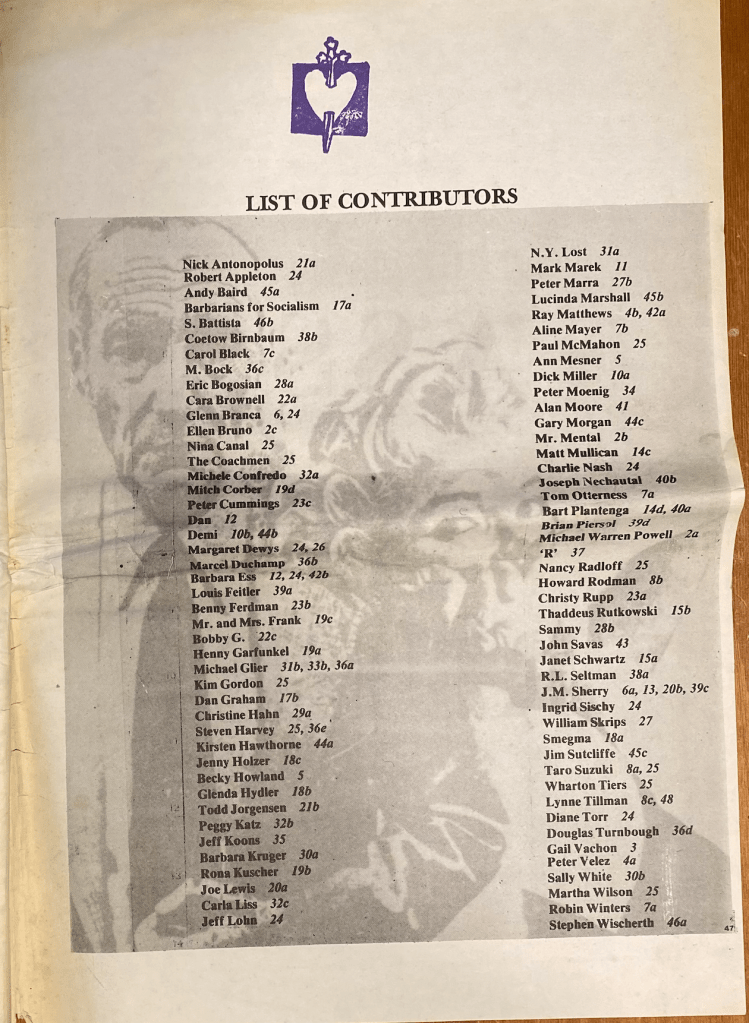
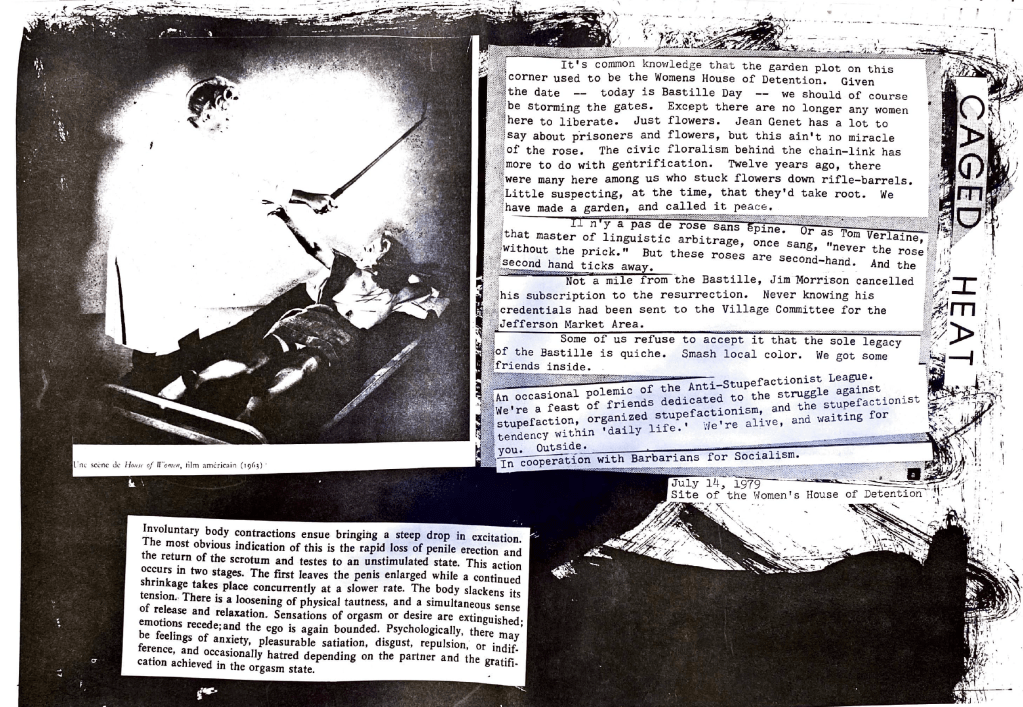
The Detroit Print Co-Op exhibit – New York Art Book Fair, September 2025

Printed Matter runs annual art book fairs in New York City and Los Angeles and I sometimes go to the New York one. For those unfamiliar, Printed Matter is a long-running artist bookshop in Manhattan and is a fantastic space for folks interested in a myriad of international, often below-the-radar, artist projects. I get there once every couple of months and the constant rotation of titles along with various exhibits and talks make it a consistently worthwhile trip.

I find the art book fairs less exciting though. It may be the nature of these kinds of events where there’s a ton of people, not a lot of space, and an unbelievable amount of stuff for sale, sometimes from counter-cultures and movements I personally experienced/participated in at what feels like outrageous prices. Sometimes it’s the grouchy and entitled people who make it difficult – like the woman who snapped at a Printed Matter worker not scanning her ticket quick enough this year while (almost) no one in line said anything, or, last year, the guy who almost punched me in the face after he stormed out of the space, smashing past me, huffing and puffing about who knows what. It may also be that I’ve never felt much comfort with “art” as such and have been inspired more by the anti-art work of Henry Flynt, the art strike effort of decades past, and the brilliant writing of Gustav Metzger. There was some of that kind of thinking present at the art book fair, but not a lot. For those inclined and able, though, one could spend over a thousand dollars for a poster from the Anti-University in London.

That said, the folks at Printed Matter who put the fair together do a truly heroic job and the workers are incredibly patient throughout the day with a lot of people. And a lot of great artists and publishers and second hand sellers (and some not so great) put a lot of time and attention into their tables, and there is a geographical diversity that is really neat. Finally, this year had many tables that drew attention to the ongoing genocide in Palestine, which was really solid.

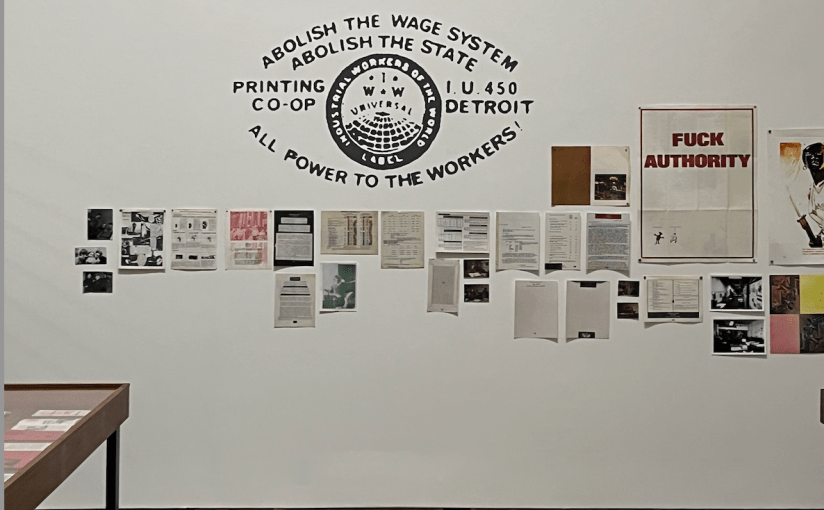
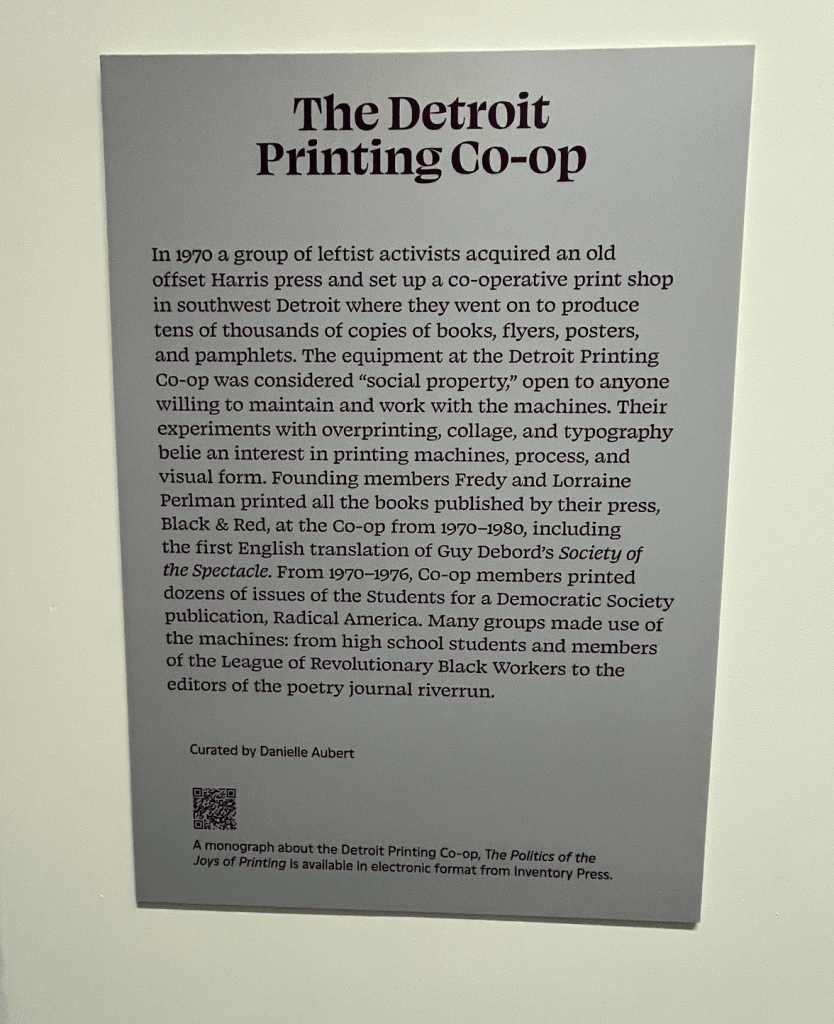
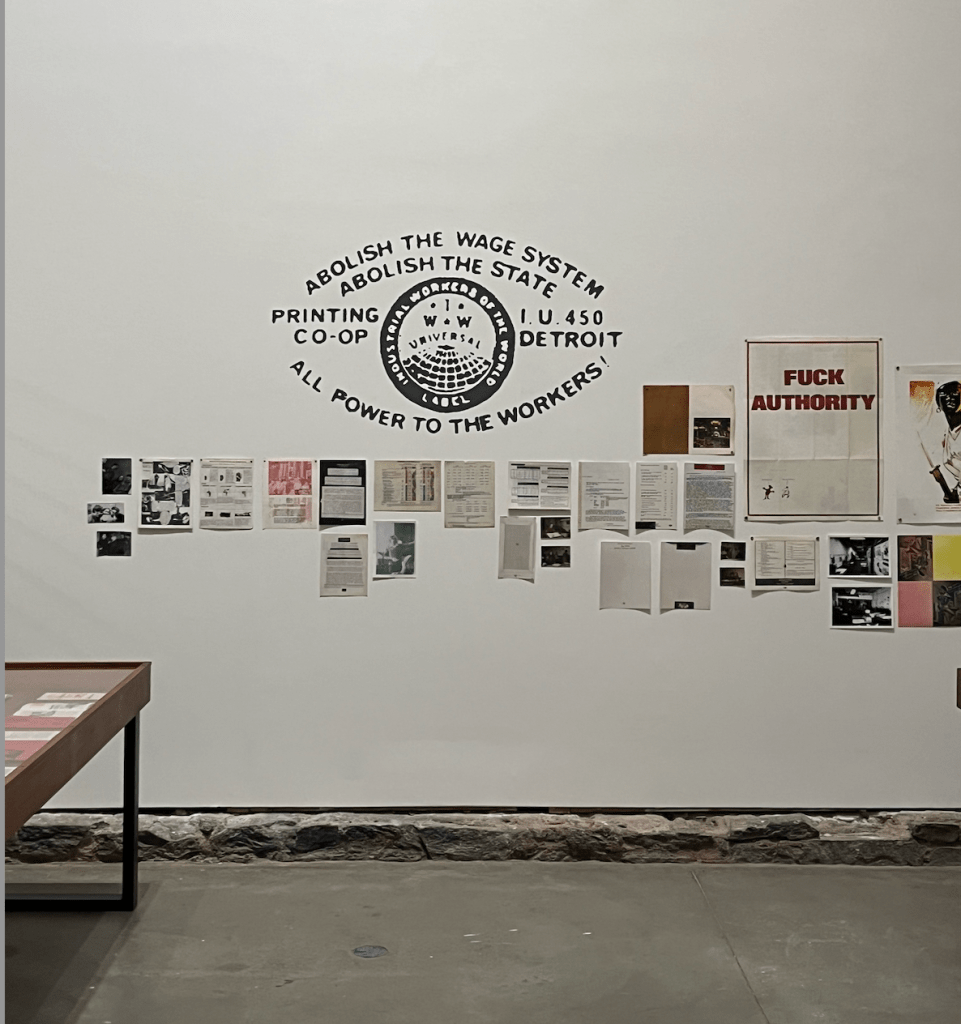
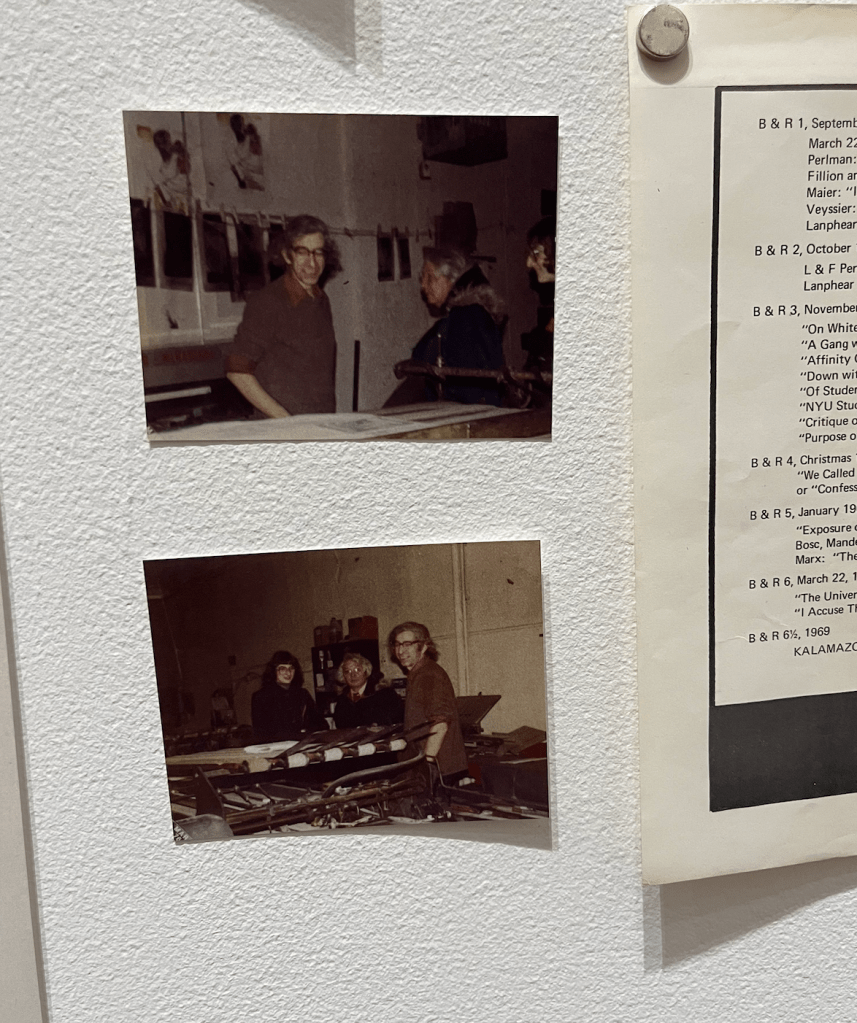
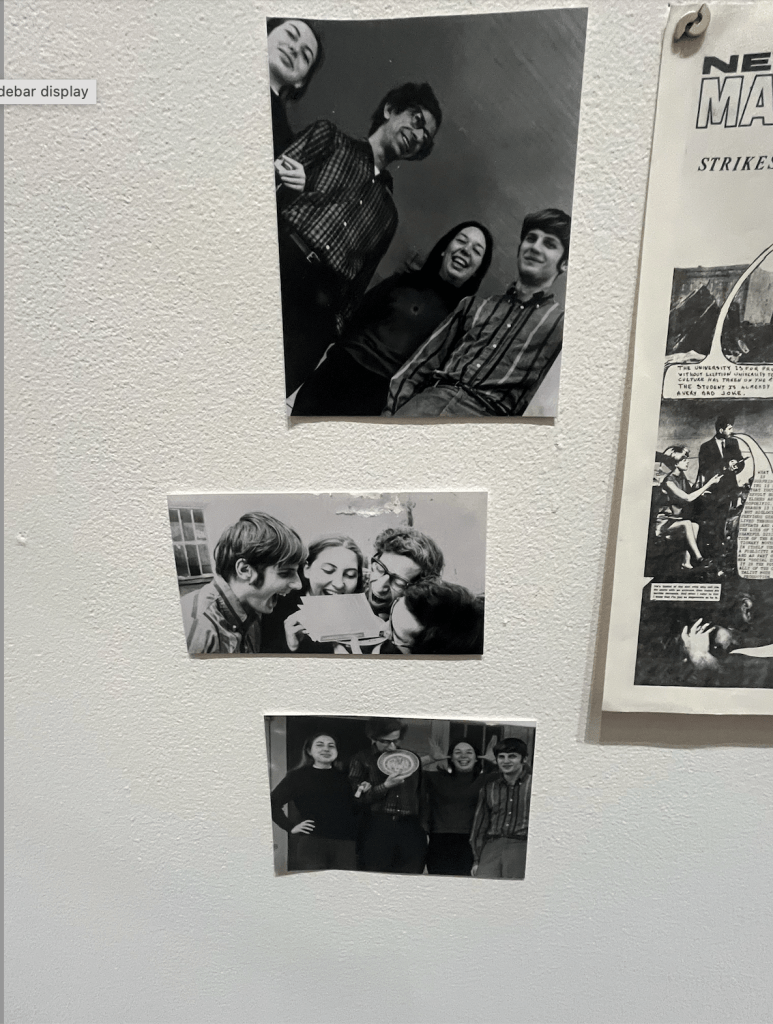
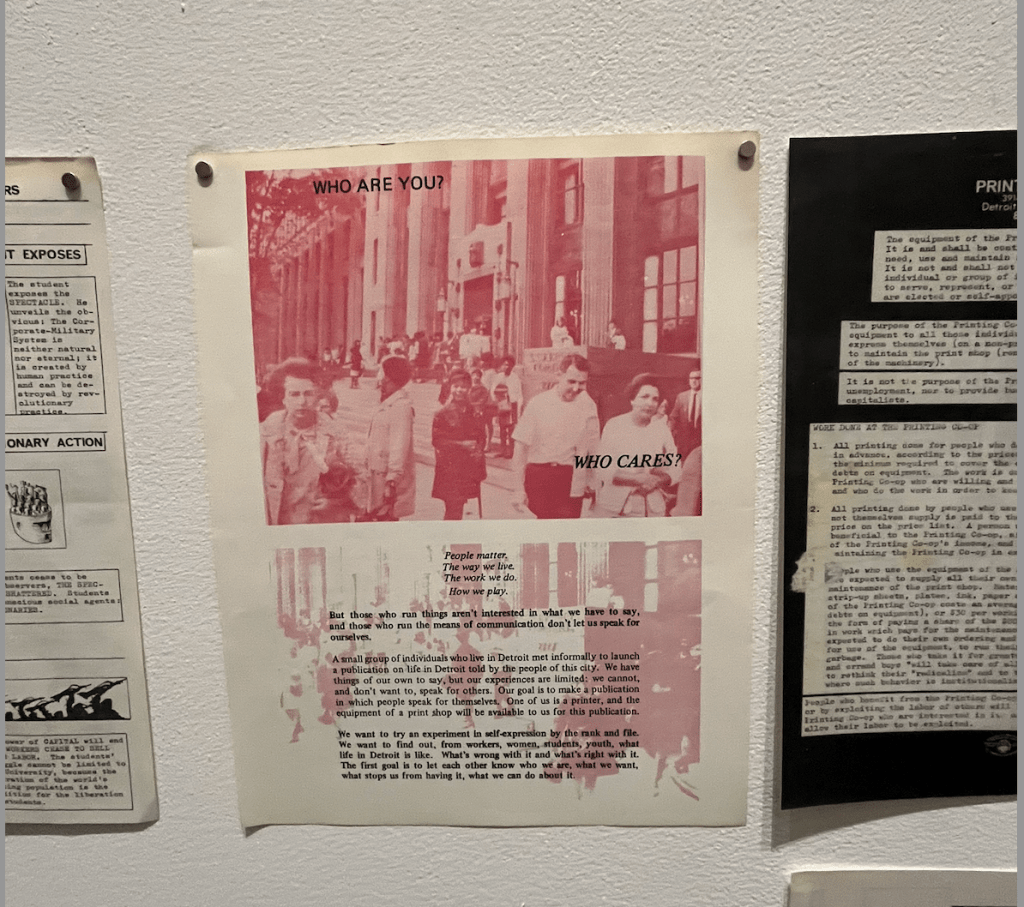
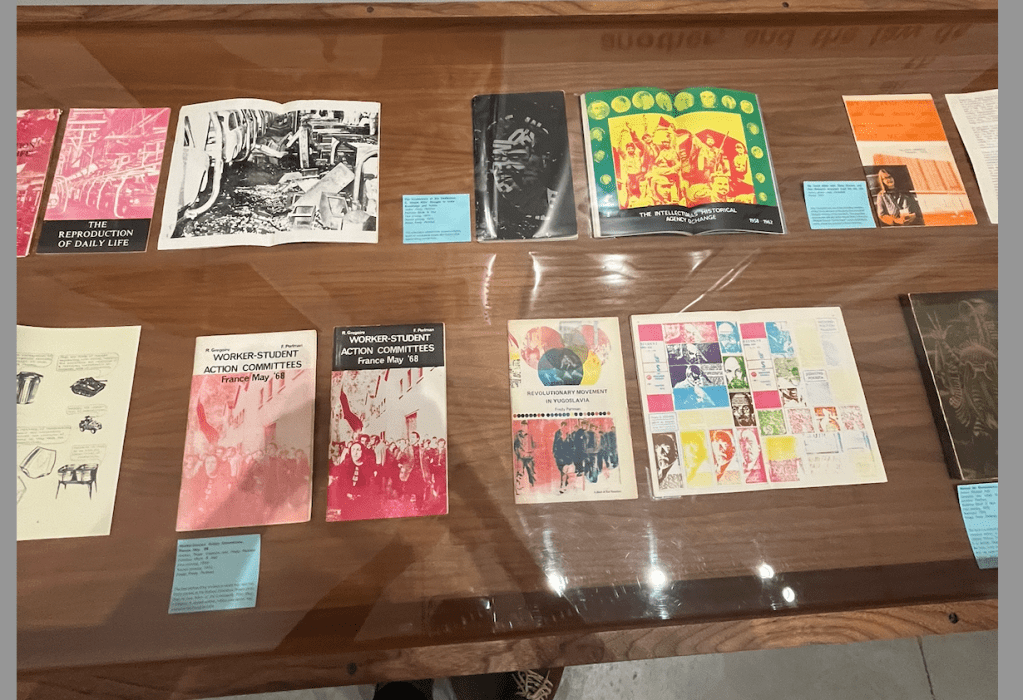
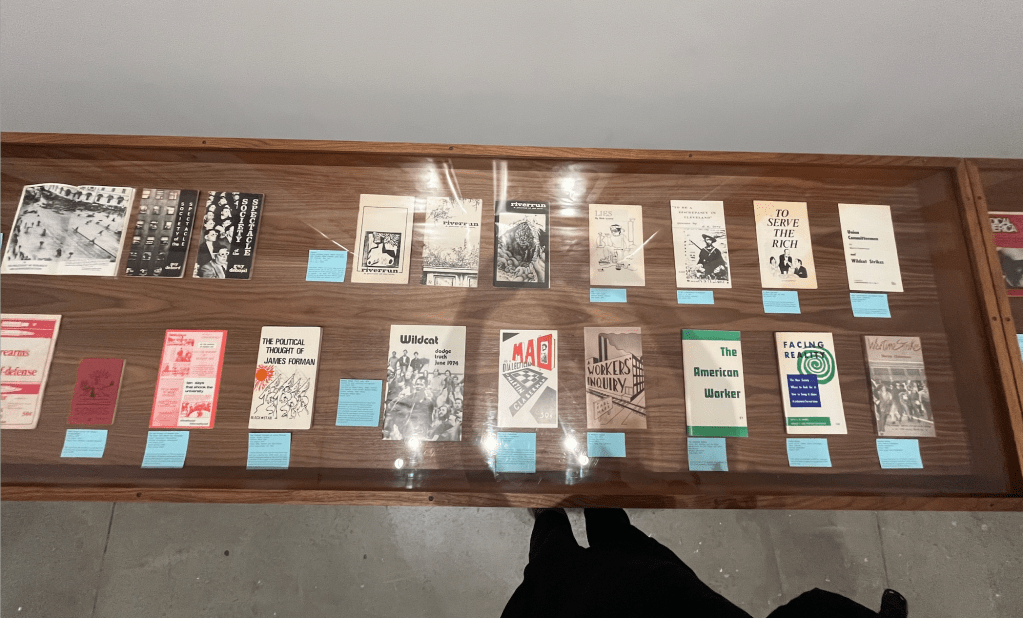
My main interest in attending this year’s fair was the one-room exhibit on the Detroit Printing Co-Op put together by Danielle Aubert and based on her remarkable book The Detroit Printing Co-Op: The Politics of the Joy of Printing (we briefly mentioned that work in the past, here). The exhibit on the Detroit Printing Co-Op, which has taken place at least a couple of other times in other parts of the US, was in a very large room at the fair, which was held at MoMA PS1 in the (almost unbelievably, at least to me), gentrified neighborhood of Long Island City in Queens.

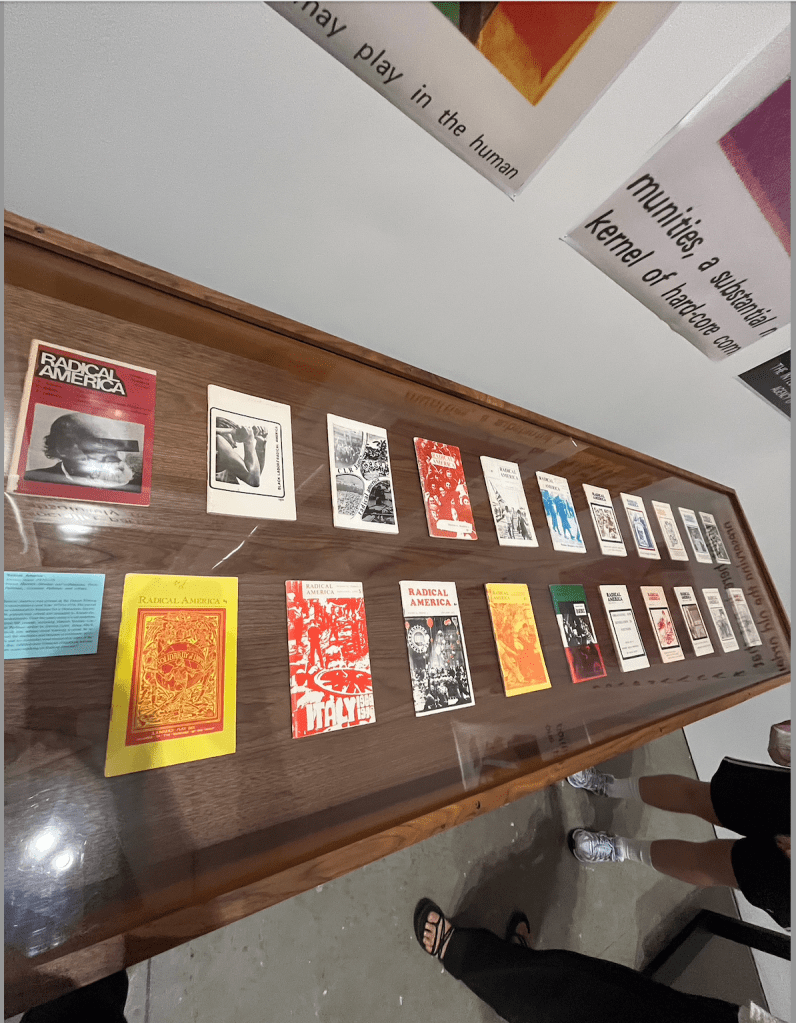
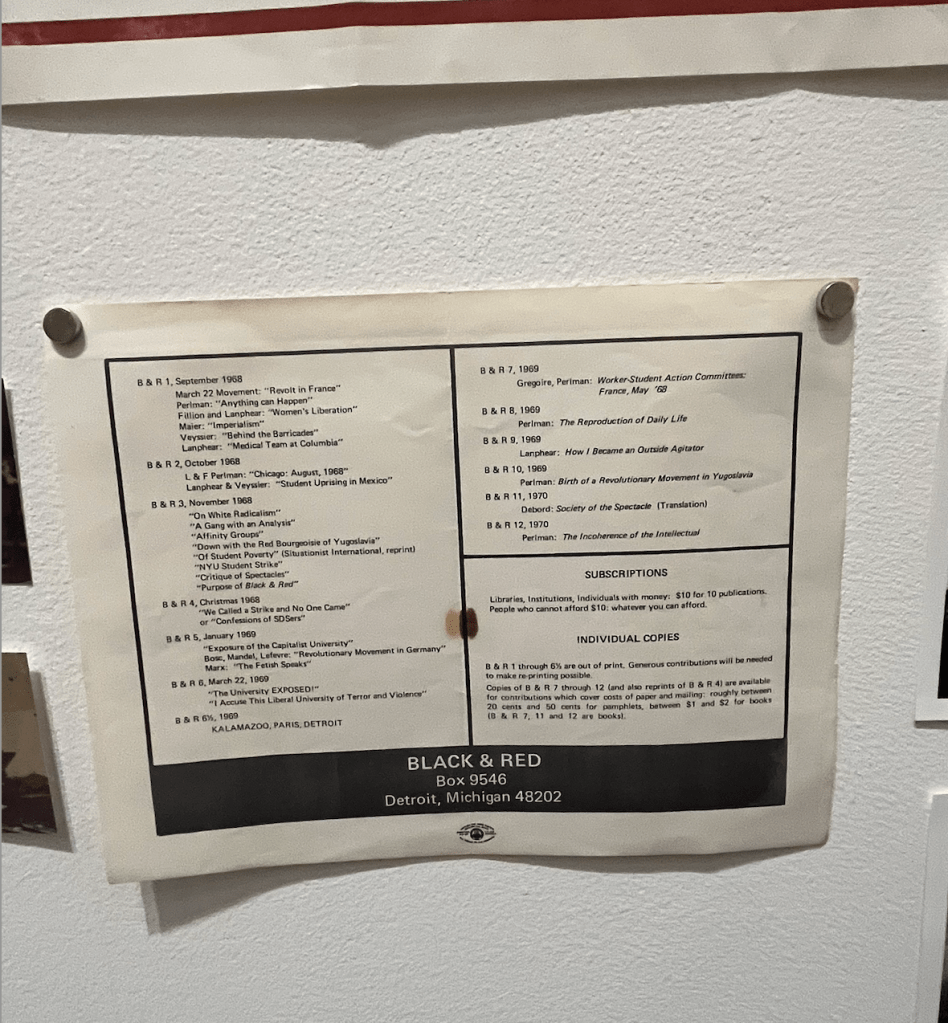
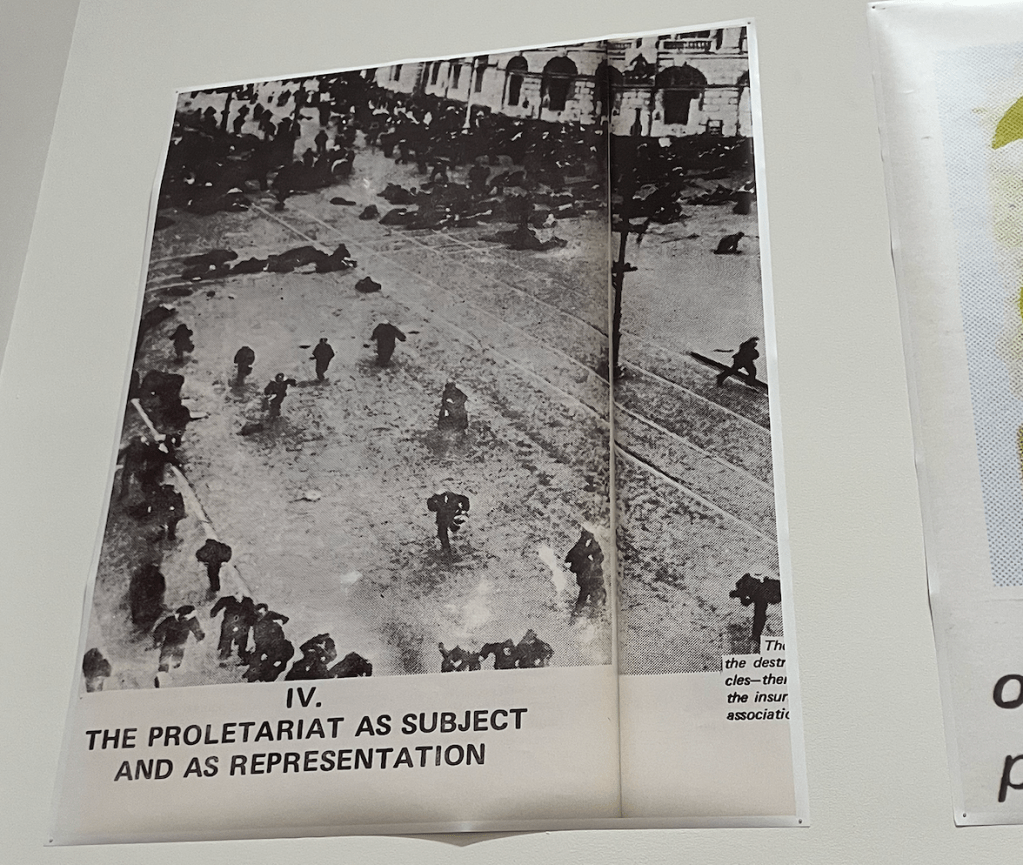
The Detroit Printing Co-Op grew from and was immersed in the radical struggles of the 60s and 70s and printed many important works, including the anarchist and situationist journal Black and Red, many issues of Radical America, and the first English translation of Debord’s Society of the Spectacle. I am mainly making this post for people who cannot get to the exhibit and might otherwise be interested so they can see what it was like. Photos below.

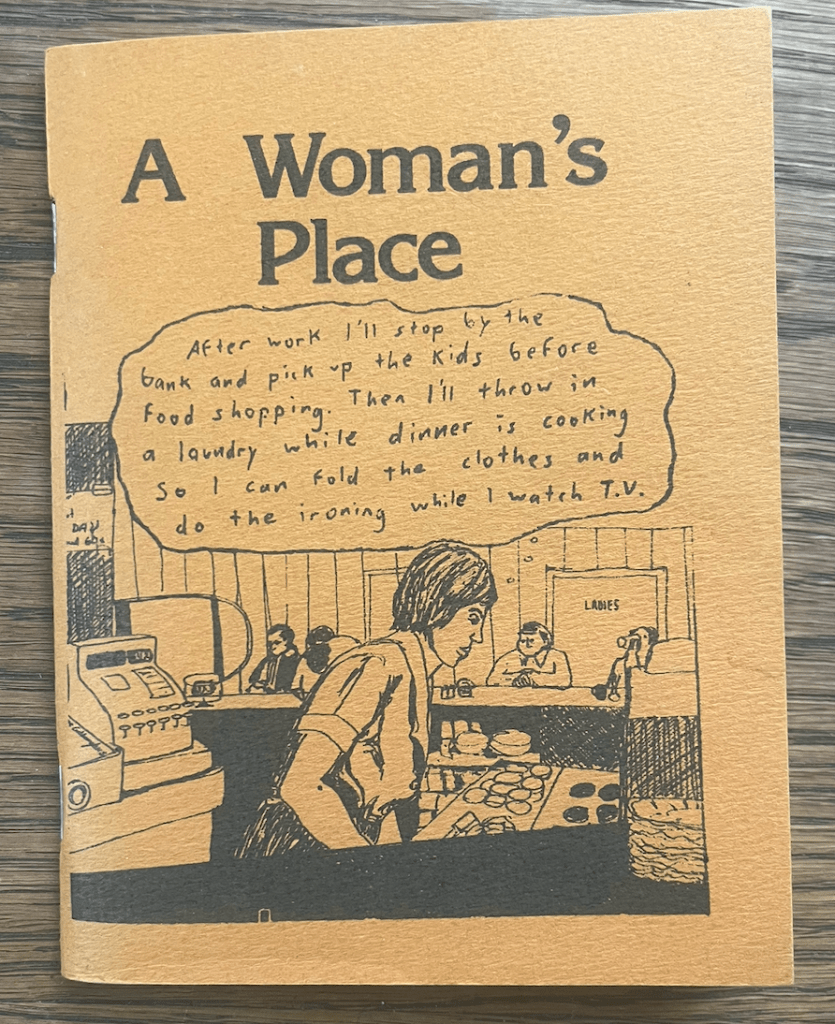
Selma James and Ellen Santori (Filomena Daddario). A Woman’s Place. February 1979 [1953]. Nameless Anarchist Group.

Selma James and Filomena Daddario’s 1953 pamphlet A Woman’s Place has a somewhat classic status in Marxist and feminist literature. The pamphlet was written by Selma James and Daddario’s name was also added for the publication. It was first published by Correspondence in 1953 and was republished in James and Dalla Costa’s pamphlet, published by Falling Wall Press, The Power of Women and the Subversion of the Community, which has been reissued by various left and feminist presses over the years. The pamphlet was reissued by Friends of Facing Reality Publications in 1970. To our knowledge, however, aside from the Correspondence and FFR editions, this is the only other standalone edition of A Woman’s Place.

A Woman’s Place is both a product of its time and also a pamphlet that has continued to be relevant year over year. Perhaps the most clear limitation of the piece is its heteronormative framing, where all women are framed as straight and all couples as heterosexual couples. That said, at the time of publication the piece was a groundbreaking analysis of the intersecting roles of marriage, the housewife, and the nuclear family in post-war capitalism. True to its roots in the Correspondence group, the essay flows from both James’ own experience and what she heard speaking with other women. There are themes of everyday resistance, self-organization, and autonomy throughout.

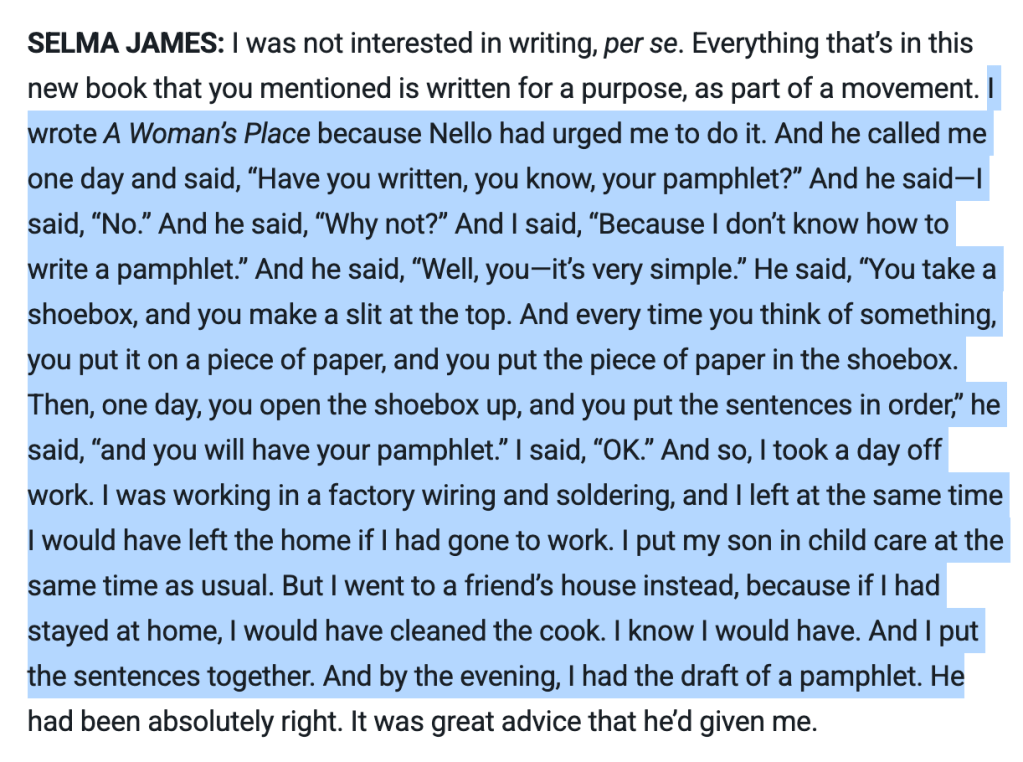
In a 2012 interview on Democracy Now!, James gave the basic history of how the pamphlet came to be:

Portion of James’ 2012 interview with Amy Goodman

Nello is, of course, CLR James.

In her recently-published monograph on Wages for Housework, historian Emily Callaci provides more context and detail about the origins of the essay. We quote at length here for those who do not have the book but are interested in this history (also we recommend buying the book).

“The Johnson-Forest Tendency divided members into three categories, or “layers” – the leaders were the first layer, the bourgeois intellectuals were the second layer, and the working class were the third layer. In a meeting they called the “Third Layer School,” they flipped the hierarchy by having the rank and file members of the group (the third layer) teach the “intellectuals.” As a housewife and a worker, Selma James was a member of this third layer, and in 1952, she traveled to New York to educate Grace Chin Lee, Raya Dunayevskaya, and other movement intellectuals about the everyday lives, desires, and revolutionary potential of working class housewives.

C.L.R. had never heard anything like it. Like many on the left, C.L.R. was not accustomed to thinking of housewives as political. The conventional party line of the Socialist Workers Party has been that housewives were politically backward and needed to join men in the workforce in order to become politically conscious. C.L.R. asked her to write a pamphlet about the “woman question.” As was his typical practice he instructed that nobody was to interfere or offer input: this young comrade was to write it on her own, in her own words.”

Callaci then quotes James giving the ‘shoebox story’ that she also gave in the Democracy Now! interview quoted above, but goes on to note that “Years later, she concluded that he likely invented the “shoebox method” on the spot, to encourage her to trust her instincts” (pp. 10-11). Callaci continues,

“She followed this advice. The day that Selma James opened the shoebox to put her thoughts together, she took a day off work, dropped her son off at school, and went to her friend’s house where she could write, undisturbed by all of the housework that needed doing in her own house. By the end of the day, she had drafted her first political pamphlet. […]

James wrote and edited “A Woman’s Place” in conversation with her neighbors. sharing her drafts and making changes based on what they said. She co-signed the pamphlet with her friend and comrade Filomena Daddario, James signing her name as Marie Brandt and Daddario signing as Ellen Santori. She sold copies to co-workers at the factory where she worked. It was the most popular pamphlet ever published by the Johnson-Forest Tendency, and the only one to ever sell out” (p. 12).

Little information is available about Filomena Daddario but Calacci notes that she was “a young Italian-American woman from Queens who loved jazz.” and also a participant in the Correspondence group.

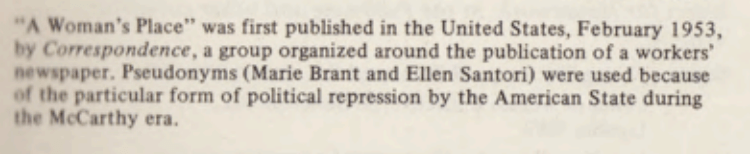
In the instant edition of the pamphlet, the publisher used Selma James’ legal name while keeping Daddario’s pseudonym as ‘Ellen Santori.’ The reason for the pseudonyms in the original is explained in the Falling Wall press pamphlet cited above. Specifically:

The publication of the pamphlet by Nameless Anarchist Group is a bit peculiar in that James is not typically associated with anarchists. In their edition of the pamphlet the publishers introduce it with an explanation that clarifies their purpose for printing it:

There is very little information available about Nameless Anarchist Group. They were based in Ypsilanti, Michigan and an affiliate member of the Anarchist Communist Federation of North America. Andy Cornell makes no reference to them in his critical work Unruly Equality: U.S. Anarchism in the 20th Century. The instant pamphlet is the sole publication identified with the group in OCLC and Archive.org only locates mentions of them from issues of the ACF’s paper North American Anarchist. In issues of NAA they are listed as, for a time, the group behind the federation’s internal bulletin. By rules of the ACF affiliation structure, there would have been at least 3 members. And they were a participant in the national Reagan for Shah effort in the early 1980s. One of their members’ name was Charlie. Aside from that, and their contact info (which could be a fruitful lead with access to more locally-based resources in Ypsilanti than we have), there is no other info online (note: if you were involved in this group or know more about them please reach out!)

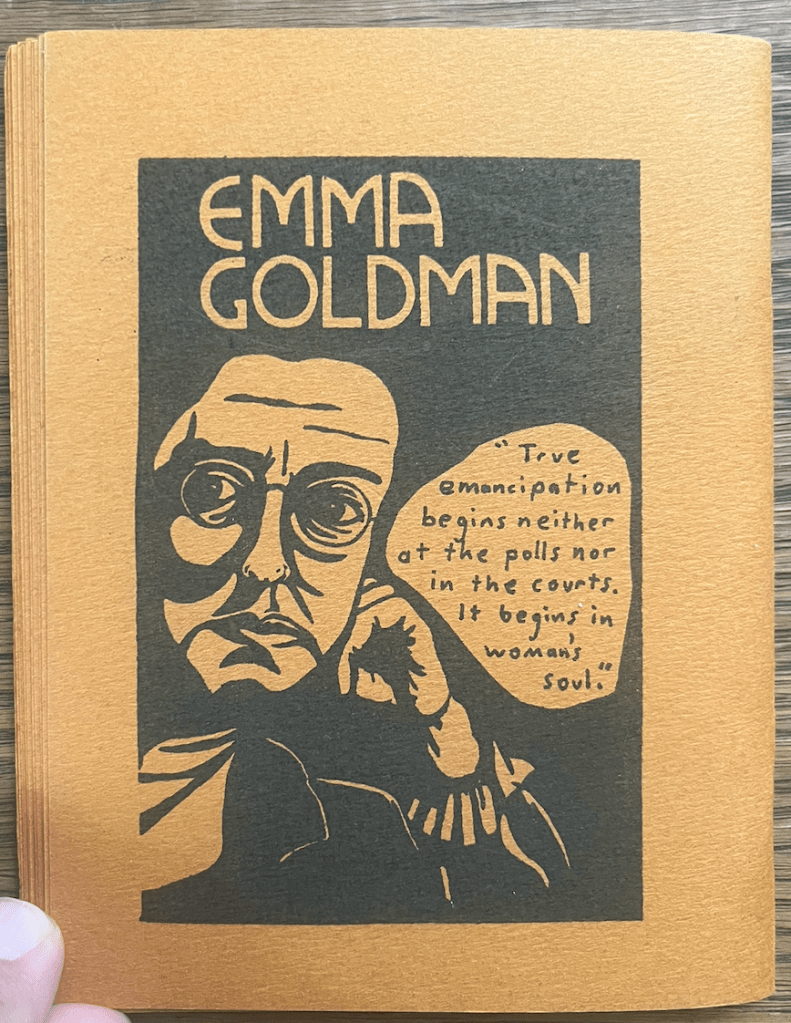
The pamphlet is really very stunning. It’s beautifully printed on a brown cardstock paper with illustrations throughout. The last pages include contact information and, on the back cover, a drawing of Emma Goldman (presumably lifted from elsewhere) and a quote from her 1911 piece “The Tragedy of Women’s Emancipation.”

The full quote from the Goldman essay is: “The right to vote, or equal civil rights, may be good demands, but true emancipation begins neither at the polls nor in courts. It begins in woman’s soul.”

This 1979 edition of A Woman’s Place is surprisingly rare, perhaps even more so than the 1953 or 1970 editions. OCLC locates two holdings (NYU and Labadie at Michigan).

Some recent journals of note – July 2025.

There’s been a bunch of solid publications coming out of late and I wanted to highlight a couple of them that may be of interest to readers of this blog and that I picked up over the past month or so.

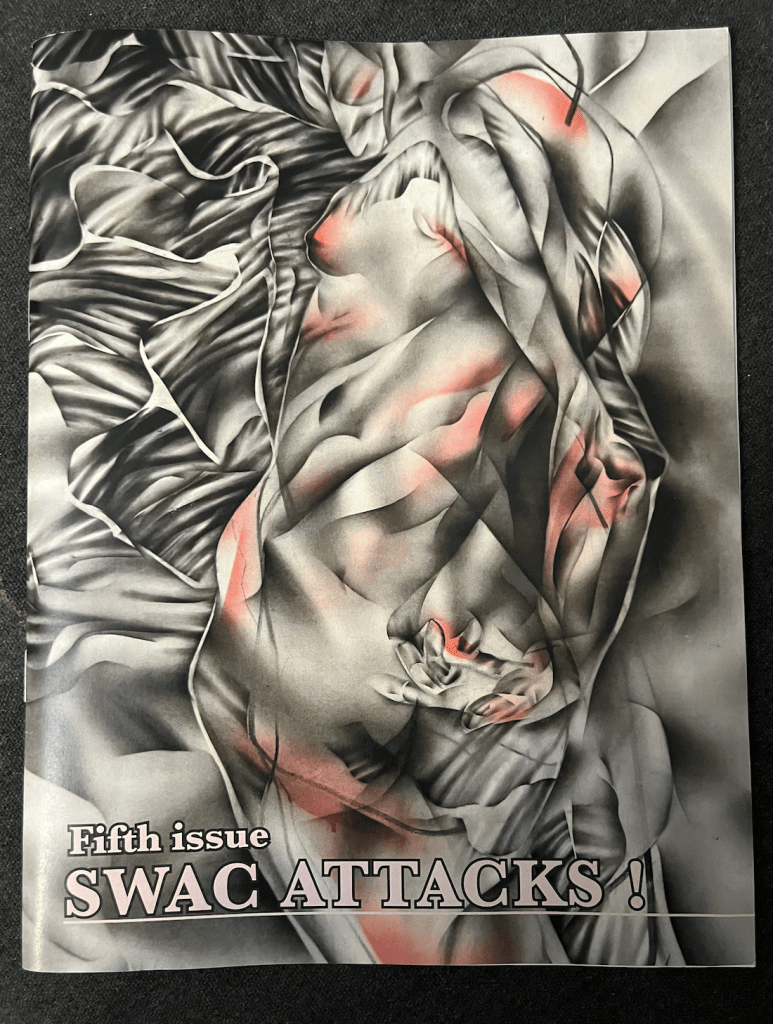
SWAC Attacks! – Fifth Issue.

During a trip to Montreal this past weekend I stopped at Bibliotheque DIRA, the incredible activist archive space upstairs from Libraire L’Insoumise, Montreal’s anarchist bookstore that I cannot recommend enough. While at DIRA, one of the extremely kind folks there handed me a copy of the SWAC journal.

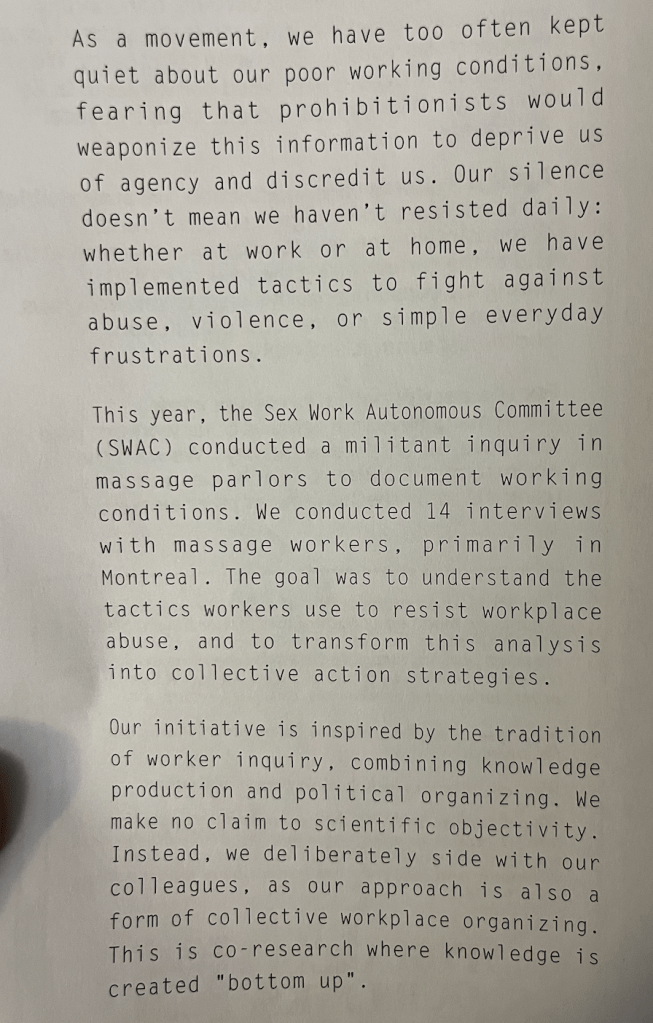
The Comite Autonome du Travail du Sexe / Sex Workers Autonomous Committee (SWAC) has published five issues of their annual journal and the fifth issue (and likely the others, I haven’t read them yet) has a ton of really important info on the experiences of sex workers in Montreal. Specifically, the issue includes a militant inquiry into massage parlors based on interviews with more than a dozen workers. There is also an inquiry into working conditions in Montreal’s strip clubs based on interviews with three workers.

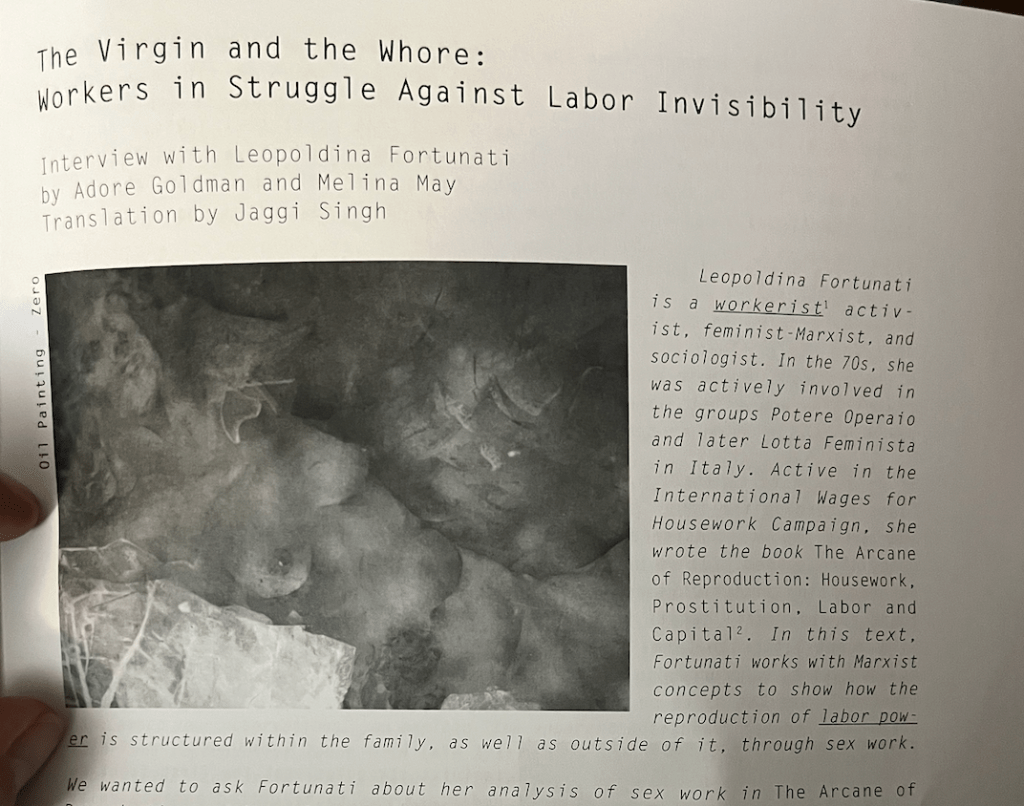
Also of significant interest to readers of this blog is the illuminating interview with Leopoldina Fortunati, author of The Arcane of Reproduction among other works.

Folks interested in reading the journal can find a PDF of it online at SWAC’s website – here.

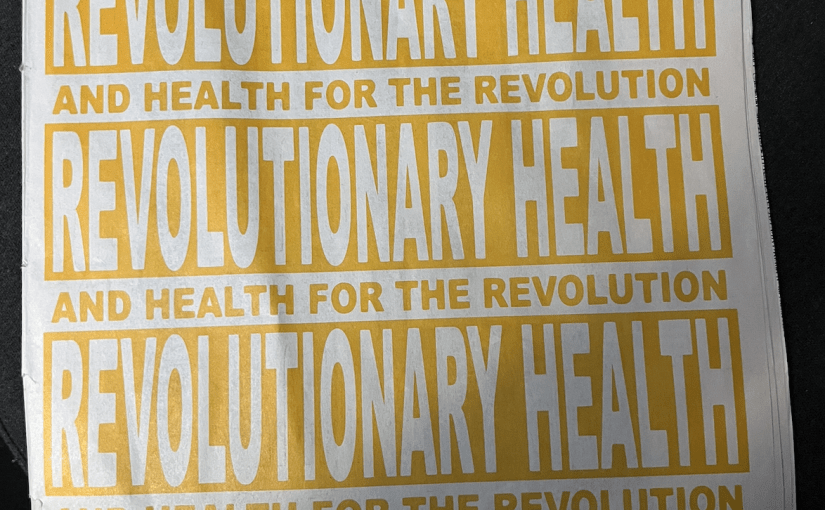
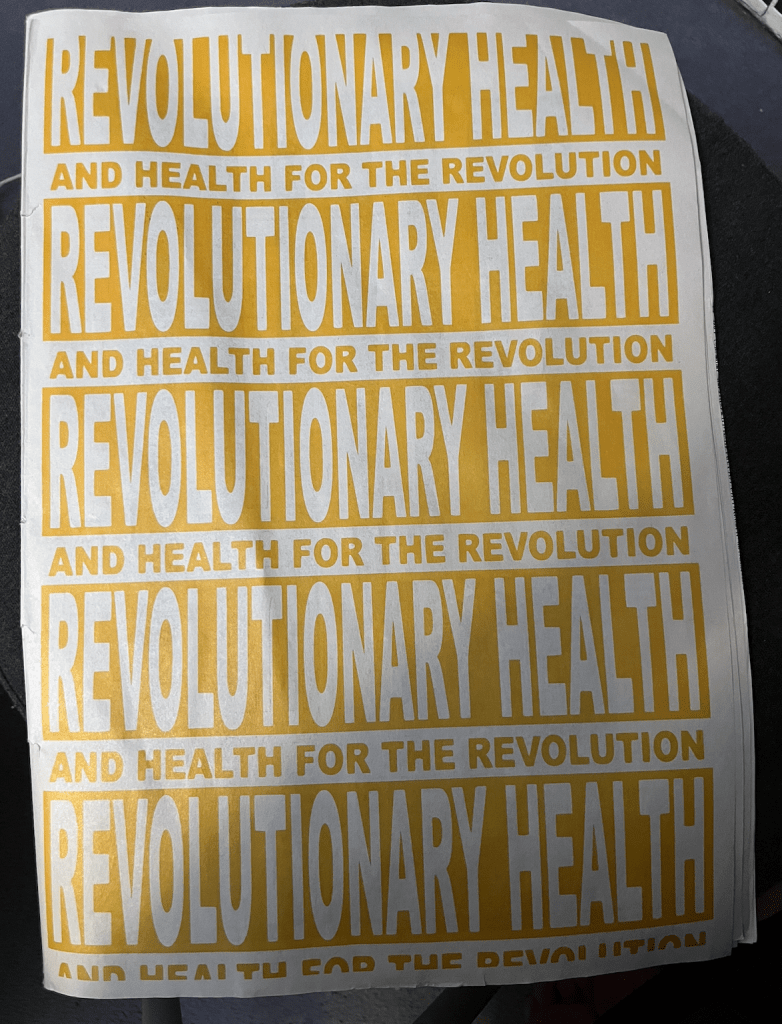
Revolutionary Health and Health for the Revolution – Fourth Issue

Revolutionary Health and Health for the Revolution (RHHR) is a large-form newspaper. The background of it, from their first issue: “Influenced by the Midnight Notes collective, by the struggle against work, payment, money, colonization, sexuality as a work from the feminist perspective, and the ongoing Zapatista struggle against the neoliberal world, we decided to bring into attention these important perspectives that are forgotten or neglected in our political realities.”

I first encountered RHHR when I picked up a copy of their third issue at last year’s anarchist bookfair here in NYC. I found a copy of this issue at P.I.T. in Brooklyn.

The journal includes a number of pieces by George Caffentzis, Silvia Federici and others (including Federici’s piece ‘Capitalist Development and the War on Reproduction, Palestine, and Beyond’ (originally published in The Commoner). Caffentzis’s timely (and unfinished) piece “Trump and Money: From Status to Contract and From Contract to Deal,” even in unfinished form is provocative and worth reading. There are multiple other pieces, most reprinted, in the journal from other writers as well. For folks interested in reading this issue or the other issues of RHHR, PDF’s are available on their website here.

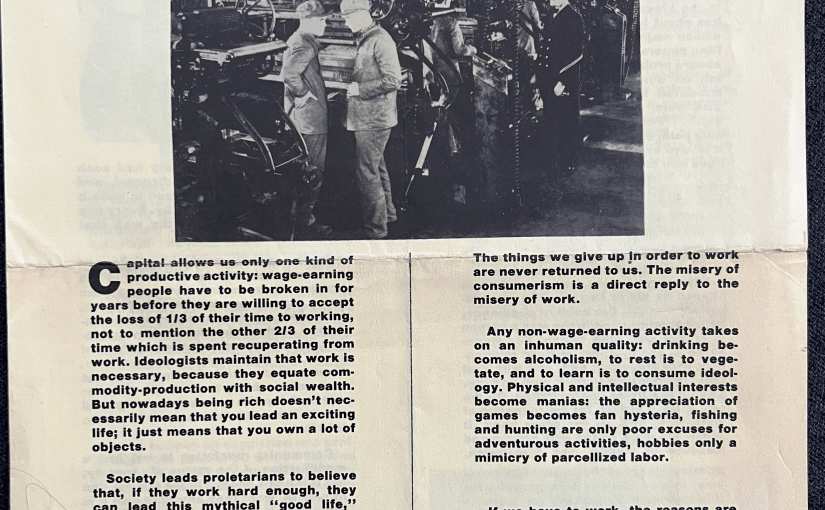
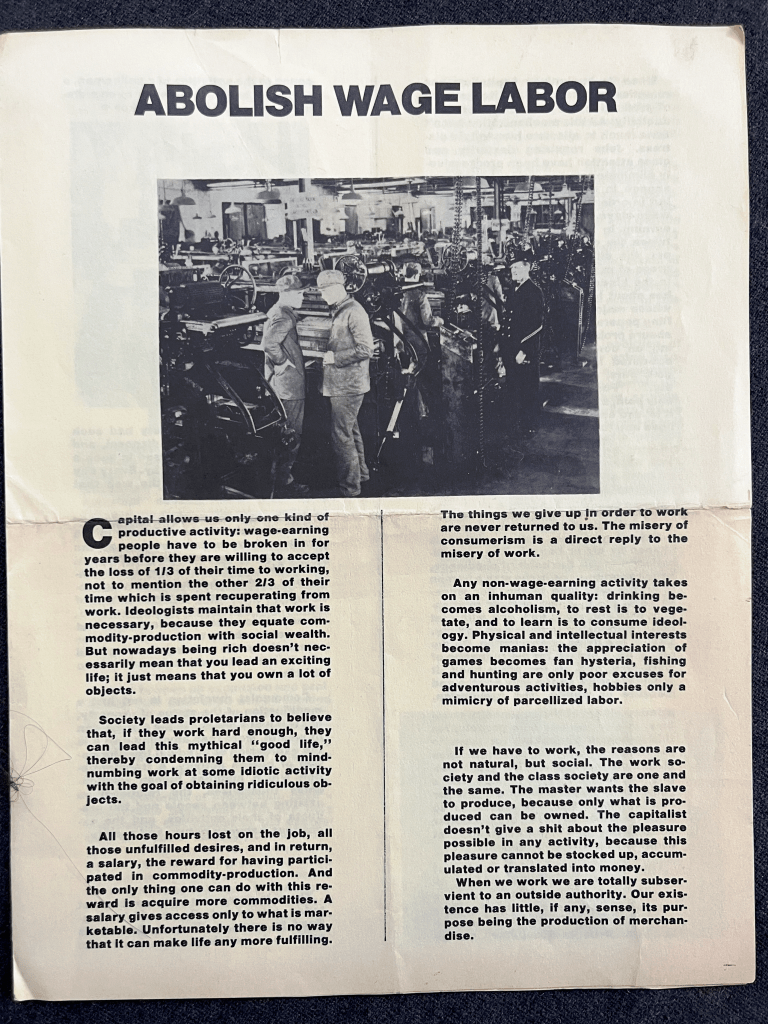
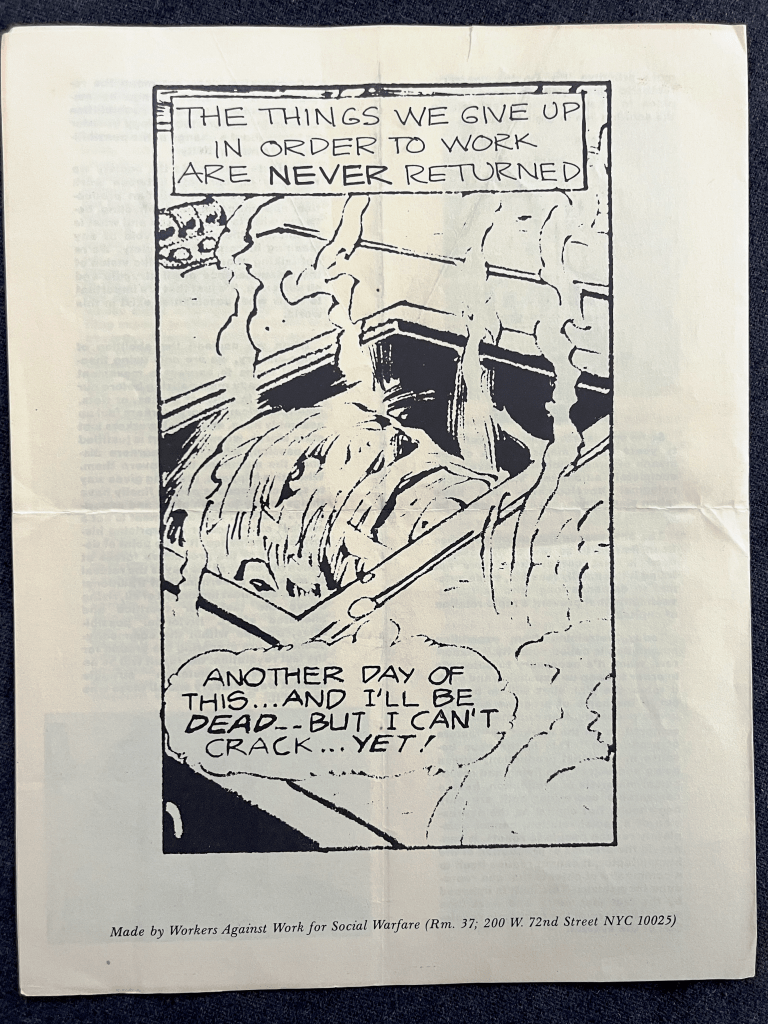
Workers Against Work for Social Warfare. ‘Abolish Wage Labor’ (New York, 1980).

Short 4-page pamphlet against work issued by “Workers Against Work for Social Warfare.” Apparently a one-off of this group (or individual) who do not seem to have published otherwise under the moniker. OCLC states that it was published in 1980 which seems reasonable given this paragraph:

“When we demand the abolition of wage-slavery, we are only using theoretical terms to express a movement that is already materializing before our very eyes, in wild-cat strikes, or riots, when American factory workers foul up assembly lines, and Polish workers loot state stores, when the effort is justified by passion, when wage earners disobey the mummies that govern them.”

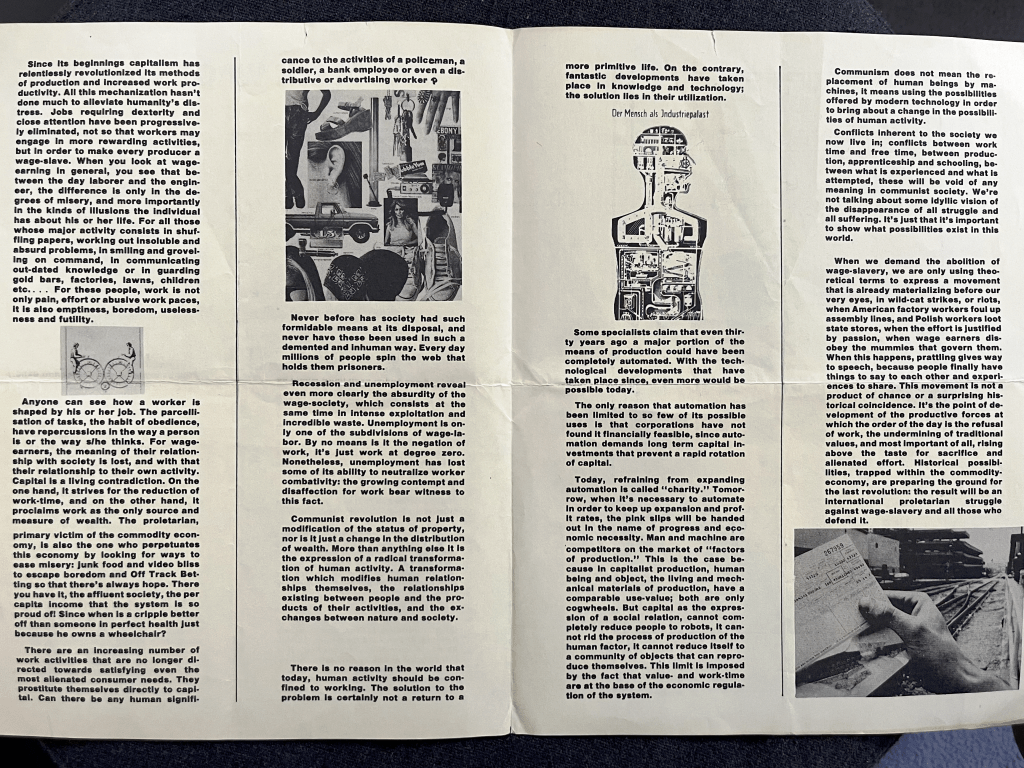
For an anti-work pamphlet it is perhaps more reliant on orthodox Marxism than is often found in these kinds of writings (e.g. “This movement is not a product of chance or a surprising historical coincidence. It’s the point of development of the productive forces at which the order of the day is the refusal of work […] Historical possibilities, trapped within the commodity-economy, are preparing the ground for the last revolution: the result will be an international proletarian struggle against wage-slavery and all those who defend it.”)

The pamphlet is a mishmash of the situ-inspired anarchism that increasingly circulated in the 1970s and early 1980s, along with the more orthodox Marxism noted above. There is a somewhat anomalous embrace of technology as liberatory that was less common in some of this anarchism (e.g. “There is no reason in the world that today, human activity should be confined to working. The solution to the problem is certainly not a return to a more primitive life. On the contrary, fantastic developments have taken place in knowledge and technology; the solution lies in their utilization”). It’s a bit theoretically confused, perhaps, but the anger is real, and it comes through.

We located almost nothing about the authors, so if you know background info please write! The address in the pamphlet for correspondence is Room 37 at 200 w. 72nd Street. That building was razed earlier this century, but in the 1970s it was home to offices of Amnesty International and some solidarity groups, though not that specific room.

OCLC locates a couple of holdings. We couldn’t find a full scan online so uploaded it to Libcom, here.

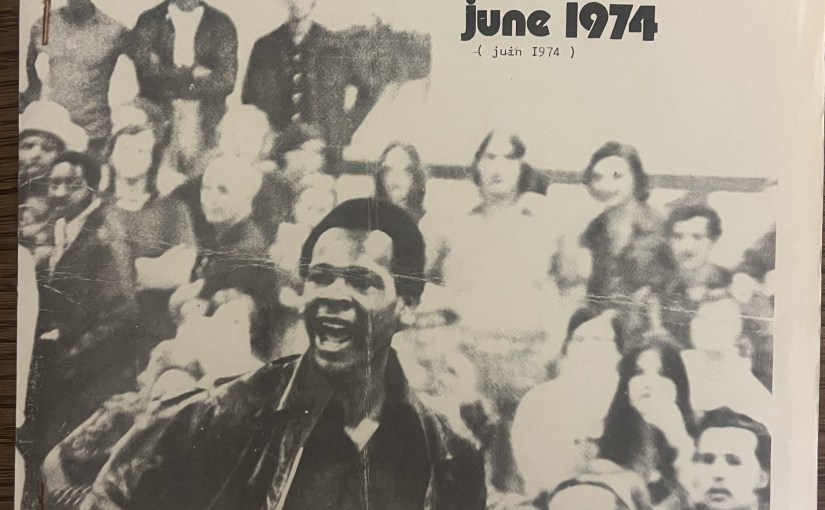
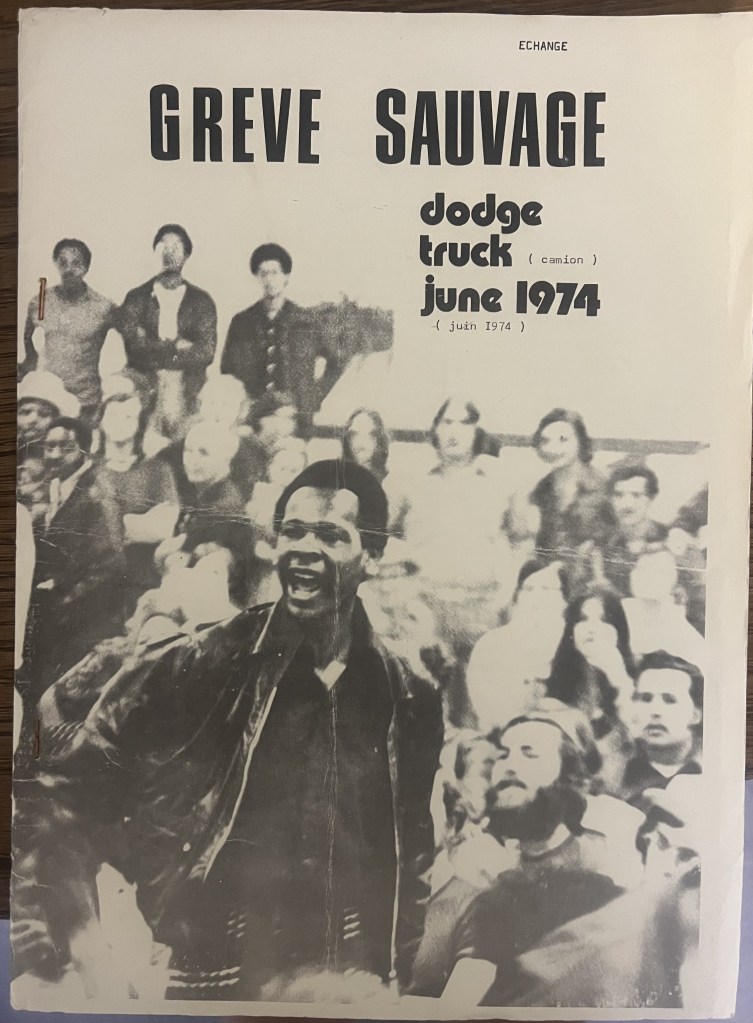
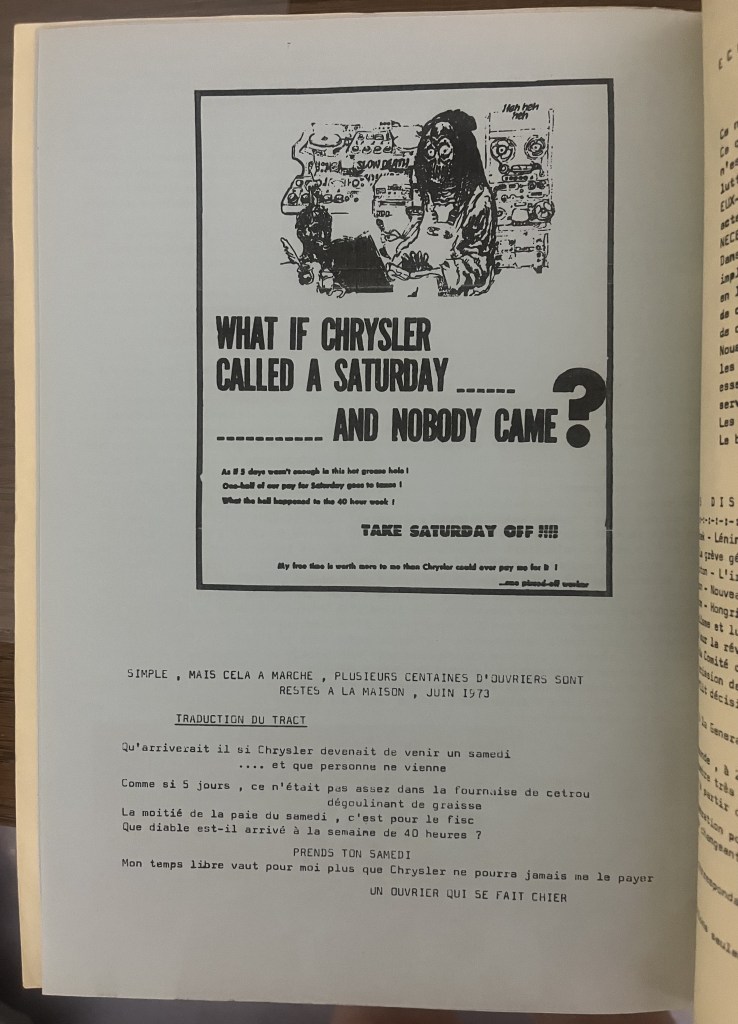
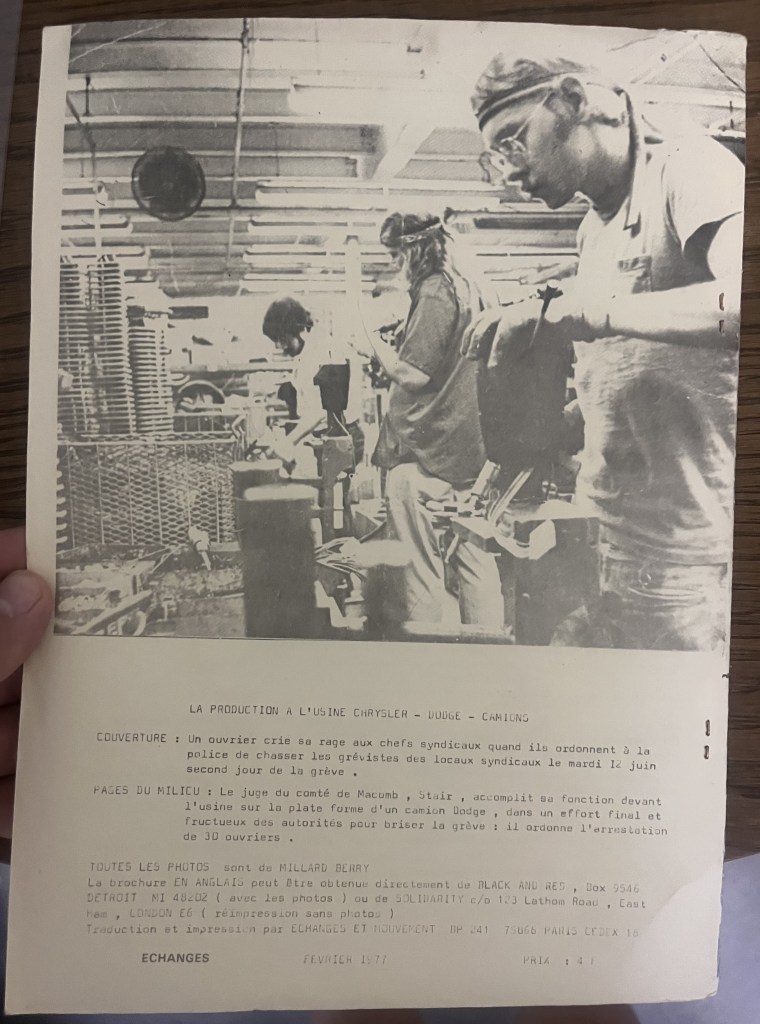
Berry et. al. GREVE SAUVAGE: dodge truck (camion) june 1974 (juin 1974). Echanges et Mouvement, 1977.

Cover of the Echanges et Mouvement edition.

This is the French translation of Wildcat: Dodge Truck June 1974 written by Millard Berry, Ralph Franklin, Alan Franklin, Cathy Kauflin, Marilyn Werbe, Richard Wieske, and Peter Werbe. The booklet, according to the 30-year retrospective piece, was “written and produced by several of the people who became the core of the Fifth Estate collective the next year when it was transformed into an overtly council communist, and then, anarchist publication.” The initial pamphlet was printed via the Detroit Print Co-Op distributed by Black and Red (Lorraine and Fredy Perlman’s publishing project). The photos throughout – which are universally stunning – were taken by Millard Berry.

Cover of the English edition distributed by Black and Red

In the late 1990s when I first got involved in anarchist politics, the English version of pamphlet was common to find in any given infoshop, but nowadays this seems less common (in no small part because there are fewer explicitly anarchist infoshops than there were decades ago).

Wildcat is a reflection on a worker wildcat strike in June 1974 (hence the title), but is also a very concise strategic analysis of working class power from an autonomous and, at points, situationist-influenced lens. The wildcat took place in context of increasing militant actions at auto plants in Detroit, and in context of widespread militancy in the the first half of the 1970s.

There are many useful observations in the essay, but in re-reading it I was struck by the very insightful observations about the role of groups associated with the New Communist Movement (NCM) particularly the Revolutionary Union. In an increasingly well-known story, hundreds and probably thousands of Leninist and Maoist militants moved into traditional working class positions during the 1970s in order to move the class toward more militant confrontations. This pamphlet offers a reflection in which the Leninist model of organizing conflicted with the revolt against work by workers themselves in an auto plant in the midwest US during the early 1970s. The essay reflects on the strategy of wildcat walkouts versus taking over and holding the shop floor during strikes: “In addition, by holding the production process hostage, the natural organization and informal communication networks are still intact. One of the most significant advantages to resistance inside the factory is that it leaves the workers on the inside and the company, union, or any others seeking to destroy or dominate the struggle for their own ends, on the outside, where they all belong.”

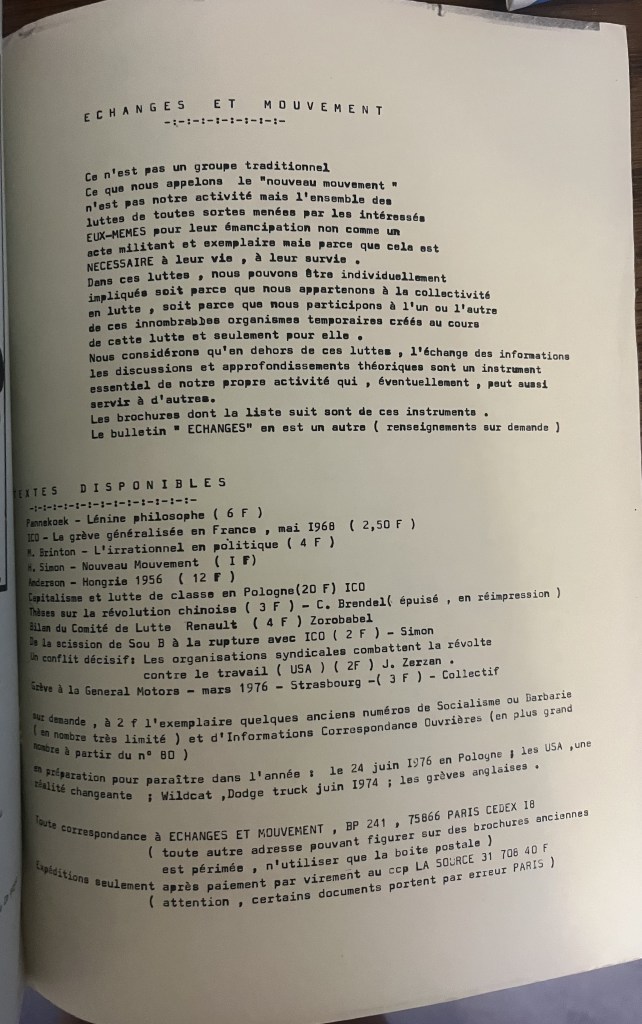
The French edition of the pamphlet was published a couple of years after the English edition by Echanges et Mouvement. Readers of this blog are probably familiar with Echanges – it was started in 1975 by militants associated with Solidarity (UK), Informations et Correspondance Ouvrieres (FR), Daad en Gedachte (NL), and the Belgium group who published Liasions. Henri Simon, who recently passed away, carried on its work for decades. The French edition mirrors the English edition almost page for page but (obviously) with French text instead of English text.

Activists in France have scanned a PDF of the French edition, here. The booklet is rare – I’ve seen only one copy for sale in recent years. OCLC locates one copy of the Echanges edition and four copies of the Echanges edition as distributed by Spartacus.

George Caffentzis. At the Edge of Everything: Collected Poems. 2025.

George Caffentzis turned 80 years old today. P.I.T. in Brooklyn hosted a gathering to celebrate his and Monty Neill’s birthdays, and to release George’s first book of poetry, At the End of Everything, published by Common Notions press. The book is small at just about eighty pages and collects poems George has written throughout the course of his life, from his adolescence through 2024 (the book notes that his first poem, “Futile Phantasy,” was published in his high school literary journal in 1961).

I can’t recall the first time I met or spoke with George. Like many others, I first encountered the work of Midnight Notes Collective – which George co-founded, along with Monty Neill and John Willshire-Carrera – as a participant in the counter-globalization movement of the late 1990s. Either from their collection Midnight Oil or from Harry Cleaver’s foundational book Reading Capital Politically, I sought out the essays in the first issue of Zerowork (which, at that time, were not available online if memory serves). In that first issue George had published an essay entitled “Throwing Away the Ladder: The Universities in Crisis.” I think I was trying to grasp the workerist conceptualization of the crisis of Keynesianism and failing to square a piece of data in that essay with a related datapoint in one of the essays in the Trilateral Commission’s The Crisis of Democracy book. I sent George a note to see if he could help me understand it (in retrospect this was really quite presumptuous!) George, ever generous with his intellect and time, kindly looked through the essay that he had written decades earlier and walked me through his take. Many times after that, George would offer his perspective and encouragement, as he has to countless other younger activists. I know I am not alone in holding his brilliant essay “The Work/Energy Crisis and the Apocalypse” – which is, regrettably, still timely – to be one of the most stunning and insightful analyses of the “energy crisis,” the refusal of work, and the political economy of capitalist “apocalypse.” Over the past couple of decades, whenever I have sought to try and understand developments in capitalism or contemporary social struggles I have looked for George’s writings, and I have learned tremendously from his razor sharp readings of Marx and analyses of class composition.

Silvia Federici reads her poem “The Cubed Steak.” To her right is Malav Kanuga, to her left is George and to his left is Monty Neill.

The celebration of the publication of George’s book of poetry and his birthday was a beautiful, warm, and deeply caring event. Though I knew some of the people there, there were many more I didn’t now, and the space was packed, which was quite wonderful and certainly fitting. Silvia Federici (the leading feminist and Marxist theorist, and George’s partner of many decades) carried the event from beginning to end, reading many of the poems in the book and explaining their context, and she was joined by readings from Monty Neill, Malav Kanuga (who gave a beautiful statement before reading a poem), and by George himself. George has struggled with illness in recent years, and it was an honor to listen to him and also to hear Silvia read and discuss so many of his poems. Their love and care for one another is truly something to behold (and is the subject of some of the poems in the book).

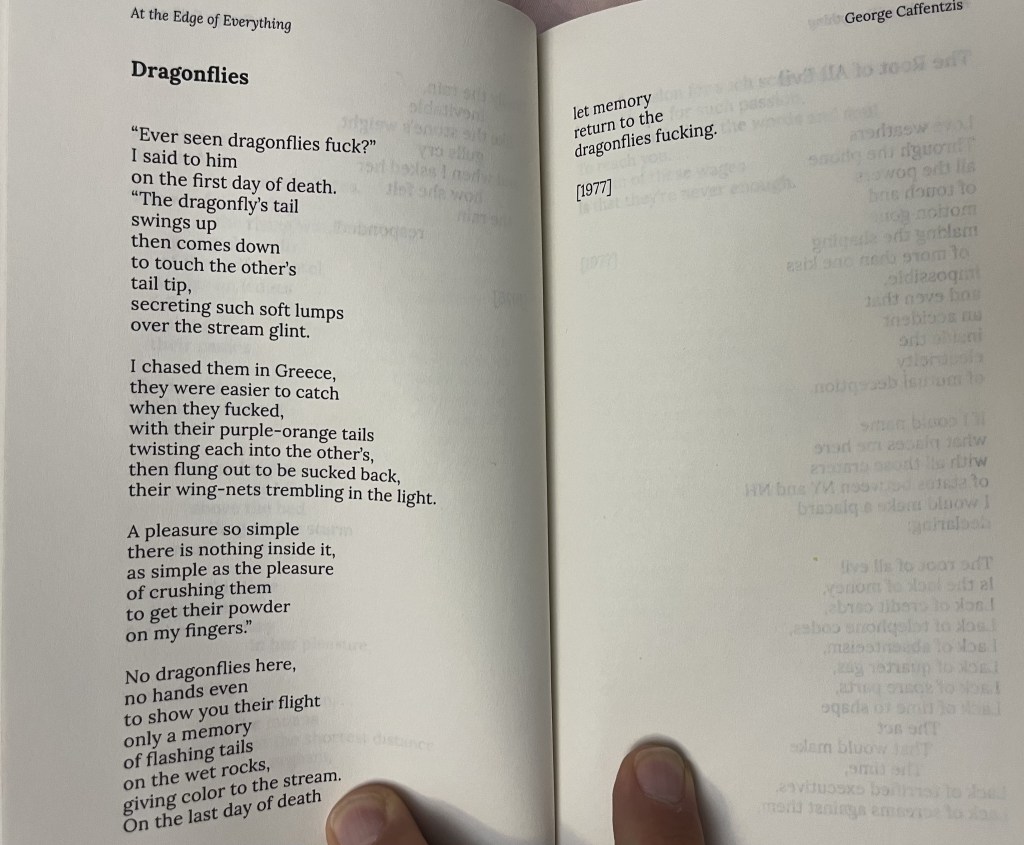
Silvia began the readings with her poem “To the Cube Steak,” named after a long-closed diner in Park Slope run by George’s father and uncles. George then gave some introductory remarks and went on to read three of his poems: “A spider in my show” (1969), “Experience of Paradise” (2024), and “Dragonflies” (1977).

Below is video of his remarks and George’s reading:

George’s opening remarks followed by reading three of his poems
“Dragonflies” by George Caffentzis, 1977.

Monty (Neill) read George’s poem “Pilgrimage to a Transvestite Saint” (I couldn’t capture it) and Malav (Kanuga) also read a poem that I, unfortunately, couldn’t capture. Silvia read George’s poem “Poem for Sol Yurick,” referring to friend and comrade (as well as famed novelist and former NYC social services worker) Sol Yurick. Here is Silvia reading that poem:

Here is Silvia reading George’s 2014 poem entitled “Poem for Joe Grange.” Grange was a philosophy professor at University of Southern Maine (where George taught for many years) and close friend of George’s:

Silvia reads George’s poem “Poem for Joe Grange” (2014)

The last video for this post is Silvia’s reading of George’s poems “Buenaventura” (2016) and “Guatemala City at Easter-time” (2018) with introductory remarks:

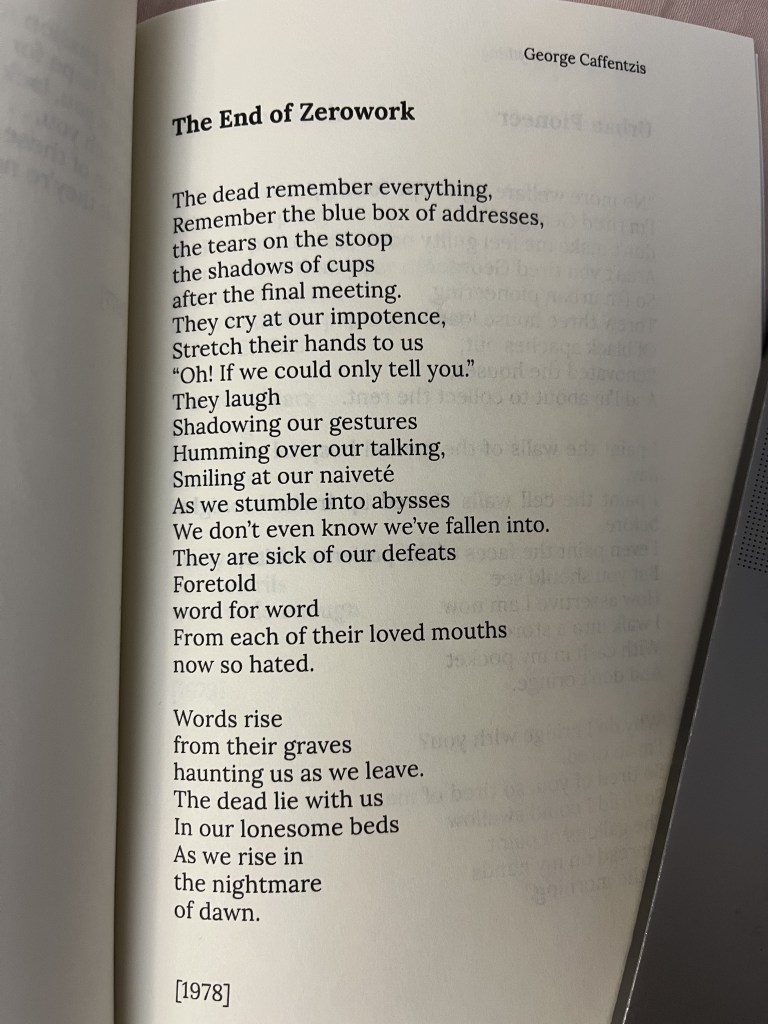
Readers of this blog may appreciate George’s poem “The End of Zerowork,” which is a personal and poetic take take on what by all accounts was a very emotionally exhausting and difficult political break.

There are many other poems in this little book and if you’re interested in grabbing a copy you can order one from the publisher here. I’ve gone through it once tonight and have dog-eared more than a dozen poems I plan to go back to this week.

Given the current political nightmare we all find ourselves in, joining comrades to spend a couple of hours celebrating George’s 80th birthday and listen to his poems read out loud was quite a gift.

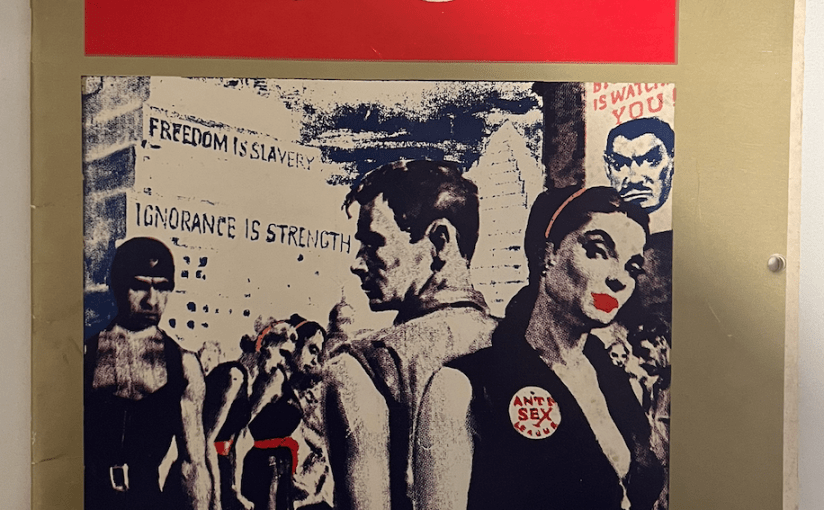
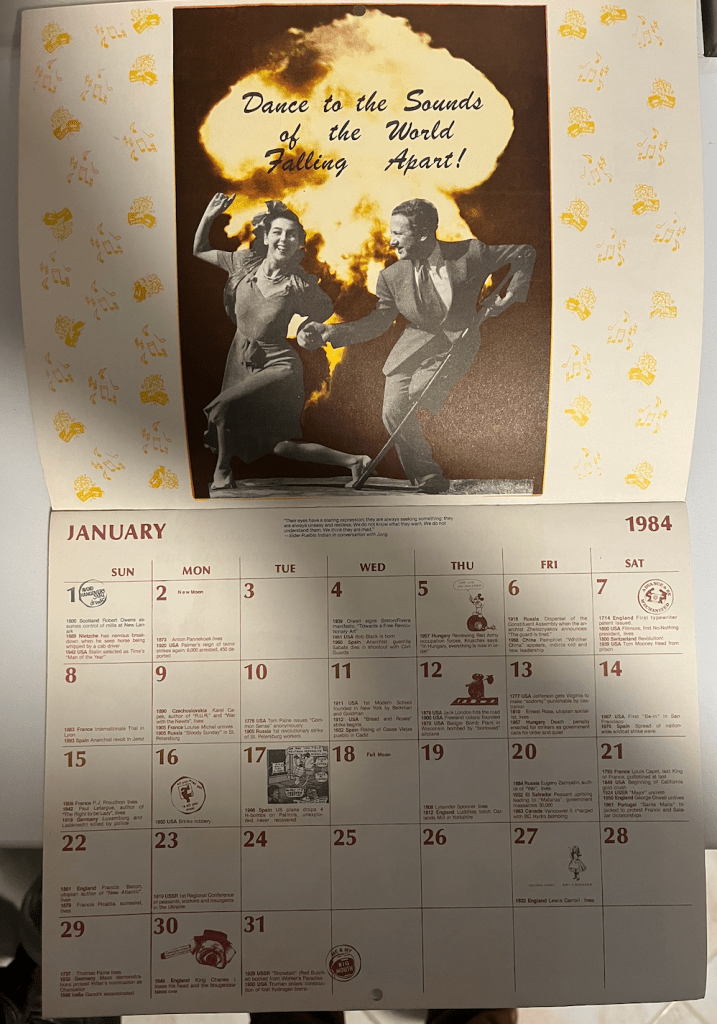
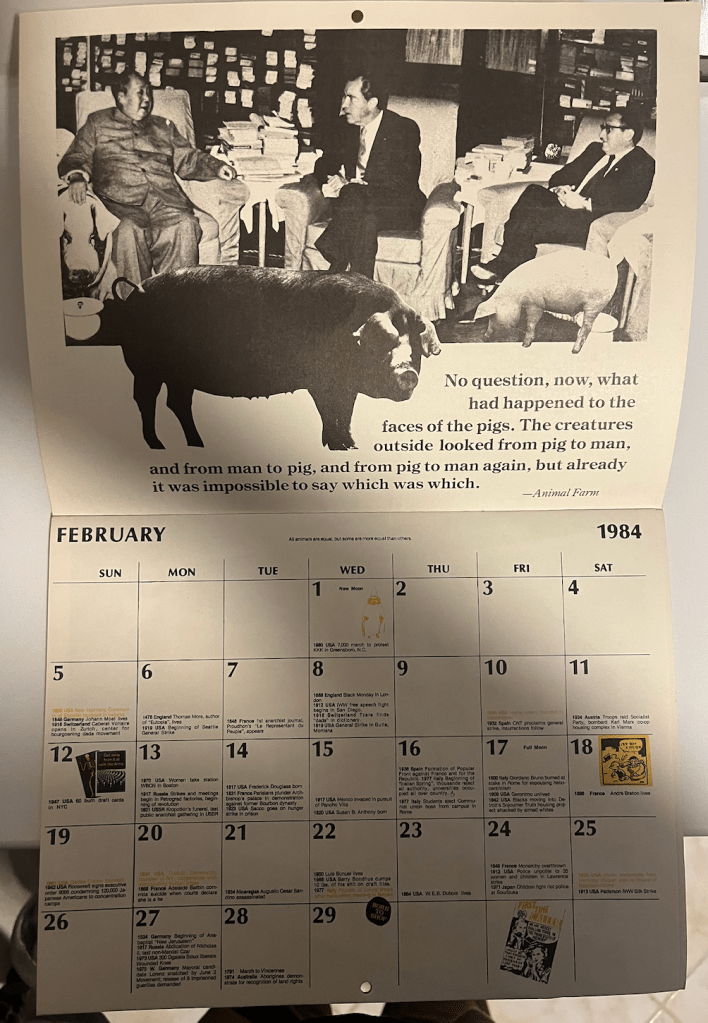
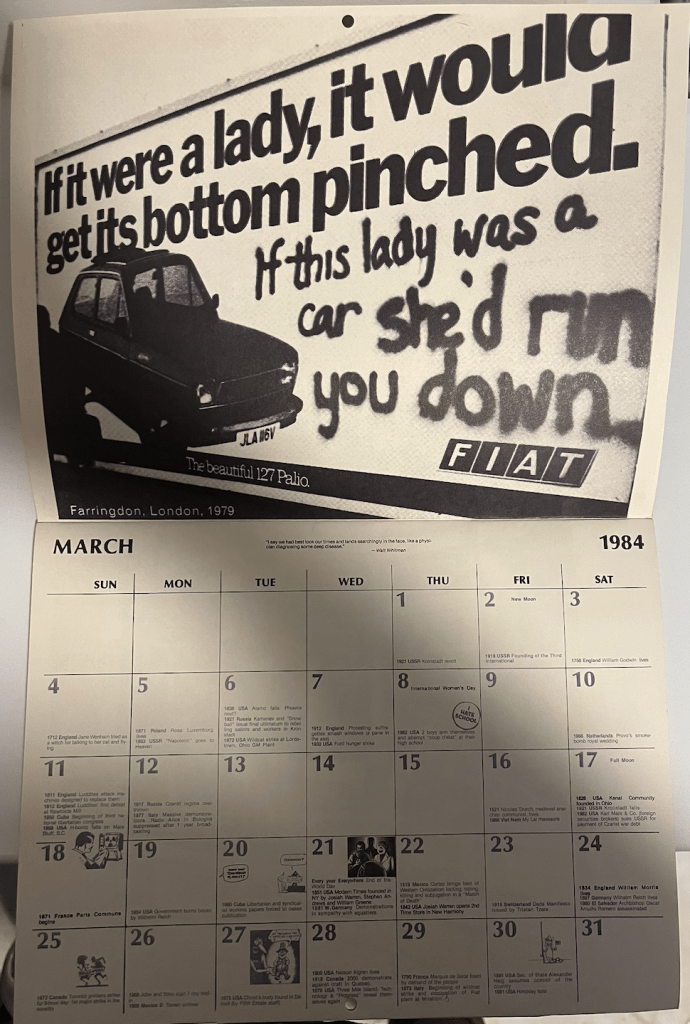
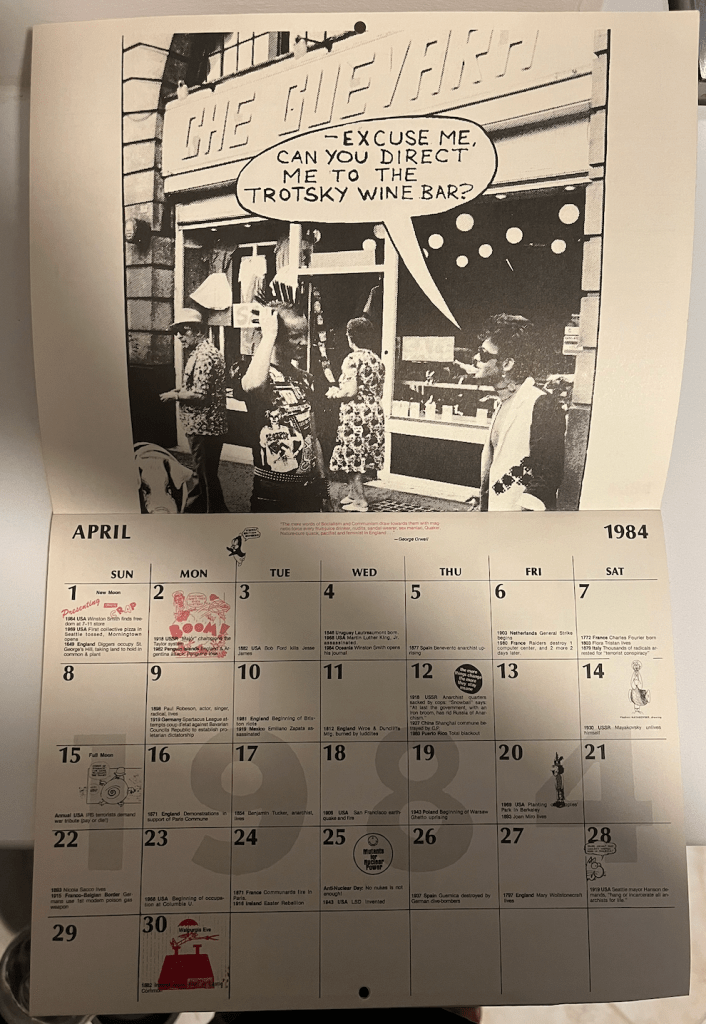
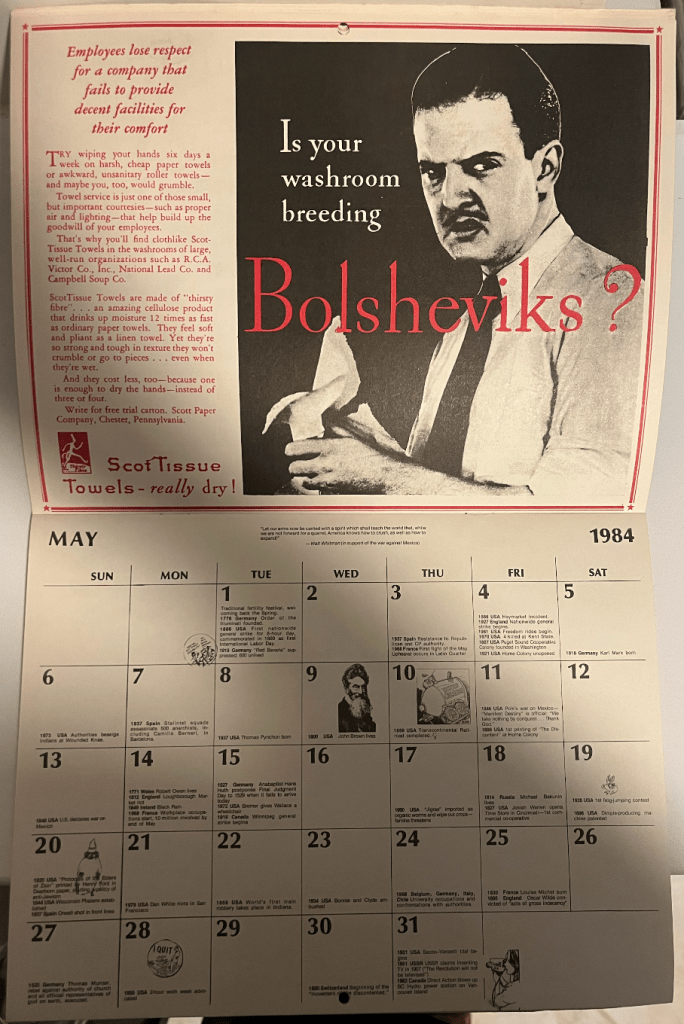
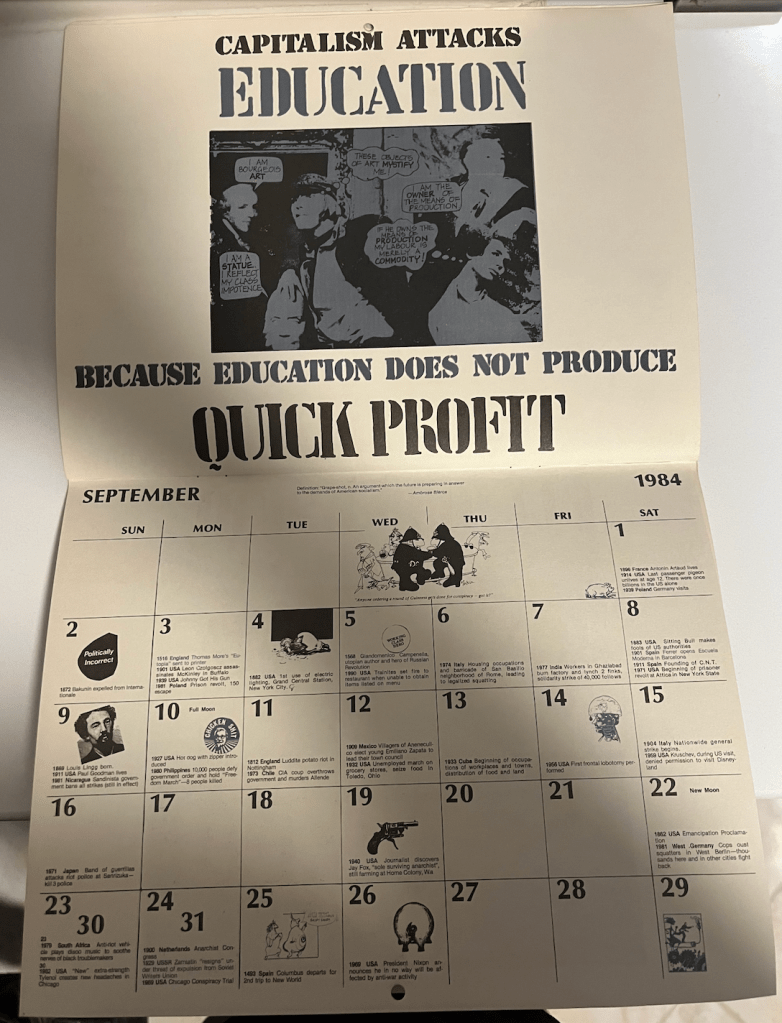
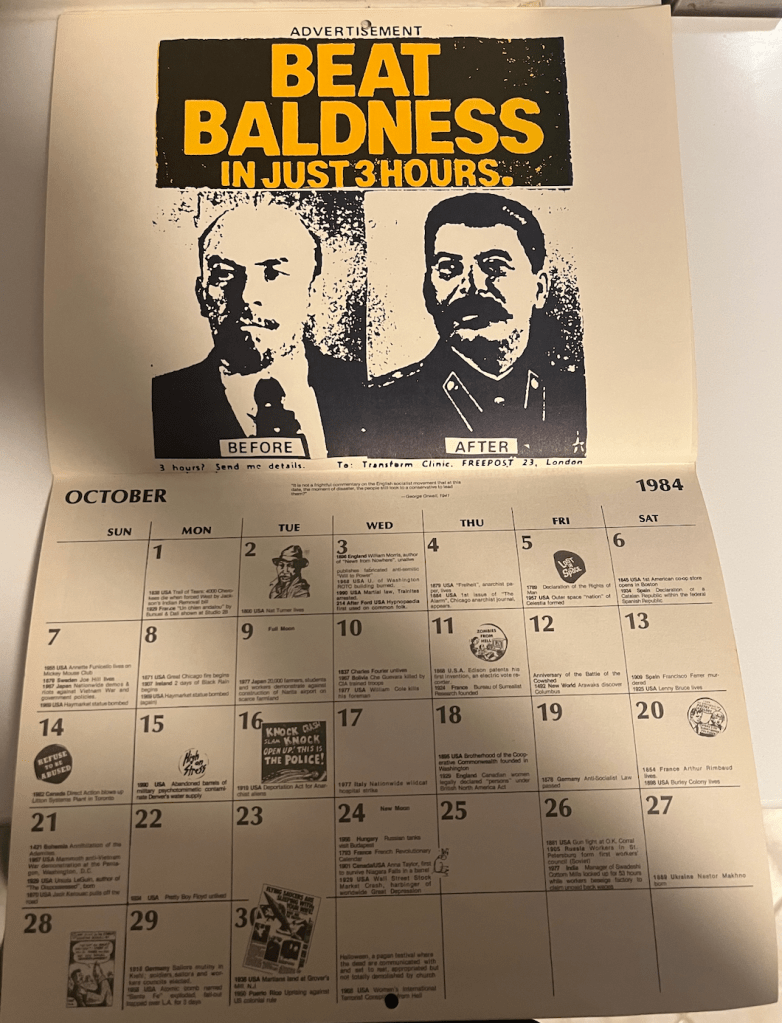
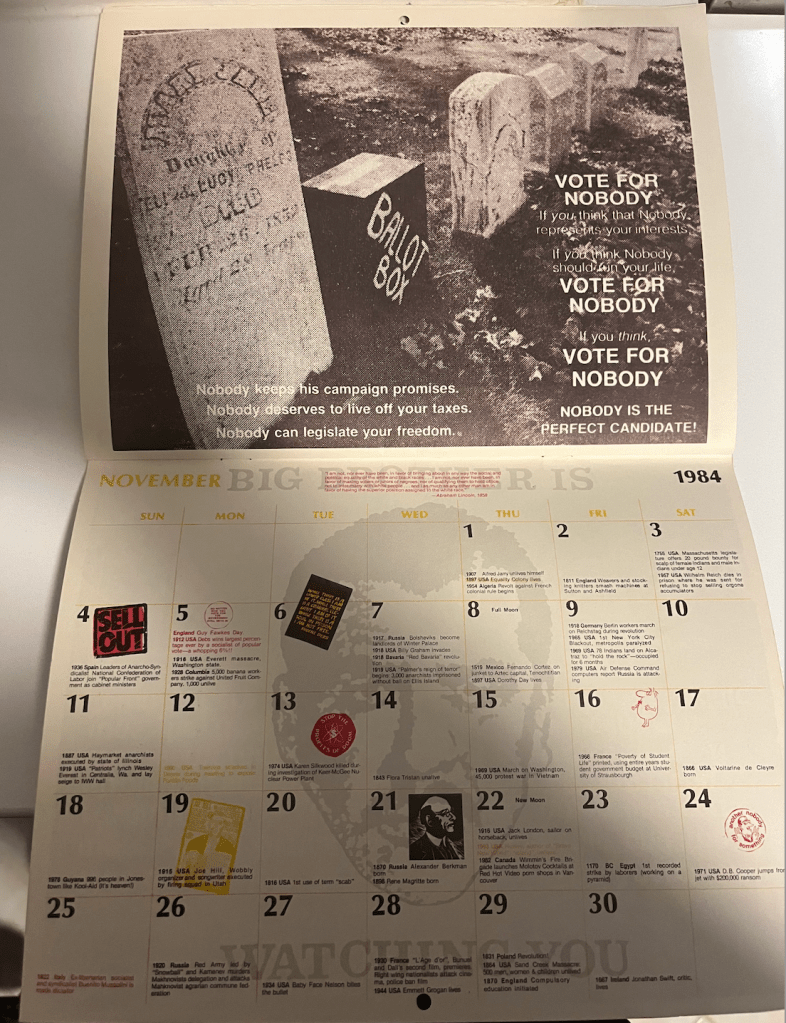
1984. The Left Bank Books Anti-Authoritarian Calendar.

The 1984 calendar published by Left Bank Books in Seattle (still there!) is, to our knowledge, the only calendar the collective produced. The reference is, of course, to Orwell’s classic text. This calendar is very much a product of the aesthetics of American anarchism of the period where situationist-inspired, typically detourned images make-up each page preceding the day-by-day breakdown of January through December. These kinds of images were often found in the pages of Fifth Estate in the late 1970s and early 1980s, in the work of Anti-Authoritarians Anonymous (John Zerzan and Dan Todd’s prolific grouping) etc. Later, this kind of artwork would become massively popular through work of Gran Fury, Adbusters, and eventually the billions of memes that populate social media.

None of the images are credited but some of familiar to us and perhaps easily identified by readers of this blog.

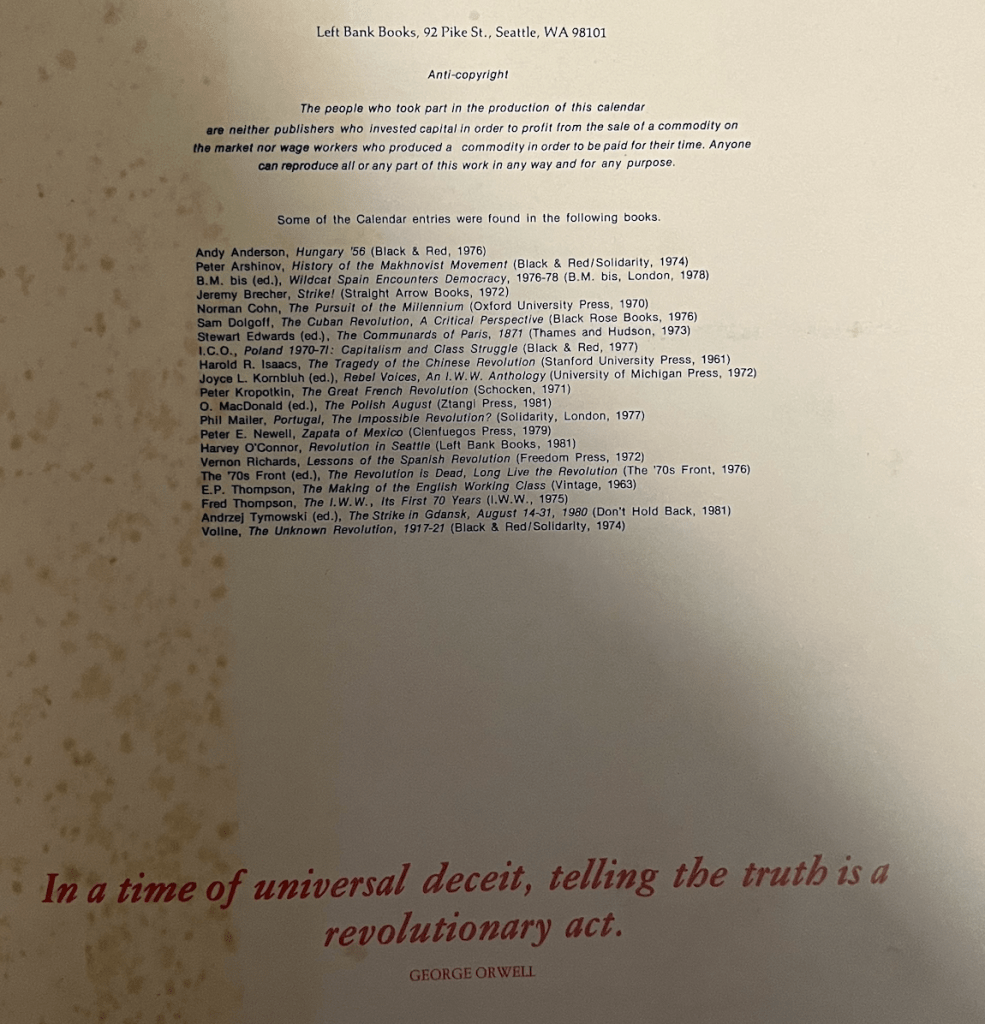
There is a long history of anarchist and radical calendars and it’s not clear whether the authors of this calendar used earlier radical calendars to fill the dates up. The back cover mentions a handful of sources:

Some of the choices are, if nothing else, humorous. For example, something as significant as the indictments of the Vancouver 5 in 1983 is given as much space as the 1951 birth of Bob Black. On January 9th, 1905 the french anarchist Louise Michel “unlives” (others also “unlive” throughout the calendar). Generally speaking the editorial choices in what the authors’ highlight on a given day hold up.

The calendar is rare with only a single institutional holding showing at OCLC (at Labadie) but shows up for sale from time to time. For interested readers a picture of each month from the calendar is below.

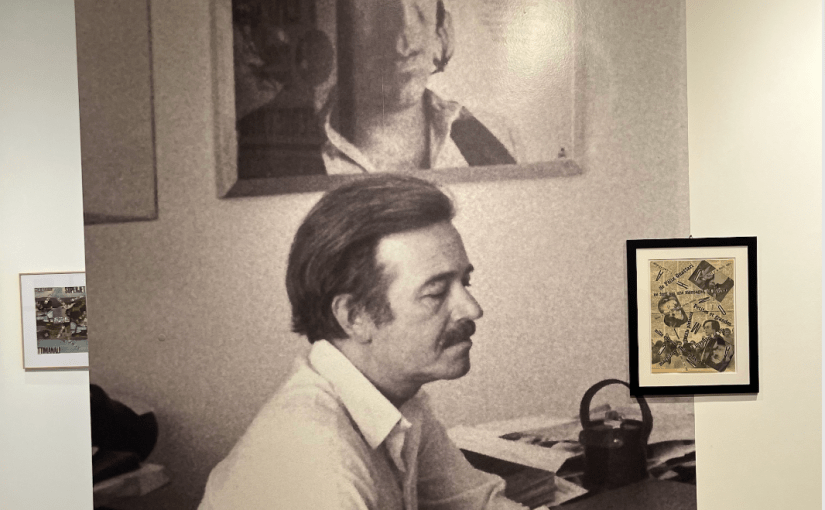
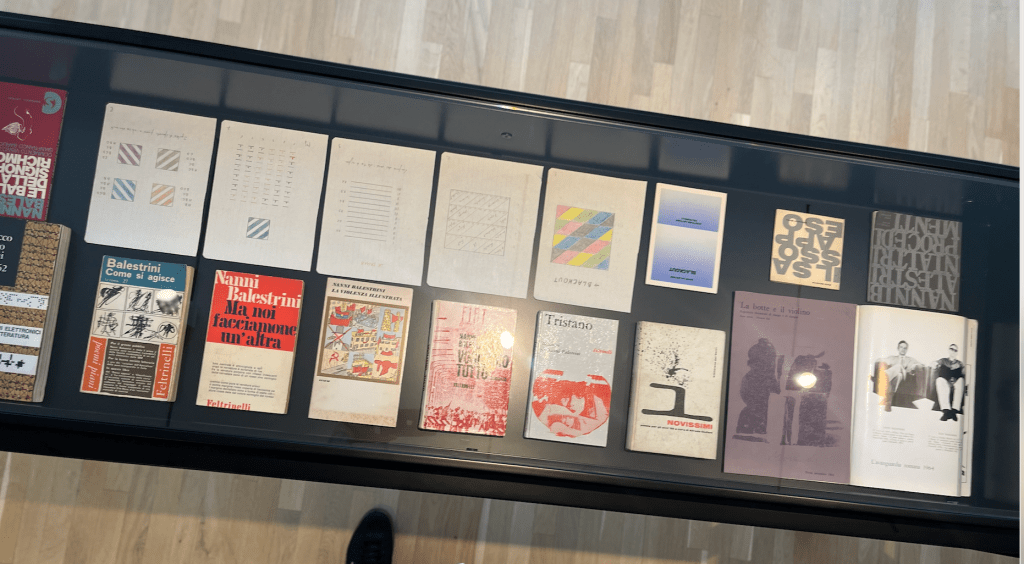
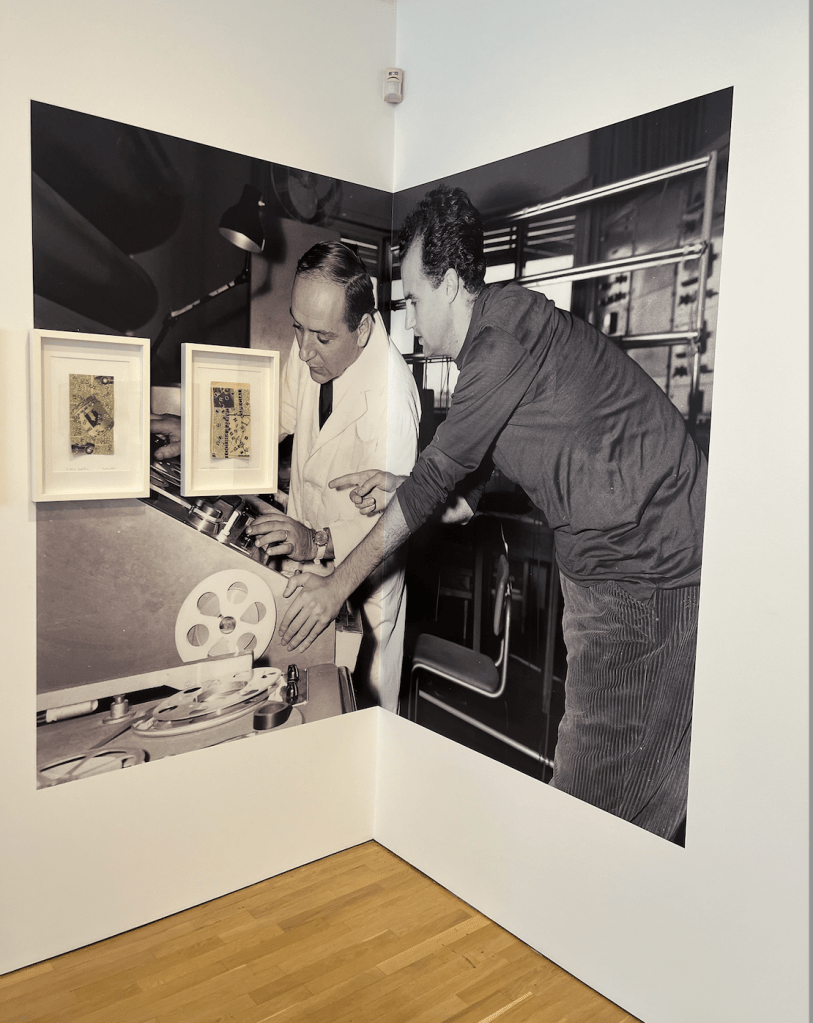
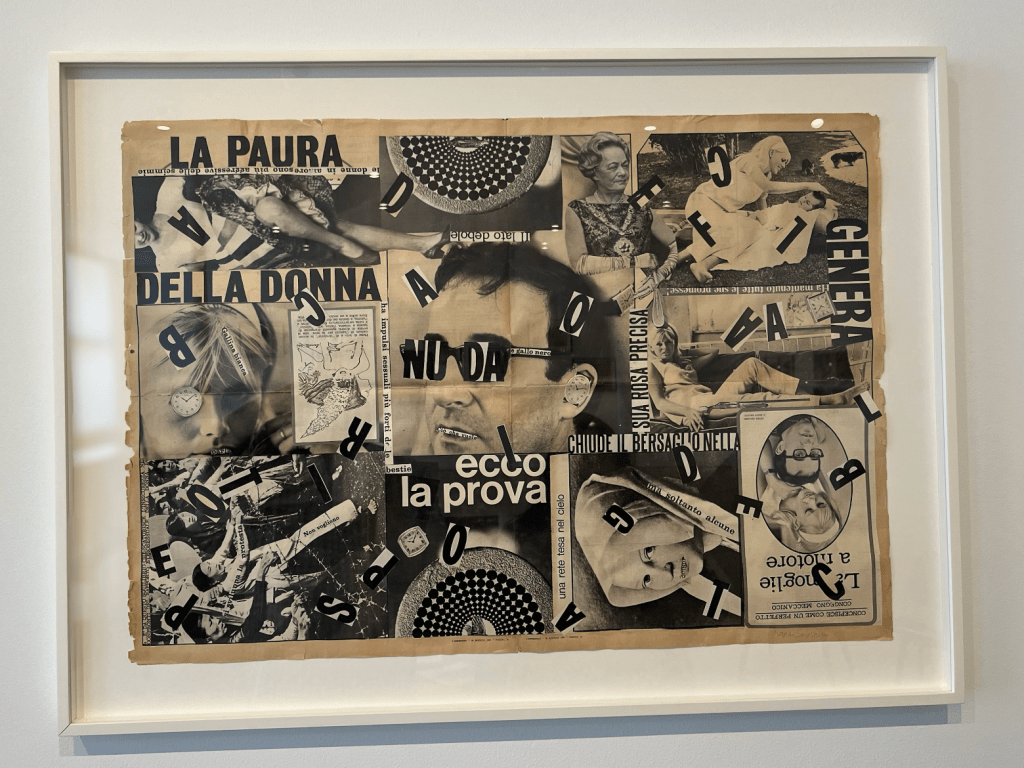
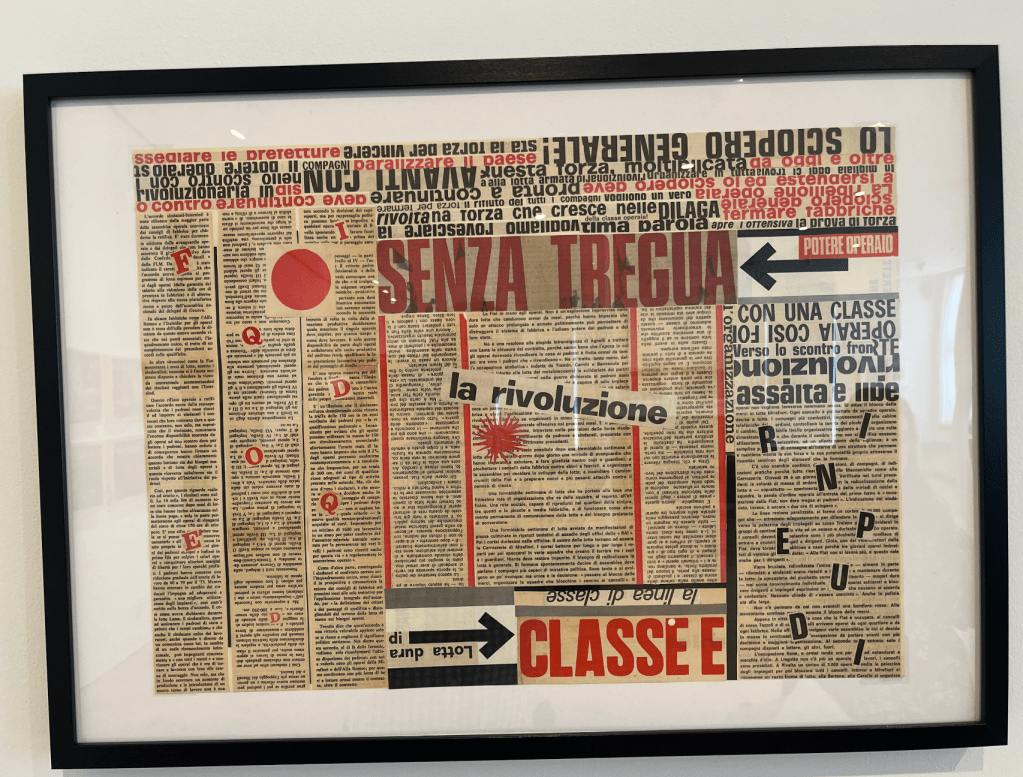
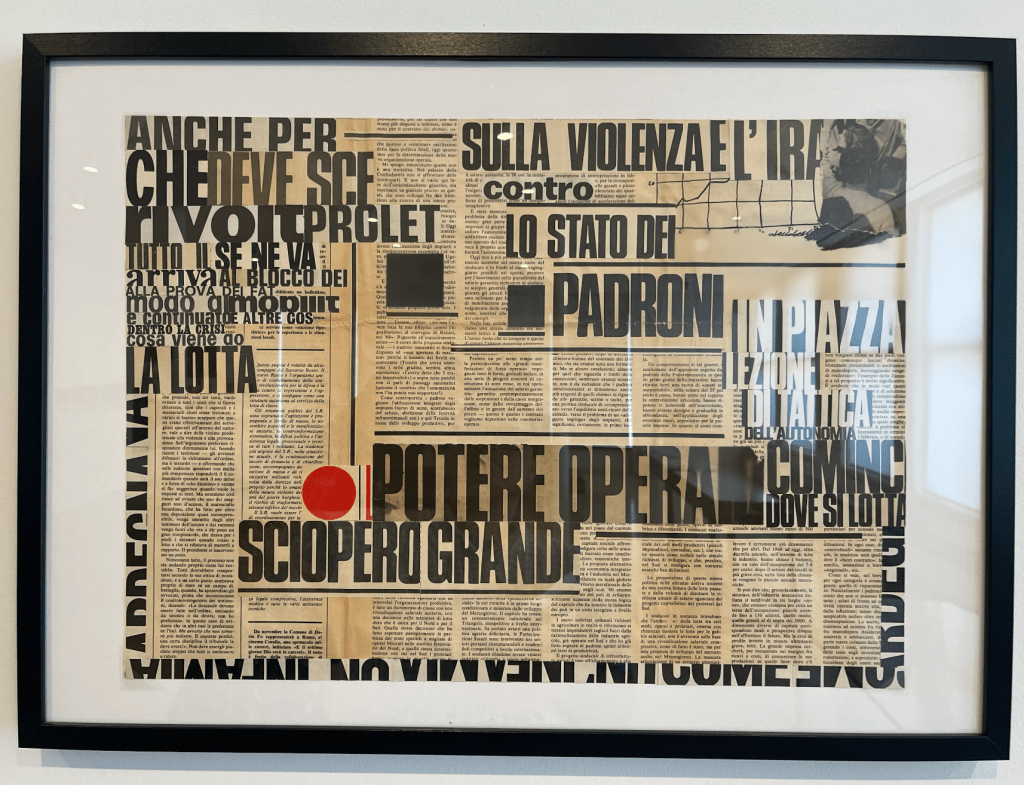
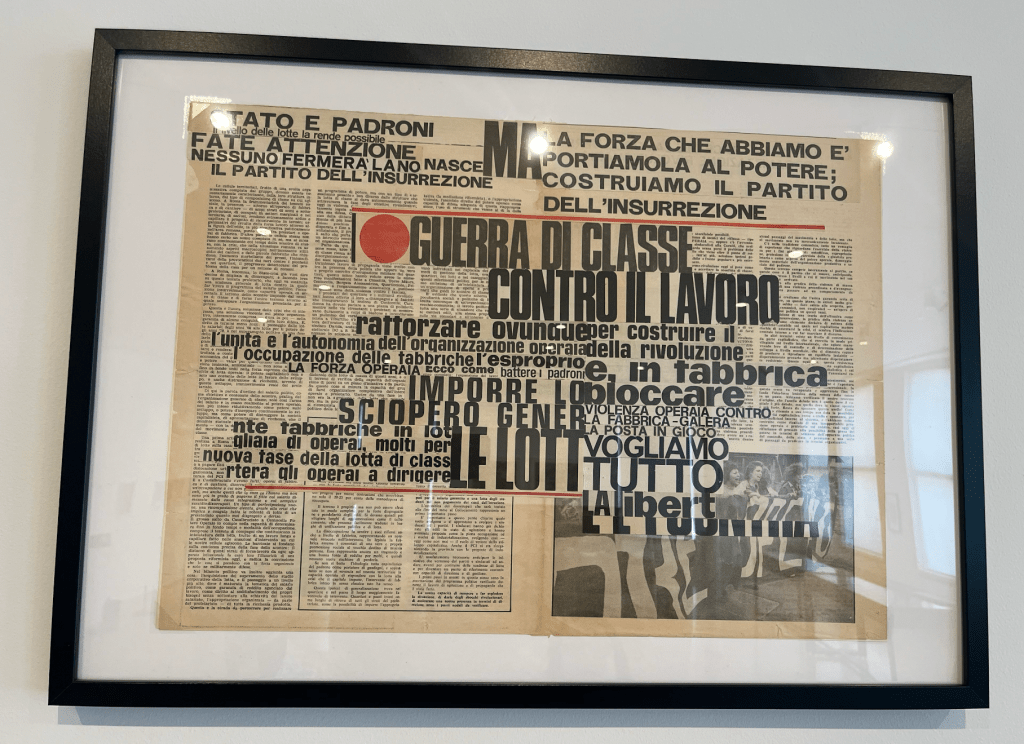
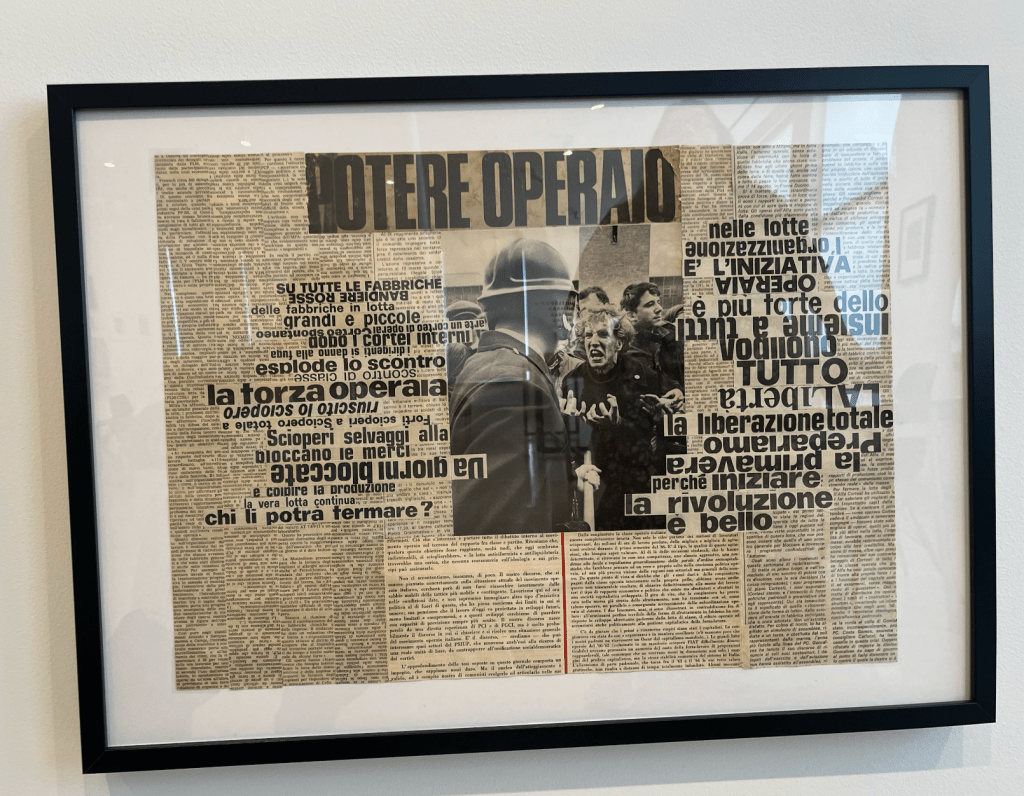
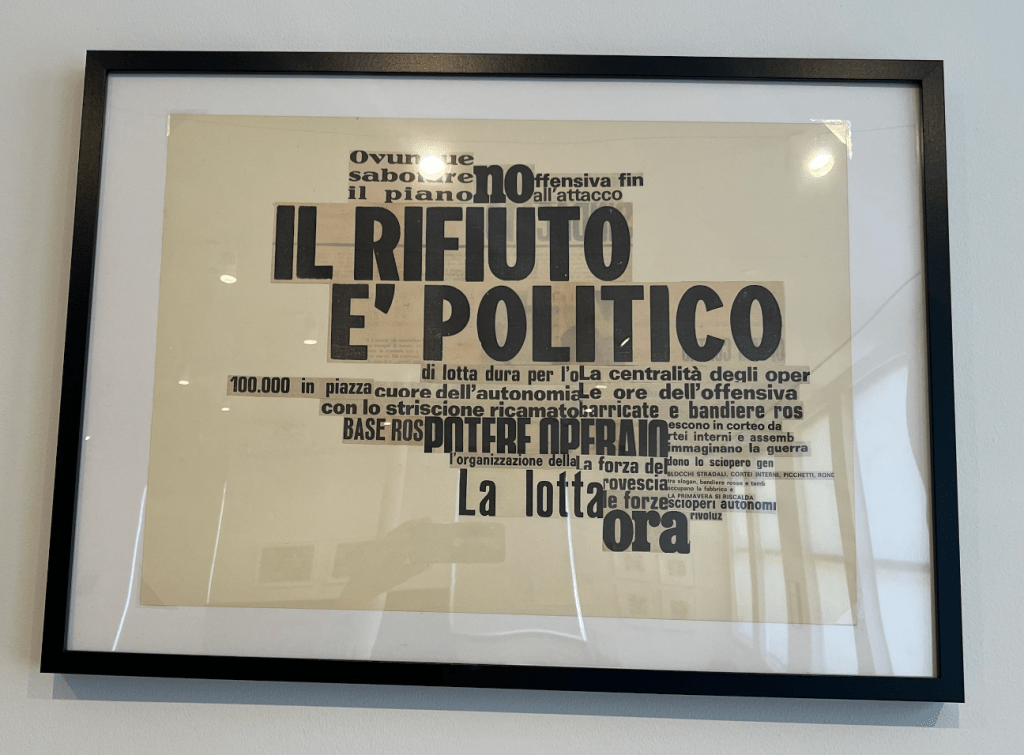
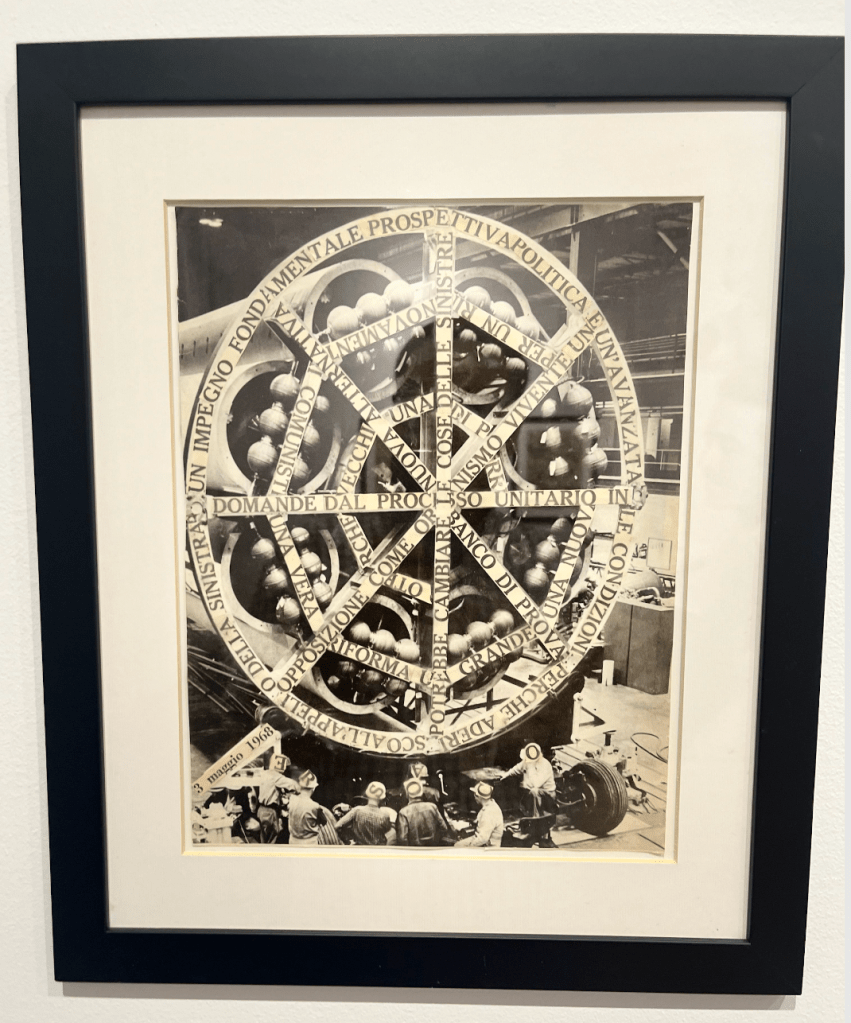
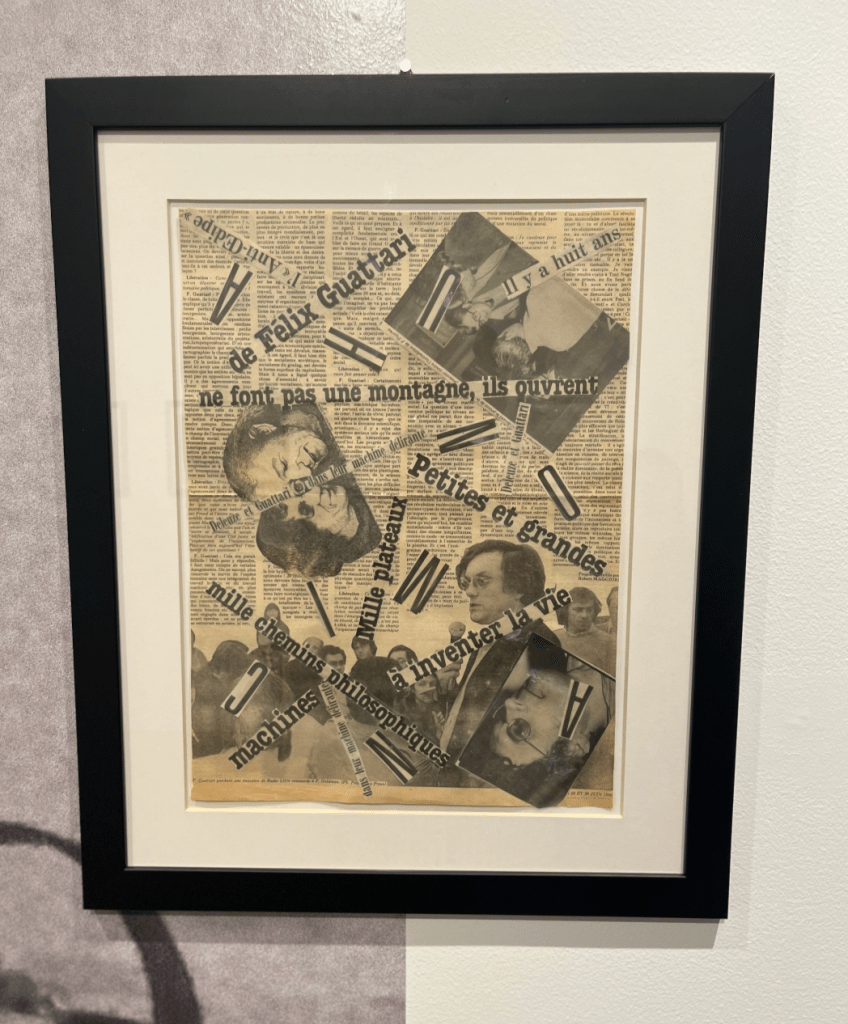
Exhibit visit. Nanni Balestrini: Art as Political Action – One Thousand and One Voices. Center for Italian Modern Art, 2024.

We were thrilled to finally get to the Nanni Balestrini exhibit at the Center for Italian Modern Art in Manhattan this weekend. This exhibit – which, according to its curators is the first retrospective on Balestrini’s work in the U.S. – opened in February and closes on June 22nd.

We haven’t written much on Balestrini for this blog, just one post about La Violenza Illustrata last year, but hope to in the future. Balestrini has gotten some attention in the US radical left over the years because of his book We Want Everything, his novel about Italy’s hot autumn of 1969. But his collage work and other visual art has gotten very little attention here, and this exhibit helps to change that. A catalog from the exhibit is also available from the Center’s store, and is quite beautiful and a solid representation and contextualization, especially for those unable to make it to NYC in person before it closes.

Below we include some pictures we took from our visit.

Tano D’Amico. 1977. Se non ci conoscete: La lotta di classe degli anni ’70 nelle foto di Tano. Edizione Coop. Giornalisti Lotta Continua.

Tano D’Amico is probably the most important photographer of the ’77 movement in Italy. His photographs have become iconic images representing those struggles and have often been re-published. Surprisingly, however, we could not locate a fully scanned copy of this booklet on the web.

This stunning book was published in 1977 by Lotta Continua, which D’Amico had involvement with. Its title can be translated as If you don’t know us: The class struggle of the 1970s in Tano’s photos. It contains 90 photos, most of which had been published previously in Lotta Continua, the daily newspaper of Italy’s extra-parliamentary left.

The background, according to an explanatory blurb on the back (roughly translated) is this:

“The notebook was produced by the 15 June Printing House, a printing house established in Rome with the subscription of thousands of comrades to serve the needs of the class movement. It is priced at 1,000 lire per copy. The proceeds from the sales will be devoted to the subscription of the daily Lotta Continua which needs, in order to survive, to raise 180 million [Lire] by August 1977.”

Here are just a sample of the photos in the booklet (all black and white, as is D’Amico’s style):

This booklet is scarce. According to OCLC, there are 5 institutionally-held copies internationally, with the only U.S. copy held by Beinecke at Yale (Yale has purchased D’Amico’s papers for years and built quite the archive, here). Copies are sometimes available in the used book trade, but they tend to go for very high prices. While we were able to locate selected photos online, we could not locate an entire scan of the booklet. Accordingly, we scanned it in full and have uploaded it here for those interested.

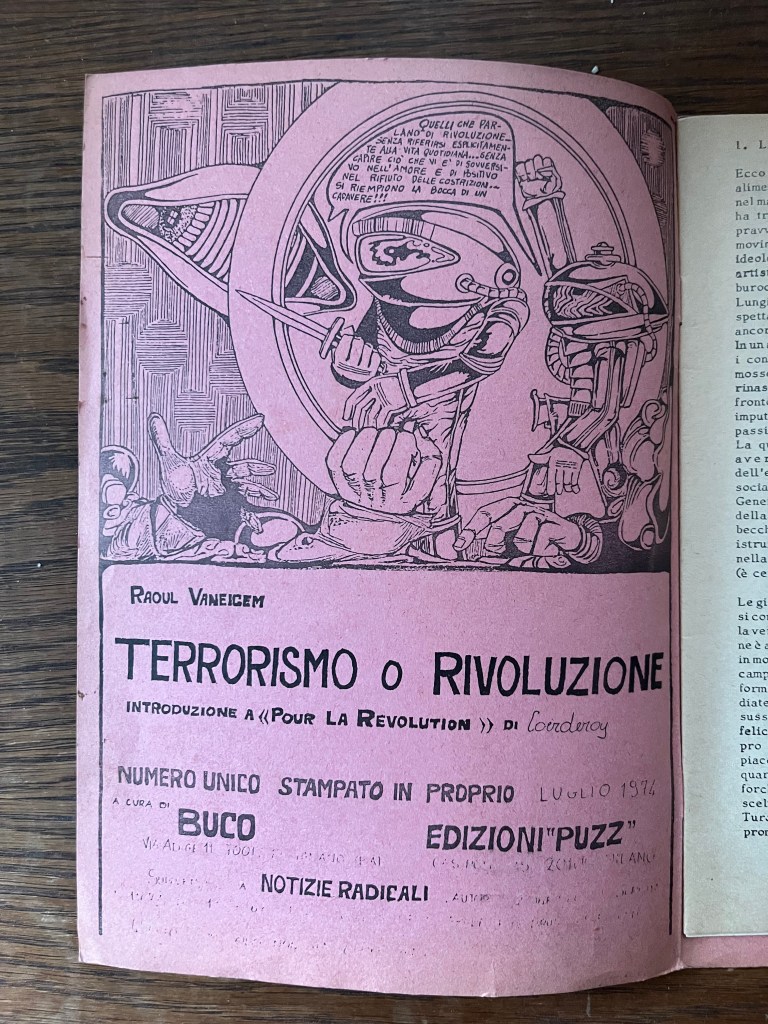
Raoul Vaneigem, “Terrorismo o rivoluzione.” Edizioni Puzz & Buco, 1974

One of our goals with this site is to draw out some of the international connections in either influence or direct interaction (or both) between the Movement of ’77 and movements and theories from outside of Italy. The impact and interpretation of situationist thought into Italy during the 1970s is particularly interesting, and we look forward to writing more, through the lens of ephemera, on that matter.

The instant example is the co-publication by Edizioni Puzz and Edizioni Buco of Raoul Vaneigem’s “Terrorismo o rivoluzione: An Introduction to Ernest Coeurderoy,” published in French in 1972 (here is an English translation).

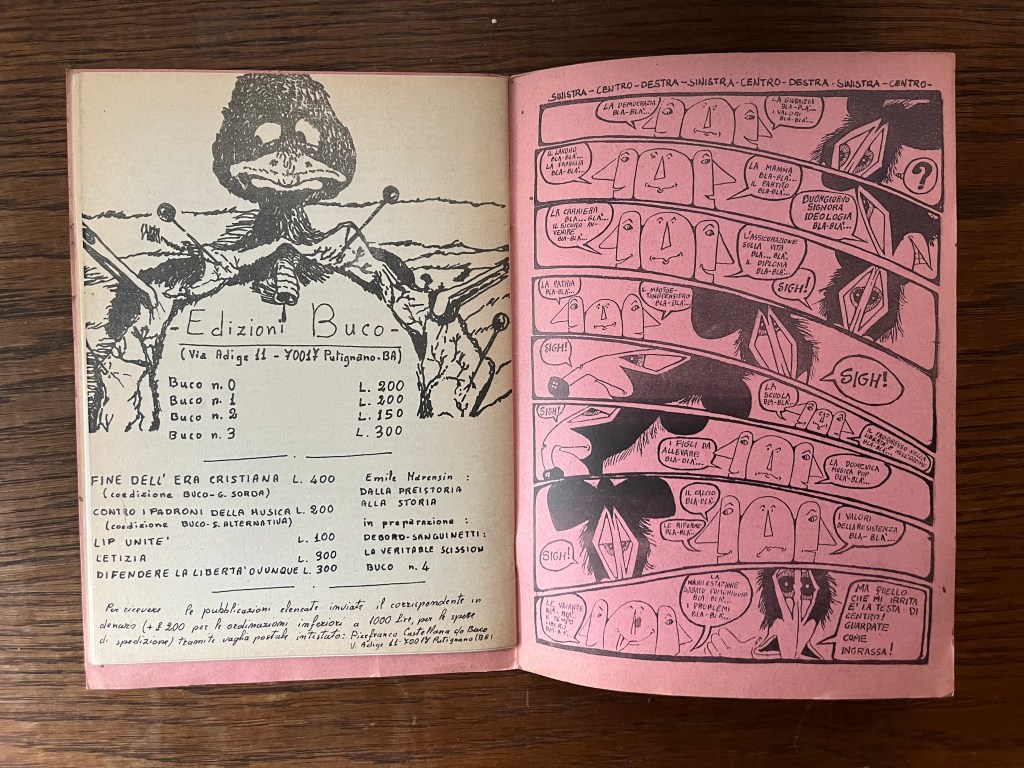
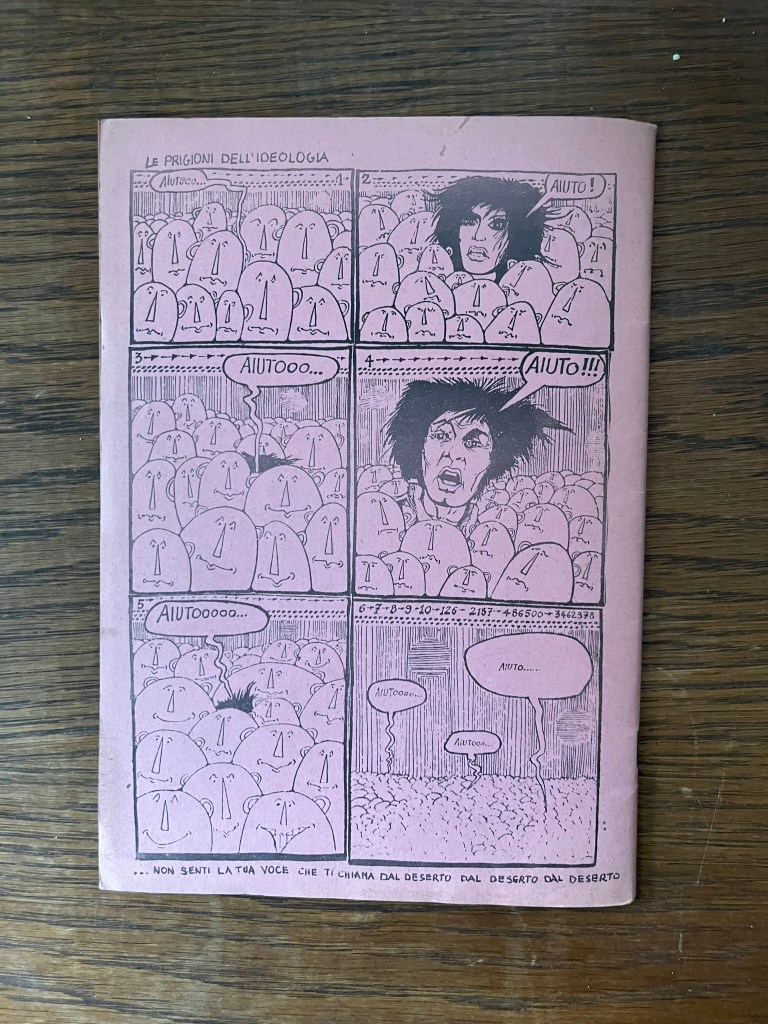
This edition, according to a fairly comprehensive rundown of Puzz publications in the Nautilus collection Puzz & Co. 1971-’78…1991, was printed in 800 copies, which was relatively small compared to the typical 2000 print run of the Puzz press. As Duccio Dogheria notes in his wonderful book on Italian pirate editions of the 1970s, Max Capa – the leading figure of Puzz – had used Vaneigem quotes in various comics.

For those unfamiliar, Max Capa (a pseudonym, his legal name was Nino Armando Ceretti) is considered by many to be the father of Italian underground comics, and his work formed an important aesthetic piece of Italy’s long 1970s. In a 2017 interview, Capa noted “With Puzz we came close to the radical theses of the communists, situationists and anarchists. This encounter greatly influenced our drawings and comics.” In situationist spirit, he continued “They were underground comics but also had a level of social and political content. They were often accompanied by theoretical texts and short subversive essays. Radical criticism and everyday life were merged in the comics.”

Il Buco was a paper and publisher (Edizioni Buco) out of Putignano in southern Italy, which played an important role in the political underground press of the period. (Some information is available here).

Because of constrictive legal requirements that required government registration, this was published as a supplement to Notizie Radicale (many underground and radical publications were produced as “supplements” of registered journals, which allowed their legal publication).

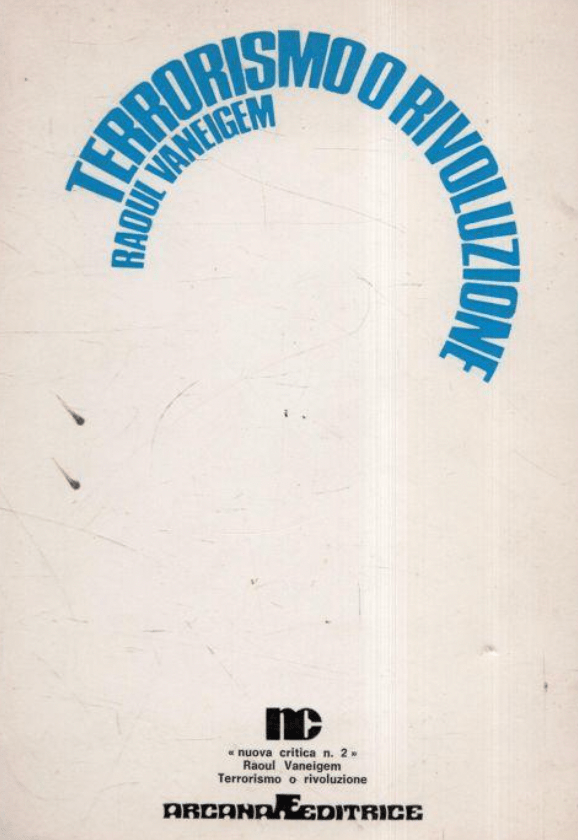
This edition of Terrorismo o rivoluzione is, according to Dogheria, the second Italian edition. The first being the “official” publication by Arcana in 1973.

Cover of the 1973 professional edition

This edition of Terrorismo o rivoluzione is rare. We have encountered it just one time in the trade in recent years and OCLC lists a single holding in Amsterdam, at the Institute of Social History. Thankfully, a good copy has been scanned online here, via the incredible collection of Puzz materials provided via the Primo Moroni Archive in Milan.

Months of silence

For most of the last few months our workplace (in public services) has been on strike. Contrary to public opinion, non-profit executives are at least as mean and calculating as for-profit bosses. Carrying out an effective strike takes at least as many hours as a 9-5, and in our experience more so – didn’t have a single full night of sleep for months, meetings and pickets and protests went from day to night and so on. But now the strike is over and the retaliation has begun. Will be working on some writing about it. In the meantime posts should begin again.

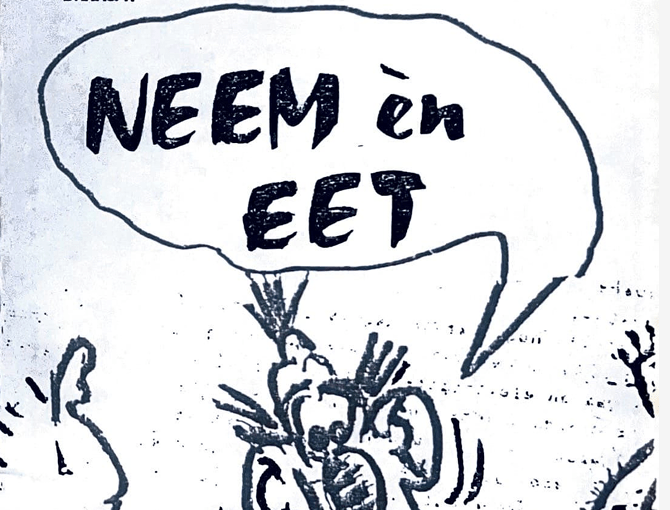
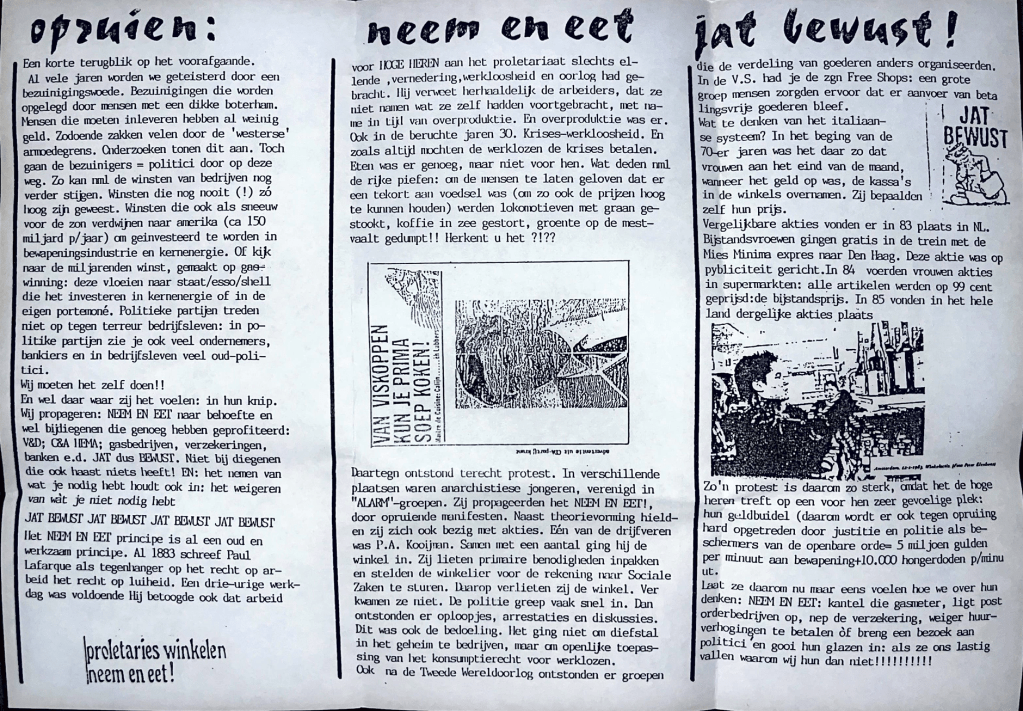
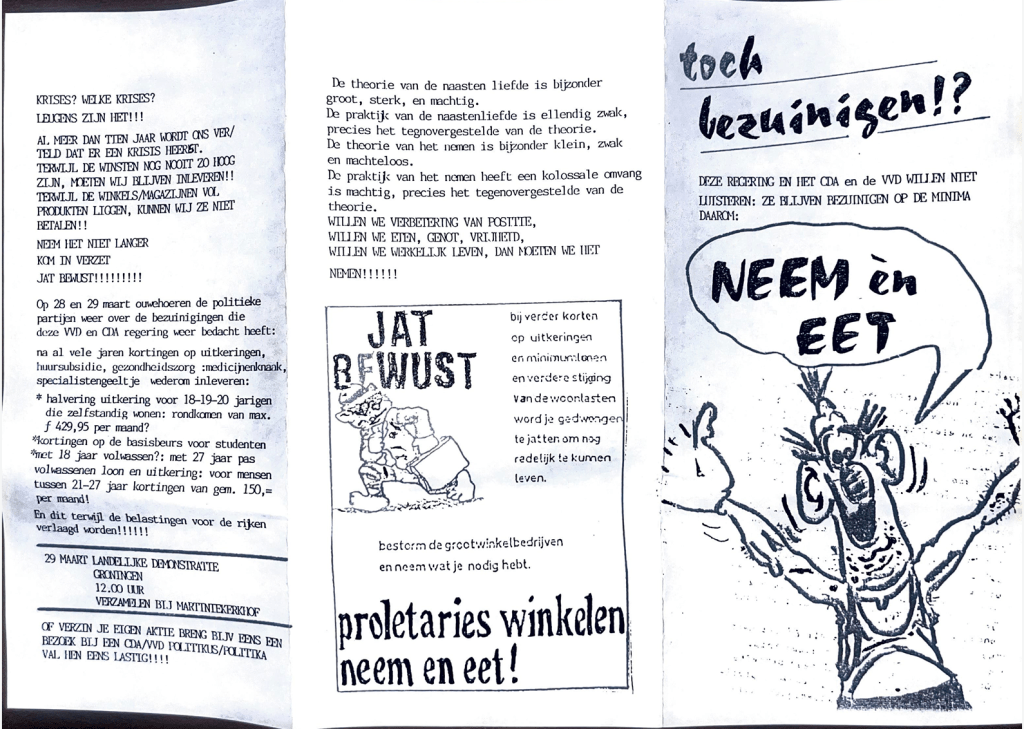
“Toch bezuinigen!? … NEEM en EET!” (1986?)

This wonderful little brochure was left inside a Dutch pamphlet we had purchased sometime back and we couldn’t quite locate its exact history.

The brochure is a photocopied, tri-fold flier calling potential participants to come to a collective act of proletarian shopping in Groningen, Netherlands. The term used here for proletarian shopping – put simply, collective acts of taking commodities without paying – is “jat bewust,” or, roughly, a call to “steal consciously.”

The context in the brochure what is described as yet another round of austerity cuts, which cause lower wages and an increased cost of living. The historical reference points are really interesting. Philosophically, the author(s) note Paul Lafargue’s work The Right to be Lazy as well as P.A. Kooijman’s work. Kooijman is not very well known in the U.S., but was a Dutch militant anarchist who forwarded a concept of theft in context of capitalist surplus (for a very brief intro, see here). In terms of movements, the pamphlet references the Dutch group Alarm and initiatives in Italy in the 1970s among others.

The pamphlet includes an image that dates back to a poster from 1983, and was presumably a graphic used in other places. From the dates mentioned inside our best guess is that this dates to 1986.

We could not find any holdings of this little brochure and we reproduce images of it below.

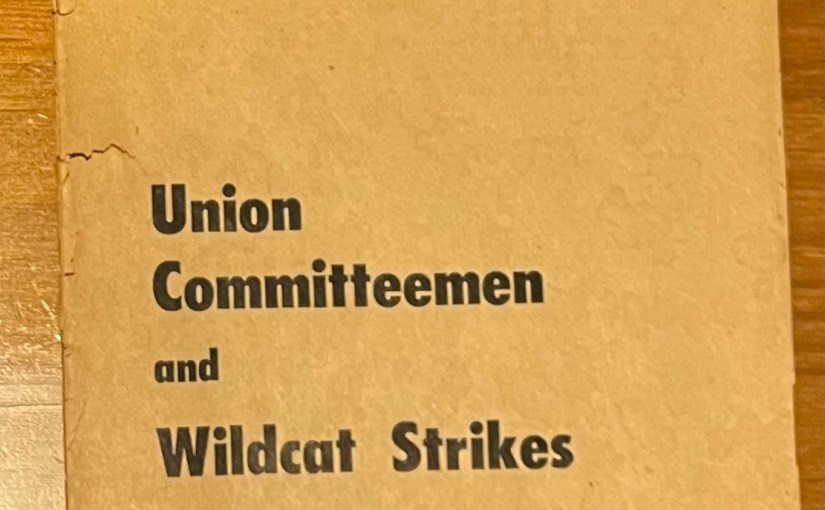
Martin Glaberman, Union Committeemen and Wildcat Strikes. Correspondence Pamphlet 1 (October, 1955)

I have written about Marty Glaberman a few times on this blog and still have many more publications of his I could write about (and hopefully will, one day).

After he died, if I understand correctly, his archives got split up. Wayne State took a substantial amount of it (see here), and what they didn’t take ended up in the hands of the Portland IWW chapter, after some of their activists organized a vehicle to pick up and drive the boxes from Michigan to Oregon. Those boxes were then organized in the basement of a building that was called Liberty Hall, now closed, which was home to the offices of a number of left groups. Liberty Hall went through at least one major flood, which caused damage to a lot of the documents, but most remained in fine shape. The PDX Wobblies setup bookshelves, and one could peruse Glaberman’s notes in Gramsci or Marx volumes, some informal correspondence with other radicals, and so on.

I spent much of the summer of 2006 sorting through the archives, trying to create some order out of file cabinets worth of pamphlets and journals, and scanning pieces here or there. What happened to the archives thereafter is not entirely clearly to me. Rumor has it that after the library at Liberty Hall closed, they were then stored in a garage or a basement, and then eventually set back up elsewhere, but subsequently “lent” out in ways the substantially reduced the collection. More recently, I heard that much of the collection remains viewable via the Portland wobs. I am not entirely clear. In any case, going through the collection that summer really helped me to grasp Glaberman’s work, and get some sense of various key points in the autonomist left between the 1970s and 1990s.

This pamphlet is composed of two essays that are classic Glaberman, along with a brief introduction. Both essays had been published in Vol. 2 #9 of Correspondence (copies of which are exceptionally rare), and this pamphlet is a reprint of them in pamphlet form.

The first essay, The Nationwide Auto Workers’ Wildcat looks at the wildcat cycle in context of auto contract negotiations, and particularly how union leadership (under Walter Reuther) sought to control workers (in this case, via a Guaranteed Annual Wage) and how workers struggled against that control and against the boss’s control on the factory floor. One can certainly see significant foreshadowing of Glaberman’s later dissertation and then, even later, his book, Wartime strikes: The struggle against the no-strike pledge in the UAW during World War II, in the piece. Unsurprisingly, the last paragraph of the piece ends with this hopeful commentary:

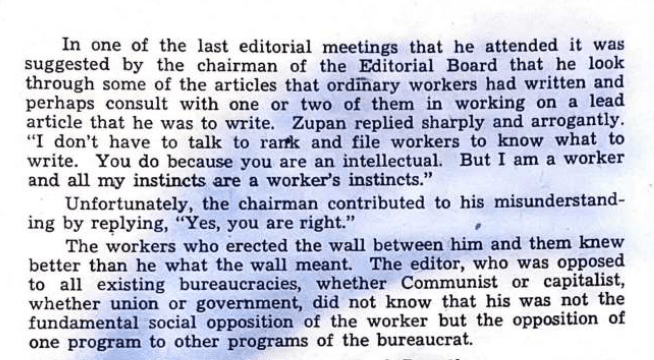
The second essay in the pamphlet, “The Left Wing Union Committeeman,” is a critical reflection on the role of “enlightened” radicals in the class struggle. In this case, Glaberman writes about former Correspondence editor, Johnny Zupan, who left the paper out of a fundamental political disagreement. For Glaberman, Zupan’s role as a full-time committeeman made him into a bureaucrat, whether or not Zupan was a good person or perceived himself to be a dedicated militant. He explains:

This essay is a powerful analysis of the often contradictory role of radicals in the unions and a classic document of the “working class as autonomous from the unions” perspective. It is also a helpful (and evergreen) analysis of how vanguardism appears in the political work of people who may otherwise say they are against vanguardism. This essay later appeared in Lynd’s collection of Glaberman’s work, Punching Out.

We could not locate a scan of this pamphlet online, and we couldn’t locate the first essay online, so we scanned it and placed it on Libcom, here. (Apologies for the pretty poor quality, but it’s readable). Our copy of the pamphlet is in bad shape – the covers are separated from the booklet and the paper (newsprint) has become frail and frayed. This pamphlet is rare but OCLC locates 18 copies, though many of them are of the later 1971 Bewick Editions reprint. – Craig

Andrea Doria. N’Drea. Comprehensive bibliography of editions, 1992 – present. (Updated as editions are published or found).

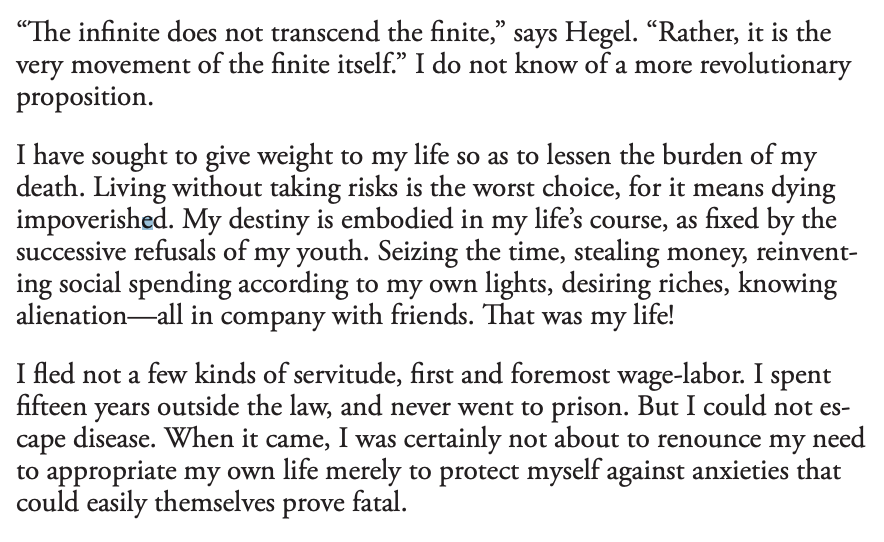
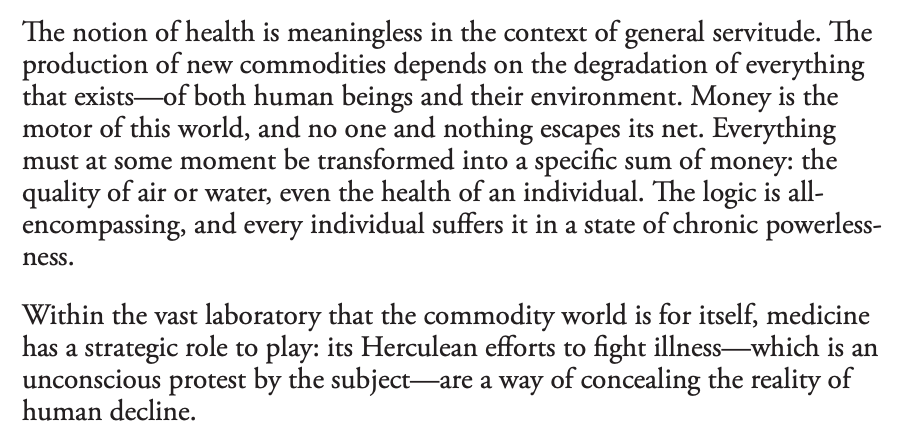
N’Drea has been kept in circulation because anarchists and fellow travelers have been committed to making it so for the past thirty years. In a period where the term “care” is used all across the radical left, increasingly to a point of nearly unlimited (and near-meaningless) expansiveness, N’Drea stands out as a particularly substantive reflection on illness, death, and medicine, in context of contemporary capitalism, and a powerful reminder of comradeship, friendship, and autonomy.

Andrea was diagnosed with cancer in 1985. She suffered both breast and lung cancers. She submitted herself to chemotherapy and other treatments and, when those were unsuccessful and she was asked to consent to participate in experimental treatment, she made the carefully considered decision to refuse. She subsequently disconnected from medical engagement entirely. She passed away in 1991. This book is a collection of letters (to her nurses, to her friend Bella) and reflections on her experiences and their context.

Andrea Doria, August 14th, 1991.

The pieces in this book are written in conversation with the movements of the mid/late 1980s and early 1990s, particularly the anti-nuclear struggles and the movement of people with AIDS. At one point Andrea writes, in frustration, “Having been rather successfully conditioned and rendered guilty as to the extent of our ignorance, we cancer patients have failed up to now to fight back, as some AIDS sufferers have done, by calling the bluff of all those medical researchers whose bluster and trumpet blowing on the subject of their supposed discoveries are nothing but a cover for their own very considerable confusion” (p. 33-34 of the Eberhardt edition).

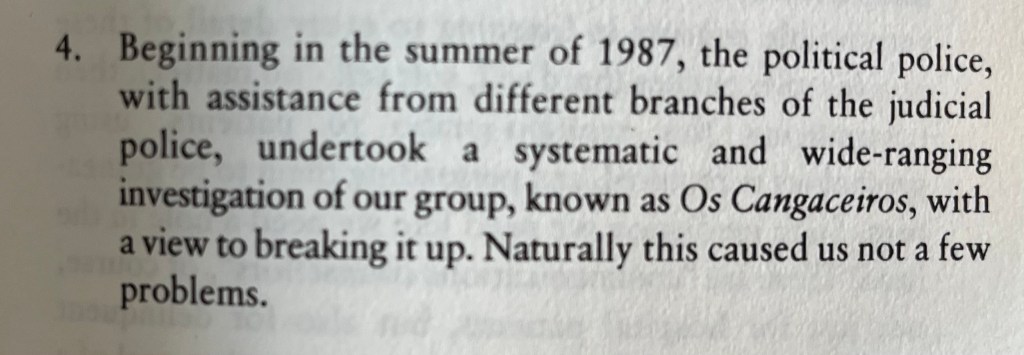
Andrea was a member of the French anarchist group Os Cangaceiros, who have become storied (to the point of fable) in anti-authoritarian milieus’ across the globe (Rolling Thunder, Crimethinc’s journal, had useful commentary on the reality vs. the myth of Os Cangaceiros in their eighth issue, here).

It is worth taking note of the name of the author – Andrea Doria. The full name “Andrea Doria” appears once in the original French text, in the second to last letter written to Andrea’s friend Bella. It is entirely conceivable that this was Andrea’s legal or chosen name, and it is also entirely conceivable that this was a pseudonym. “Andrea Doria” is, of course, also the name of an historically notable 15th & 16th century Italian statesmen, and later the SS Andrea Doria – an Italian luxury ship that sank on its way to New York in 1956.

The context of the book makes knowing this particularly difficult. Andrea, as a participant in Os Cangaceiros, reports to have been under significant surveillance from the police beginning in 1987:

As a group that purportedly survived for many years via robbery and petty crime, shielding identity would have been an important part of the Os Cangaceiros project. Moreover, the use of pseudonyms was (and is) common practice in the milieu of the pro-situ and anti-authoritarian left, for reasons practical, political, and theoretical.

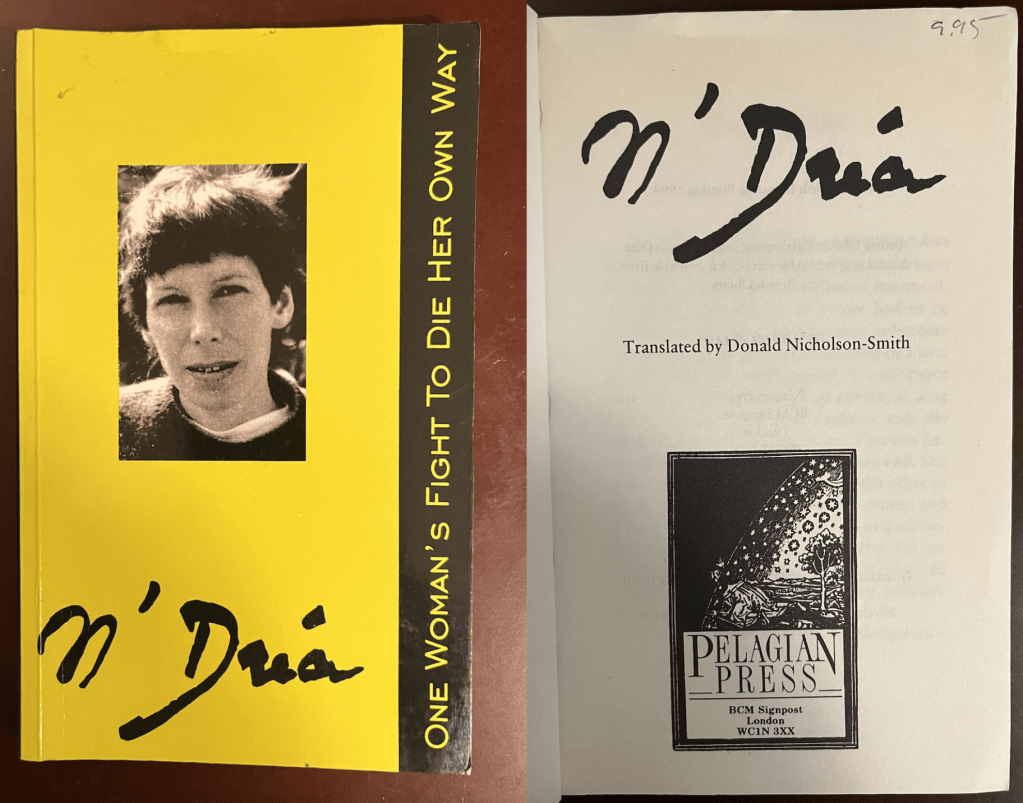
We also do not use the subtitle that has been repeatedly used, “One Woman’s Fight to Die Her Own Way,” which initially appeared in the first formal English-language translation, published by Pelagian Press in 1998.

For purposes of this bibliography we are only including formally printed editions of the book. That means there are other versions of it that we are leaving out, for example editions we have found online that seemed to have been published as photocopied pamphlets by anarchist presses etc. This isn’t to minimize the importance of that kind of pamphleteering work, but including those would make this kind of bibliography less useful. That said, at the end of the post we are including links to each of those in a bulleted list.

Text from the book

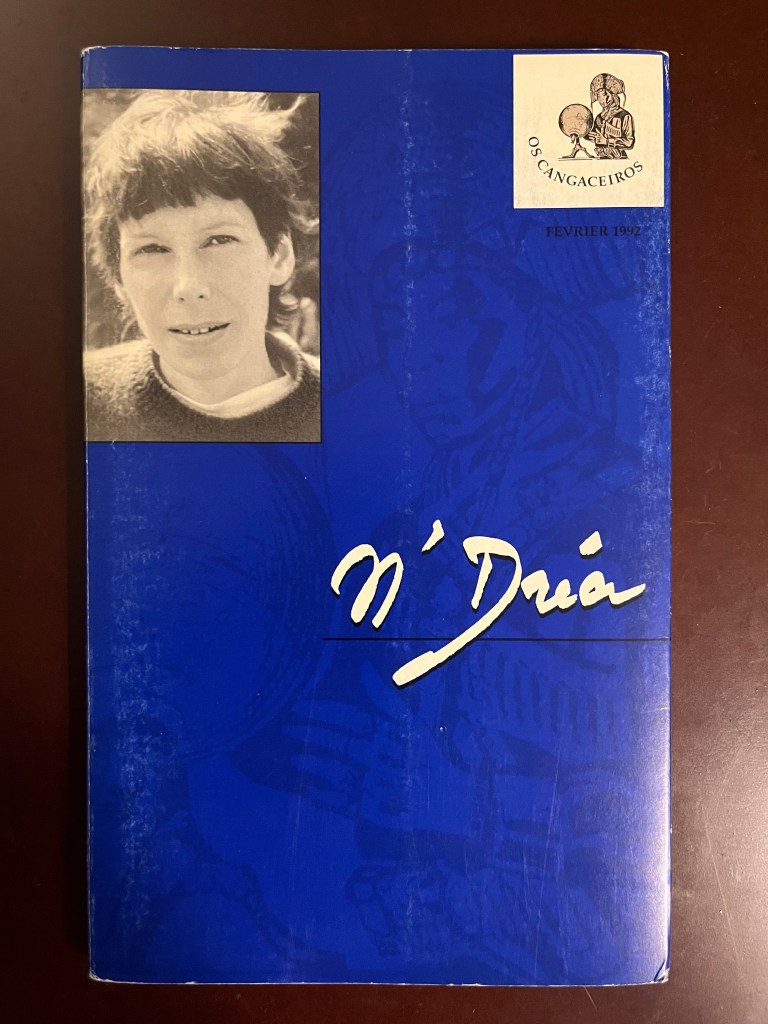
First edition, February 1992. Self-published by Os Cangaceiros. French language.

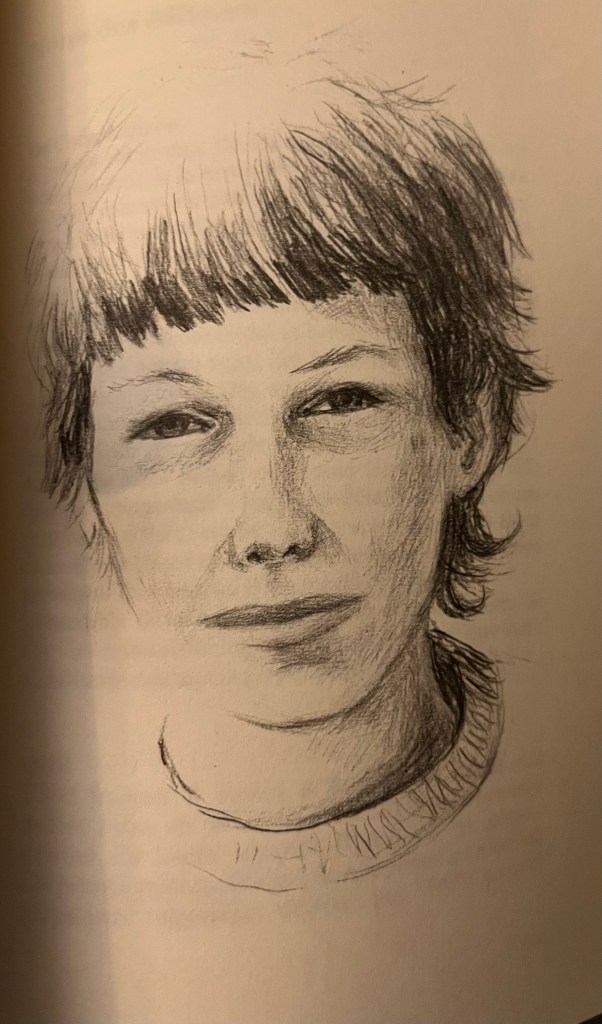
The first edition was self-published and is uncommon but shows up from time to time in the book trade (at the time of writing there is one known copy available from a French seller). This original version is where one finds the pictures of Andrea – the headshot, the picture of her dancing – that show up in later editions (sometimes as copies, sometimes as drawings). It is 65pp (and priced at 30f). We could not find any institutionally-held copies in OCLC.

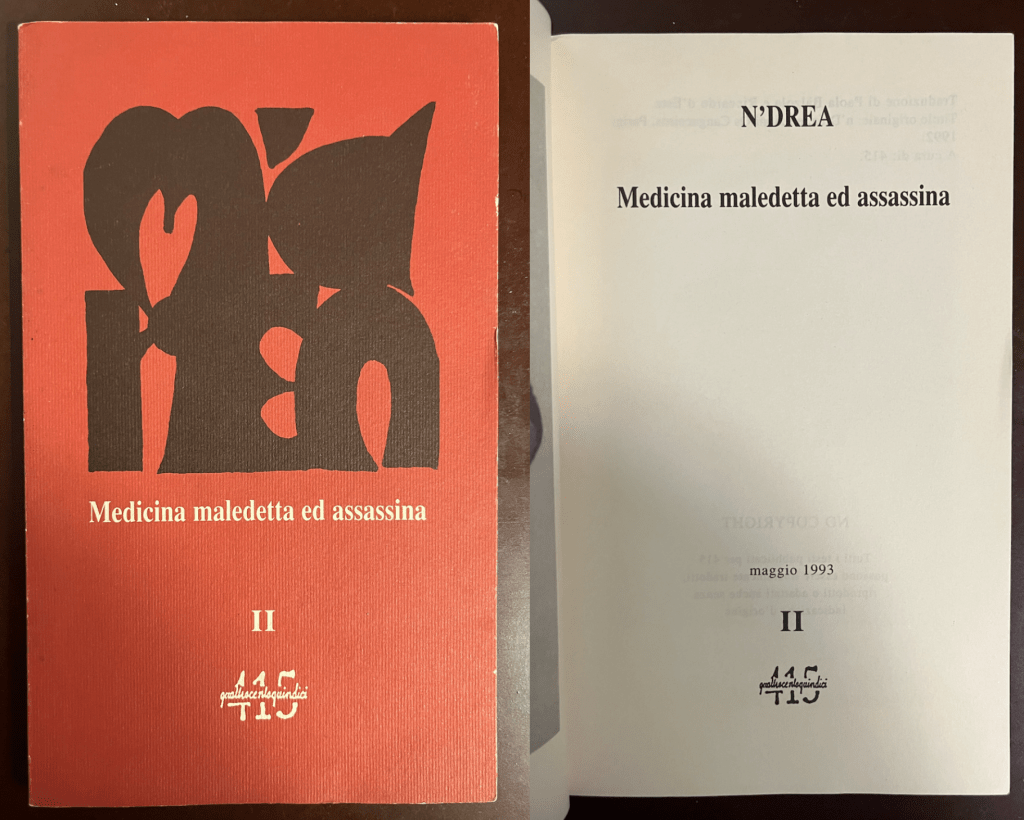
First Italian edition. May, 1993. Published as N’drea: Medicina maledetta e assassina by Quattrocentoquindici.

The first Italian edition was published by the anarchist and post-situ press Quattrocentoquindici (415) and, to our knowledge, was the first published translation after the original French edition. It is arguably the hardest to find edition of the book. This edition includes an introduction by the publishing collective, as well as essays by Giorgina Bertolino (“In ospitale”) and Ricardo d’Este with Simone Peruzzi (“La maledizione e l’assassinio”). A scanned edition of the full book can be found online, here. As an aside Ricardo d’Este – of whom Guy Debord once wrote that, “In 1968 he did the most in Italy to import the spirit of [the French] May and notably among the workers” – may be familiar to readers of this blog as a significant name in the history of Italian’s communist left, including as a founder of the “comontismo” current. We found no institutionally-held copies in OCLC.

First Spanish edition (Castilian). November, 1993. Published by Virus Editorial in Barcelona.

The first Spanish (Castilian) language translation came out a year after the first French edition and was published by Virus Editorial, the now-long-running anarchist press based in Barcelona, which had started just about two years earlier. The Virus edition is out of print but is pretty common in the book trade. OCLC locates one institutionally-held copy at the Universidad del País Vasco.

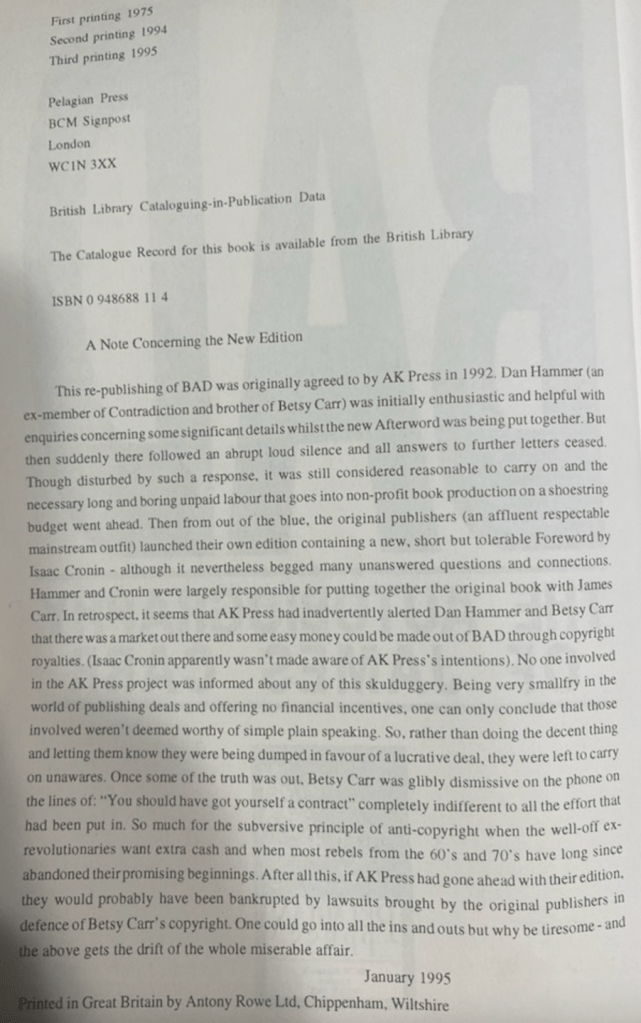
First English edition (UK), published as N’Drea: One Woman’s Fight to Die Her Own way in 1998 by Pelagian Press.

The first English-language edition of N’drea was translated, in 1997, by Donald Nicholson-Smith, a leading translator of radical French thought and former member of the English section of the Situationist International. This is the first time the subtitle of the book (“One Woman’s Fight to Die Her Own Way”) appears. It is 90 pages. According to David Wise (King Mob, BM Blob), Nicholson-Smith did the translation for free. Pelagian Press, who Wise reports was associated with the situationist-ish journal Here and Now, published this edition. OCLC locates a few institutionally-held copies of this edition, but it often appears in the book trade.

First Greek edition. Published 2006 by εκδόσεις (Foreign) Editions as Andria Doria, Η εξαιρετική περίπτωση μιας συνηθισμένης ιστορίας.

In 2006, the first Greek translation was published as Η εξαιρετική περίπτωση μιας συνηθισμένης ιστορίας (English: The Exceptional Case of an Ordinary Story) by Foreign Editions, which was also the name of a journal and the publisher of situationist titles. It was translated by Katerina Marcianoudi. This Greek edition is available online for download, here. OCLC locates no institutionally-held copies of this edition.

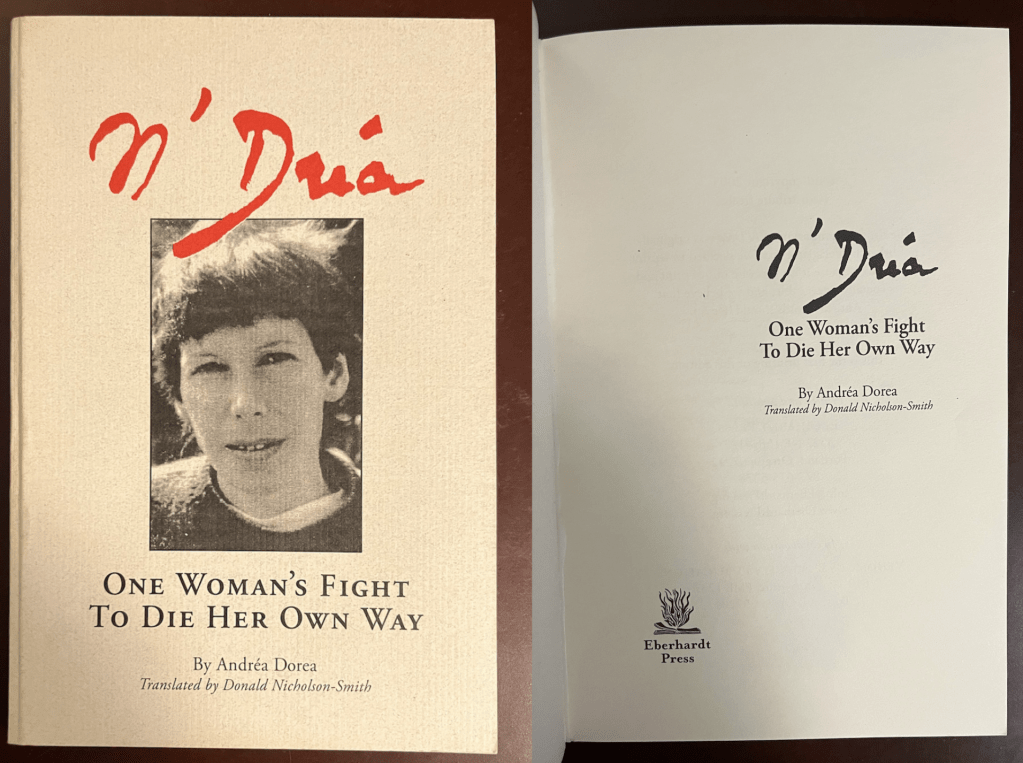
Second English-language edition (first US-edition) 2005, published by Eberhardt Press in collaboration with Venomous Butterfly.

The second formal English-language publication of N’drea was a re-print of the Pelagian edition printed by the anarchist Eberhardt Press along with Venomous Butterfly (the press run by the writer who goes by Wolfi Landstreicher). A note inside the book states “We decided to reprint this book because it is otherwise out of print and generally unavailable, and we believe Andrea’s words should live on. […] This is the first printing of this edition.” While we think this is the first formal US edition, OCLC lists an earlier Venomous Butterfly edition from 2002, and we could not confirm (despite our efforts to!) either way on the accuracy of that record (if you know please write us!). The Eberhardt edition is available for download online, here. It is rare. OCLC locates no institutionally-held copies of this edition.

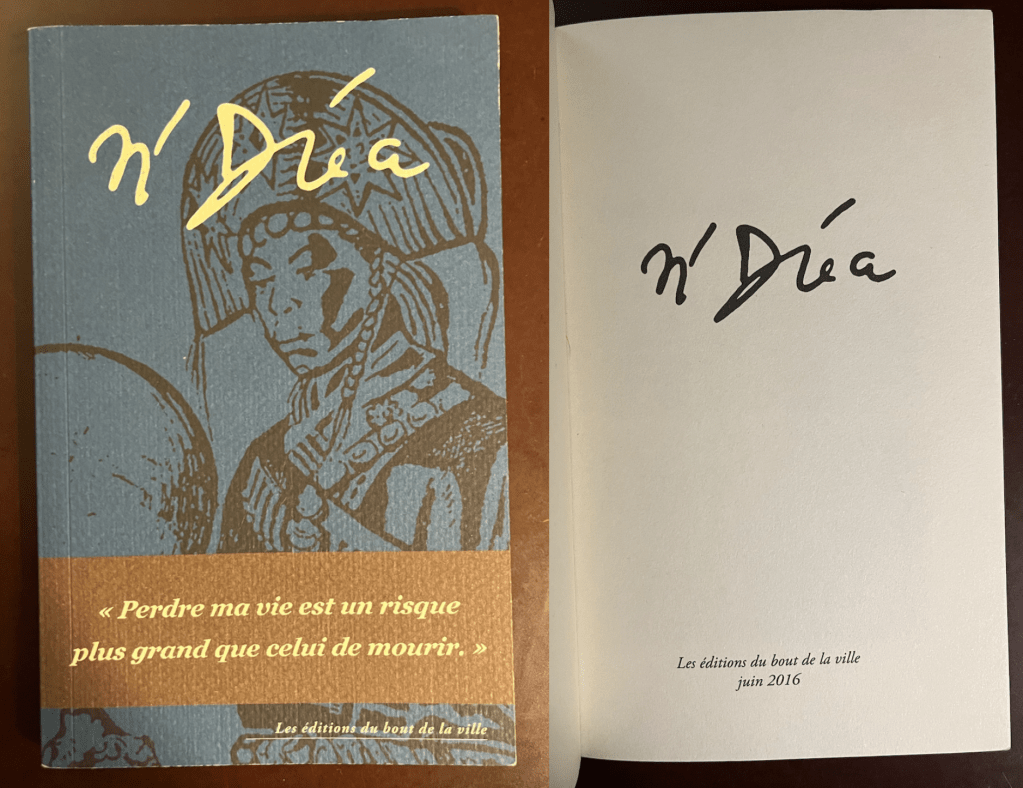
Second French edition, June 2016, published as N’Drea: Perdre ma vie est un risque plus grand que clui de mourir by Les editions du bout de la ville.

Drawing from the Les editions du bout de la ville edition.

We thought that this could not be the second French-language edition, but rather the third or fourth, but we could not find proof of that and the editorial introduction notes that it had circulated for a quarter-century in French, and was translated into other languages, before it was reissued in this edition. The editors added the subtitle “Perdre ma vie est un risque plus grand que clui de mourir” (“Losing my life is a greater risk than dying”), as well as a helpful glossary. Information on the publisher can be found here. OCLC locates no institutionally-held copies of this edition.

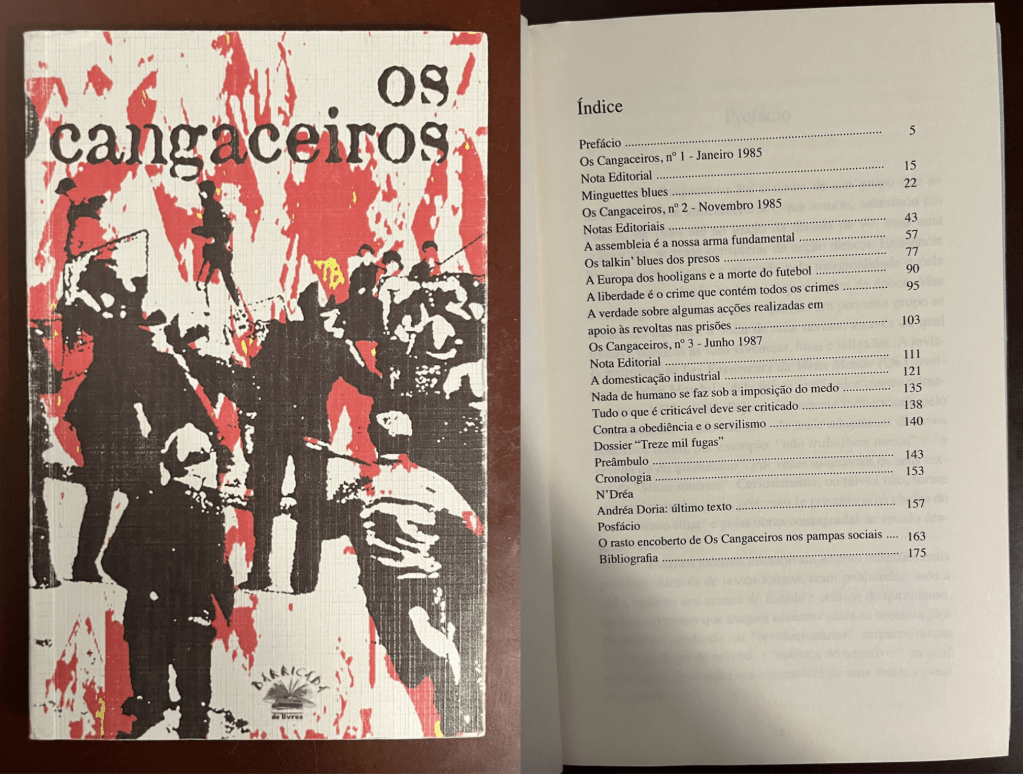
First Portuguese edition (partial), June 2017, Barricada de Livros.

Drawing from the Barricada de Livros edition.

The first Portuguese translation was partial, consisting of Andrea’s August 1991 reflection (pp. 68-76 in the Eberhardt Press edition), for which the editors used the 2016 French edition. This chapter was in a book of texts from Os Cangaceiros, which is the first in Portuguese. Barricada de Livros is an anarchist publisher based in Lisbon. OCLC locates no institutionally-held copies of this edition.

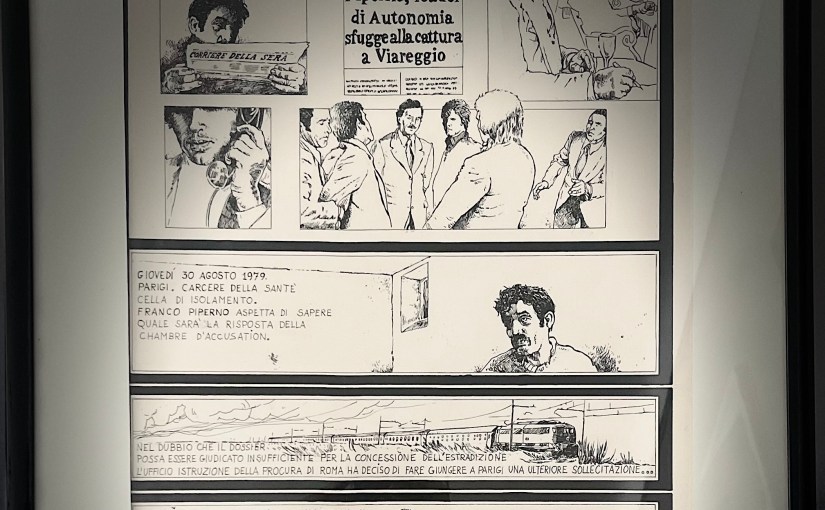
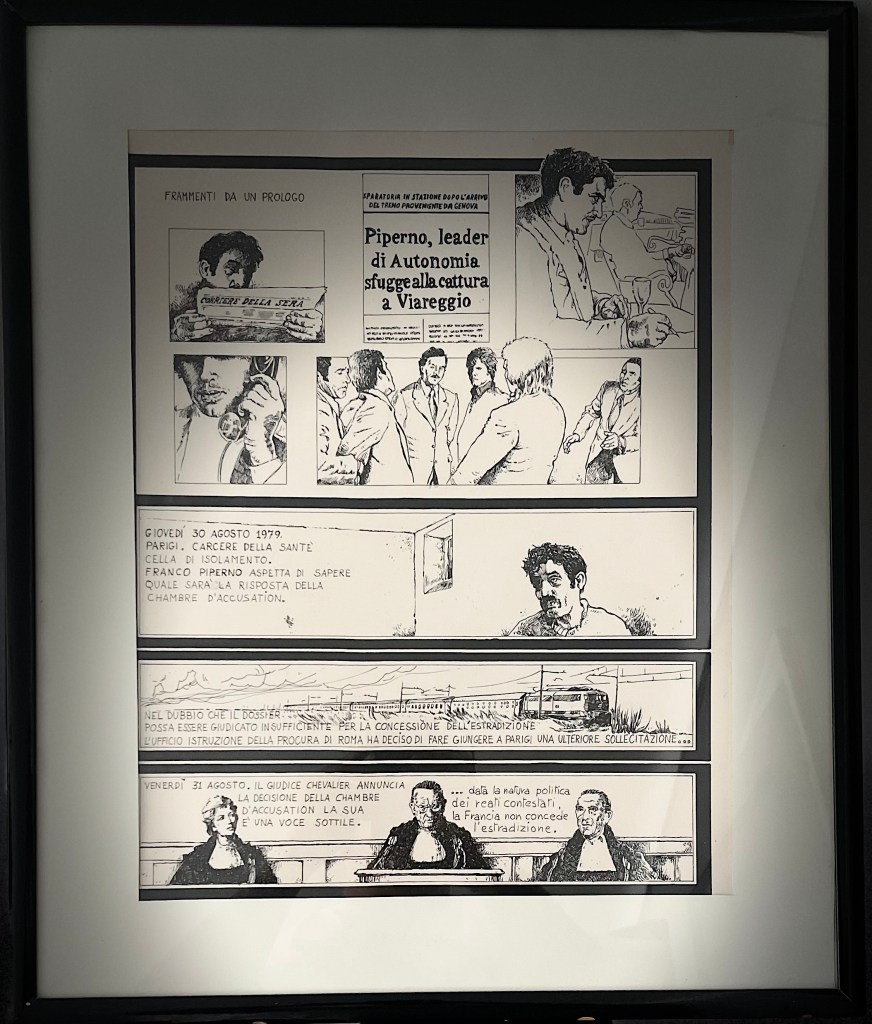
Beppe Madaudo. Original comic on the extradition of Franco Piperno from Paris. Likely drawn in 1979.

Original comic drawn by Giuseppe (Beppe) Madaudo and, as far as we know, unpublished (if you know of publication please let us know!) The comic, which measures 12×16 inches, depicts Piperno in a French jail awaiting a judge’s determination on extradition to Italy. The judge finds Italy’s evidence insufficient and denies the request. (Some background on Piperno’s travails is found in a previous post, here).

The comic is particularly notable because the artist behind it, Beppe Madaudo, was himself targeted for prosecution related to a separate comic in a famous (relatively speaking) and related incident (he was not tried or incarcerated). The artist had drawn a piece on the kidnapping of Aldo Moro, which was published in the first issue of the autonomist journal Metropoli (copies of which were seized two days after publication) in the spring of 1979. A brief interview with former Metropoli editor Paolo Virno, published on the DeriveApprodi website (here), is well worth reading for those interested in the incident.

This piece was purchased from LibriSenzaData in Milano (a great shop).

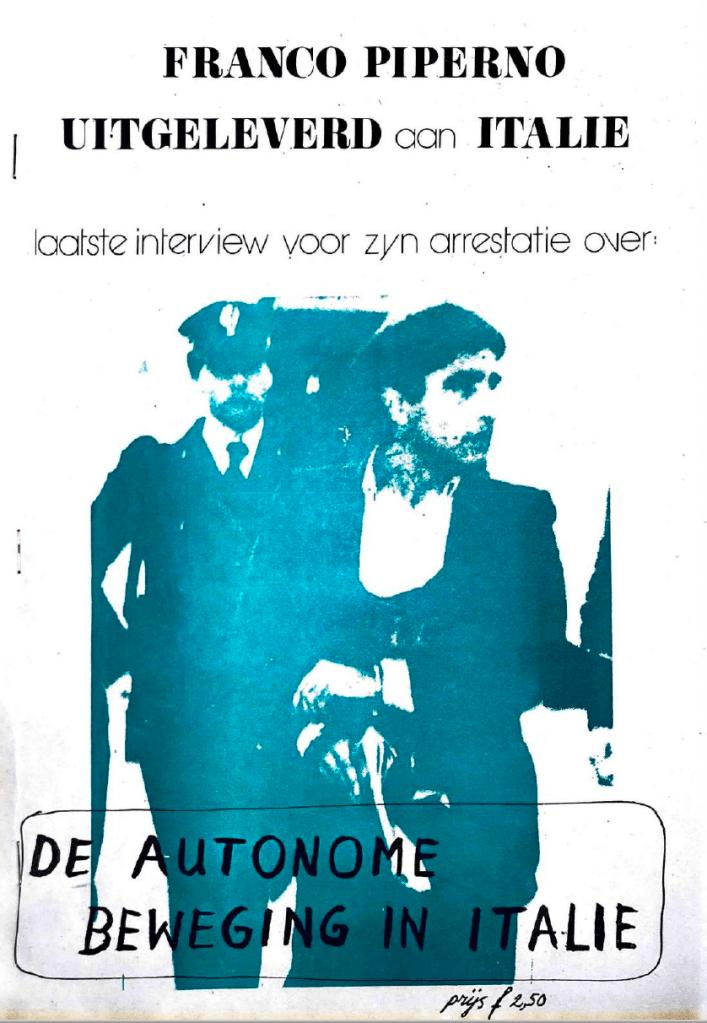
“Franco Piperno Uitgeleverd aan Italie: Laatste interview foor zyn arrestatie over: De Autnome Beweging in Italie” (1980)

Franco Piperno, a physicist and founding member of Potere Operaio, was one of many militants targeted by the Italian authorities, following the kidnapping and subsequent killing of Aldo Moro by the Red Brigades in 1978. He was a founder of the autonomist journal Metropoli (along with Oreste Scalzone and others) whose editorial team was targeted in the 1979 sweep against the radical left.

Piperno fled to France, and was extradited in 1979 on charges related to the Moro kidnapping. Those charges were subsequently dropped, with the Christian Science Monitor noting that they illustrated “the penchant of Italian police to often arrest first and hope to find concrete evidence later.” Piperno went back to France and was subsequently arrested twice during the fall of 1981 in Montreal (Canada). Subsequently, Piperno – with strong international support – won a fight against extradition back to Italy, only to be arrested again, for a third time, on additional charges; he subsequently beat that case. With a tourist visa expiring, Piperno sought to leave Canada and go back to France, only to be refused entry. He then filed for refugee status in Canada. In 1988, he returned to Italy, where, having been sentenced to 10 years of incarceration, he served a reduced prison sentence. (The CIA was a bit contemptuous of him). He has since been involved in other projects.

The international organizing in support of militants targeted by the Italian state in 1979 is a story in need of its own book(s). Interesting pieces of that struggle include Marty Glaberman (and Toni Negri’s) lawsuit against a voice expert in Michigan, the Committee Against Repression in Italy coordinated by Federici and Caffentzis, the organizing of Guattari and Moulier-Boutang’s Centre d’initiatives pour de nouveaux espaces de liberté (CINEL), etc. For those interested in a starting point, it’s worth looking at Red Notes’ fantastic collection Italy 1980-81: After Marx, jail! The attempted destruction of a communist movement, available here.

From the ninth issue of the Committee Against Repression in Italy, courtesy of Arlen Austin’s scanning

The subject of this post is the second of two pamphlets put together by activists in the Netherlands who were concerned about the repression in Italy and similars developments elsewhere. The first of the two pamphlets was put together by the Komite Bella Italia and participants in the psychiatry journal Narreschip, entitled “De autonome beweging in Italië,” and published in 1979. The second of the pamphlets, with the focus on Piperno, was put together by two participants in the Narreschip project, Martijn Bool and Ronald Kampman. Per the introduction, their interest is not just in Piperno but in the wider meanings of cases against activists internationally:

“We are not only interested in Piperno, but also in the fact that it is an example of how in Western Europe the (certainly outdated, dating from the King’s era) right of asylum is being eroded, and how there is an ever-increasing judicial and police cooperation at the European level: the creation of a European judicial area.”

(Translation via DeepL).

The two writers go on to note, “This brochure is written by two people from the group that made the first brochure. In itself we like to make such a brochure, but we have also become lonely, unpaid journalists; that means a lot of work, especially since there are only a few of us.” While they appeal for others to take up their project and engage in dialogue, we could not find published evidence of that having occurred.

The main text of the pamphlet is a Dutch translation of Piperno’s last interview prior to his extradition to France in 1980. The interview was done for the French journal Liberation (we, unfortunately, could not locate a copy online). The pamphlet also includes a court statement from Piperno and a call for Piperno’s freedom, written by CINEL.

This pamphlet is rare. We locate one copy, via OCLC, at the Institute of Social History in Amsterdam. As we could not find a copy online, we scanned it (not too well) and posted it on Libcom, here.

(Last update – November 11th, 2023).

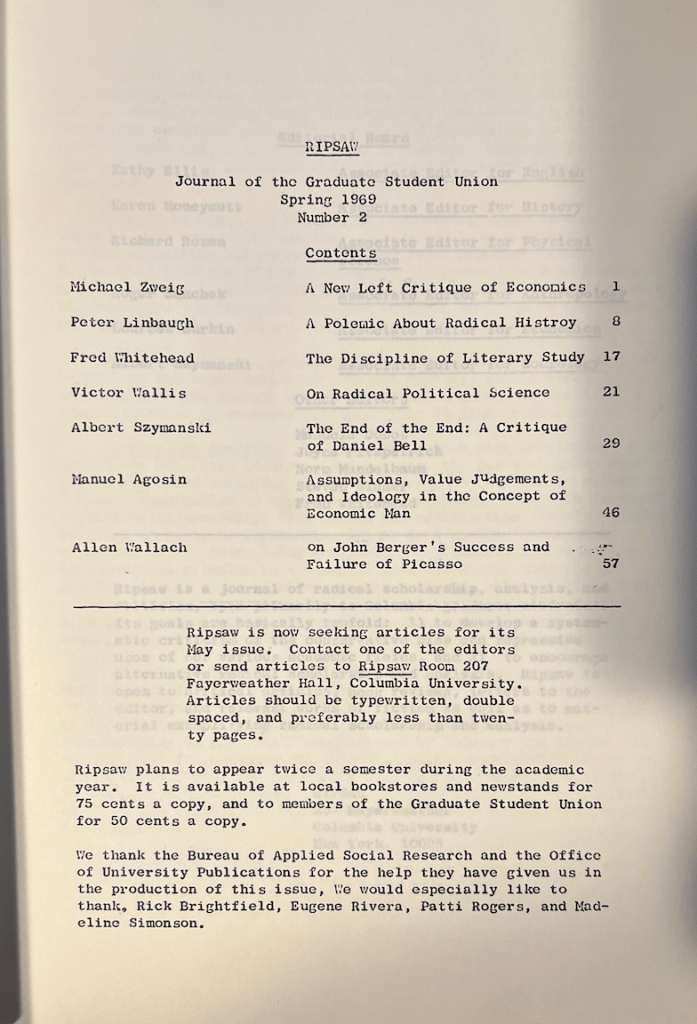
Peter Linebaugh, “A Polemic on Radical History,” in Ripsaw #2 (Spring, 1969)

Early essay written by historian Peter Linebaugh in 1968, published in Ripsaw, the radical student journal of the Graduate Union of Columbia University.

An early piece by Peter Linebaugh – editorial member of Zerowork and collective member of Midnight Notes – who would go on to write the seminal work The London Hanged (1991).

The essay is very much a work of its time. Couched within the historiography of the period, its targets are the “New History,” with its move toward quantification, its use of specific jargon, and its positivism. He gets some digs in at Staughton Lynd and the historicans associated with Radical America, which was interesting. The influence of EP Thompson, Linebaugh’s mentor, is clear.

Ripsaw published a total of 5 issues, the first two with the tagline “published by the graduate student union of Columbia University,” and then after that by the “graduate students at Columbia University.” As we understand it the journal ceased publication in 1970.

Interestingly, few copies of Ripsaw are held by institutions. We locate a complete set of 1-5 at NYU, but even Columbia only seems to have 1-4. Number two is held by just a handful of schools, per OCLC.

The Linebaugh article is of interest for our project, but the other pieces less so. Accordingly, we have scanned his article and placed it on Libcom, here.

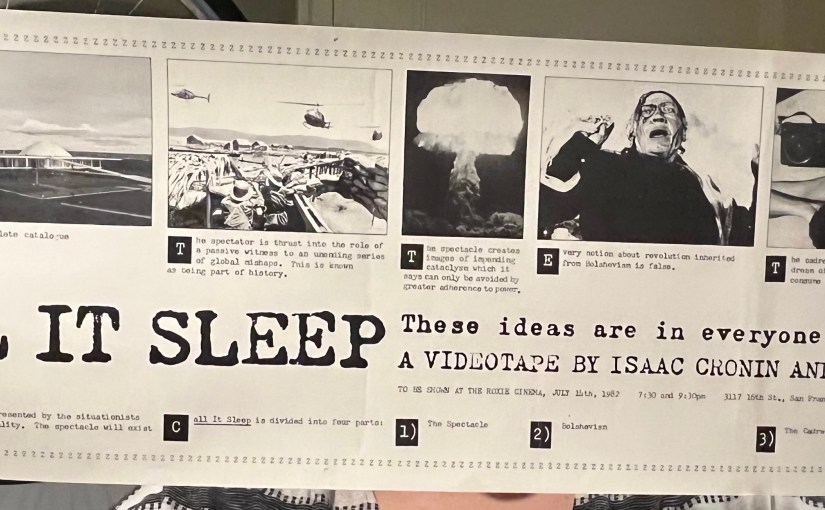
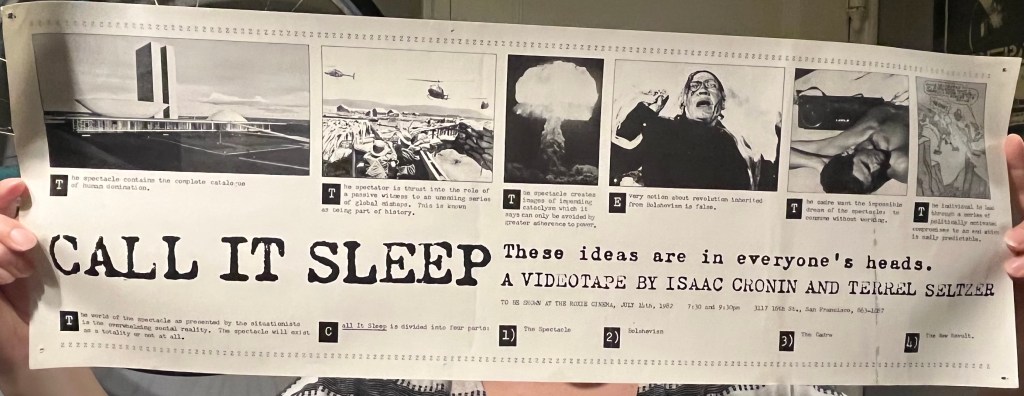
Isaac Cronin & Terrel Seltzer. Call it Sleep. Poster for the film’s second showing, in 1982, at The Roxie in San Francisco.

Our copy of the poster

Call it Sleep is a situationist film created by Isaac Cronin and Terrel Seltzer. Released in 1981, the film has become a bit of a cult classic for those interested in situationist ideas in the decades since. It is available for free online via YouTube, here. It really is quite well done and we strongly recommend watching it.

While copies of the film script are often available in the trade, copies of the poster used to advertise individual screenings are far less common. OCLC locates no institutional holdings. Our copy is for a July, 1982 screening at The Roxie in San Francisco.

According to Cronin, the event at The Roxie was the second public showing of the film and some 600 people attended. Readers can hear him discuss the development of the film in a very helpful interview done by Aragorn! (RIP) on the The Brilliant podcast, here.

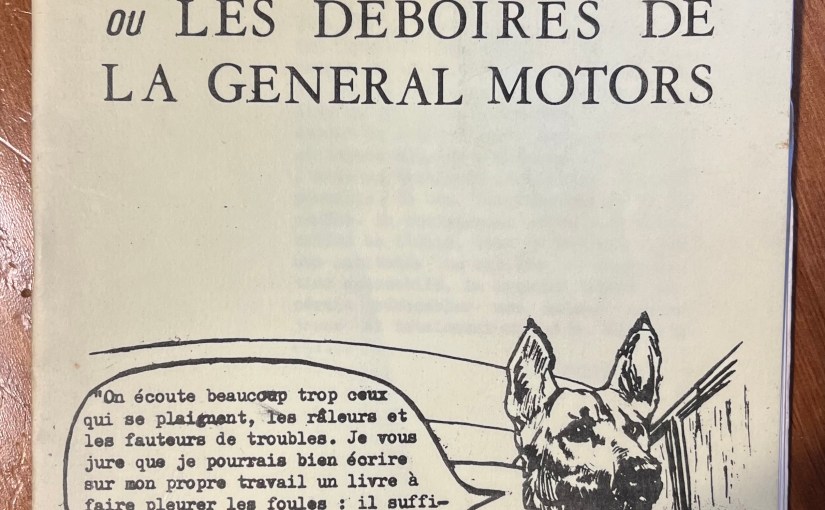
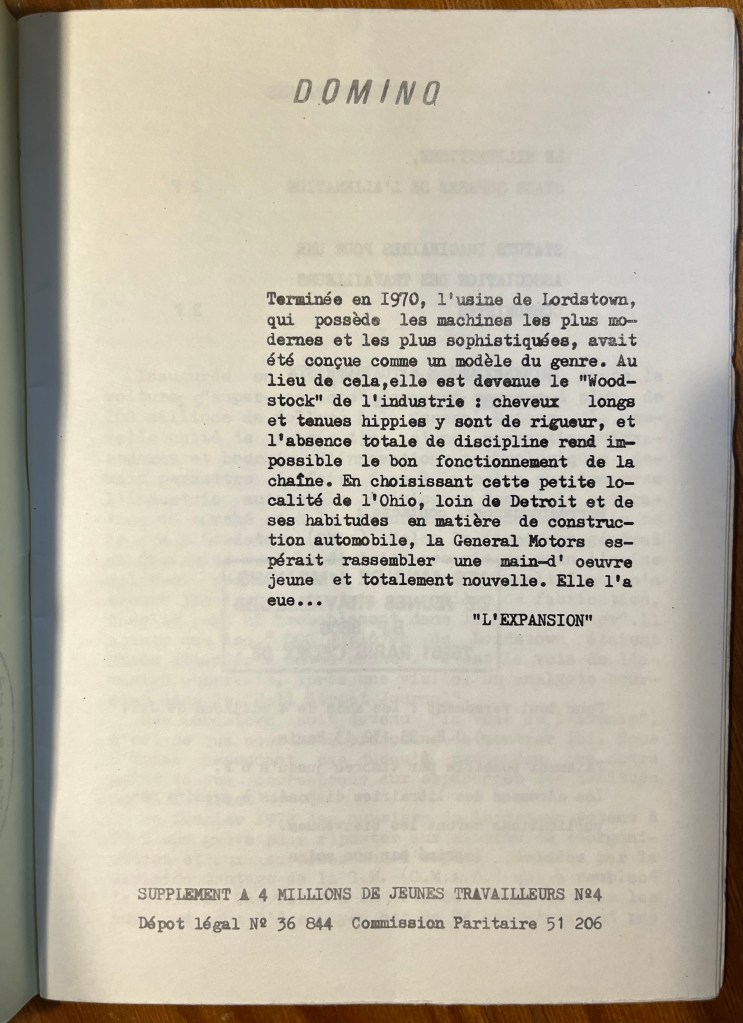
Anon. “Lordstown 72 ou Les deboires de la General Motors”. First edition (1973).

First edition of this pamphlet, published without authorship, in 1973. While it is often stated that the pamphlet was published in 1977, that doesn’t make sense from the content of the essay, which is clearly contemporaneously written during the upsurge of factory-based struggles in the early 1970s. The 1977 edition refers to the second edition, which was published by Editions de l’Oubli and includes a notation that the first edition was published in 1973.

This essay is a powerful communist analysis of the struggles at the GM plant in Lordstown, Ohio, that was opened in 1970. In 1972 the overwhelming majority of workers voted to authorize a strike. But Lordstown 72 focuses less on the strike authorization or actual strike than on the culture of working class sabotage and self-organization that it occurred in.

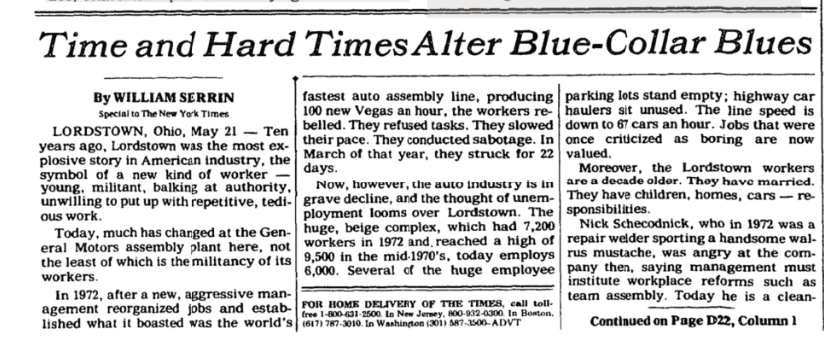
“Time and Hard Times Alter Blue-Collar Blues,” cover page of the New York Times May 25, 1982.

The essay is a striking assessment of the generalization of sabotage and everyday resistance, which occurs in context of widespread forms outside of the union and party structures. The author(s) analysis seamlessly flows from shop-floors in the U.S. to those in Italy and elsewhere. From a culture of resistance the author(s) then try to locate seeds of communism in the workers’ struggles.


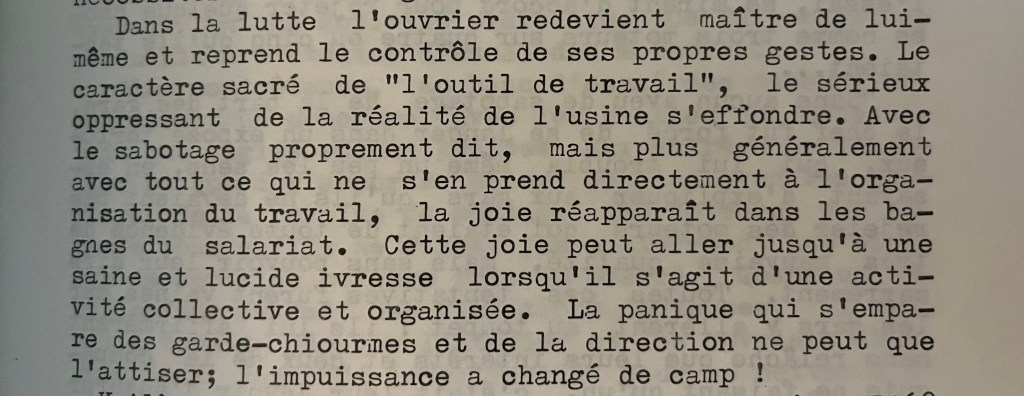
In the struggle, the worker regains control of himself and his own movements. The sanctity of the
“tool of the trade”, the oppressive seriousness of factory reality, collapses. With sabotage itself, but
more generally with anything that directly attacks the organization of work, joy reappears in the
prisons of wage labor. This joy can even lead to a healthy, lucid intoxication when it comes to
collective, organized activity. The panic that grips the guards and management can only fan the
flames; impotence has changed sides!” (translation via Deepl, so there may be errors).

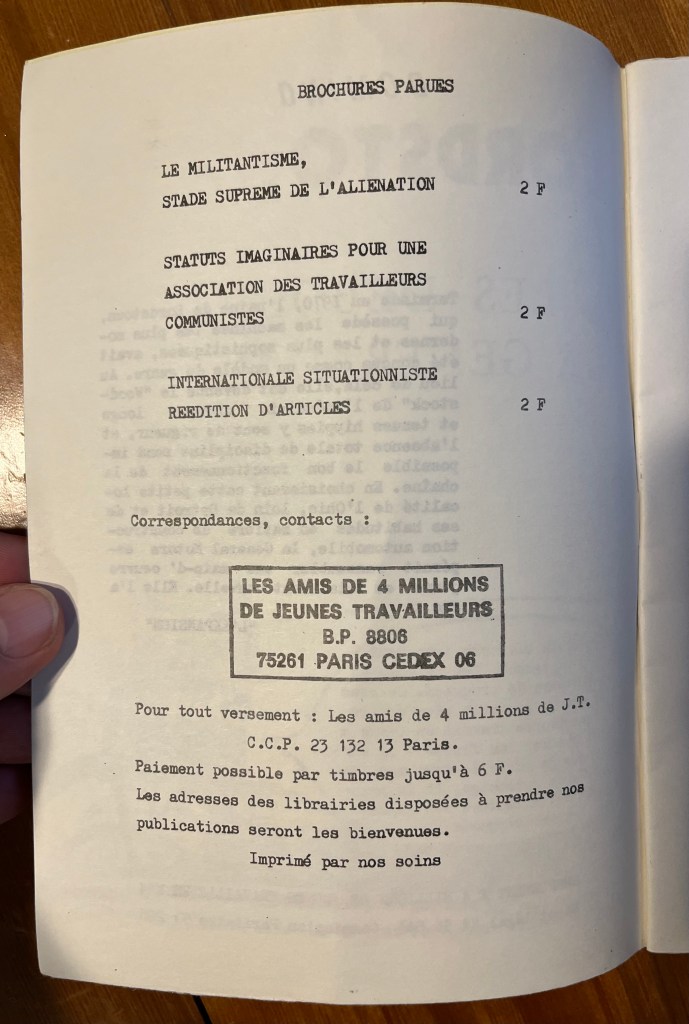
As mentioned above, the first edition of the pamphlet stated no authorship. The second edition would attribute its authorship to “Pomerol et Medoc,” though those appear to have been pseudonyms. The pamphlet was produced as a supplement to the fourth issue of 4 Millions de Jeunes Travailleurs and published, presumably by the same people, under the moniker of Les Amis de 4 Millions de Jeunes Travailleurs. The group published a number of relatively important essays within the French ultra-left milieu of the 1970s, as well as a collection of pieces from the Internationale Situationniste. The major figure behind the project, at least from what we could find online, was Dominique Blanc, who would later go on to found the antisemitic journal La Guerre Sociale.

The first edition of the pamphlet is rare. Copies very rarely show up in the trade. We did not locate any on OCLC but copies are probably held in one of France’s anarchist libraries.

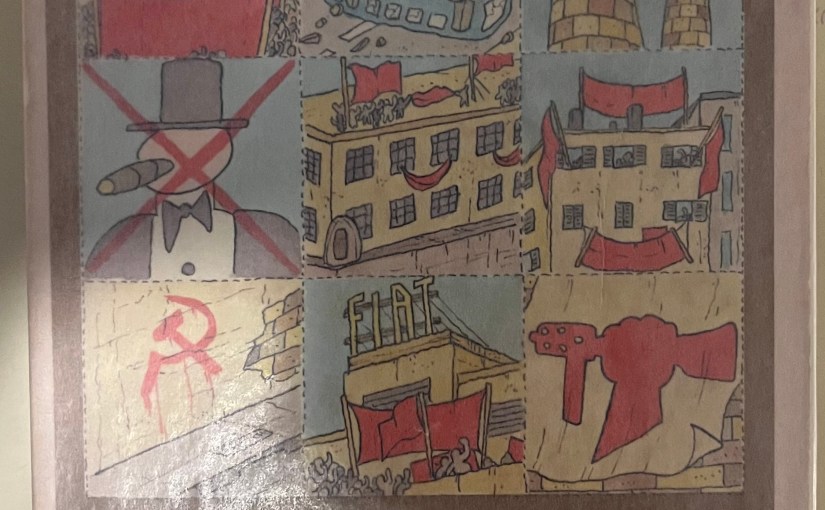
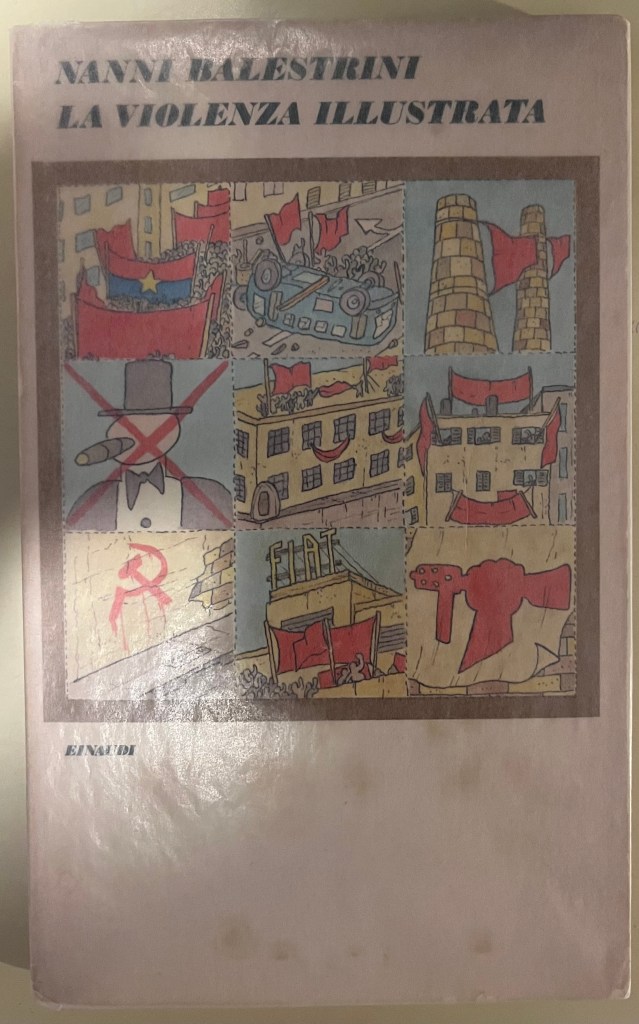
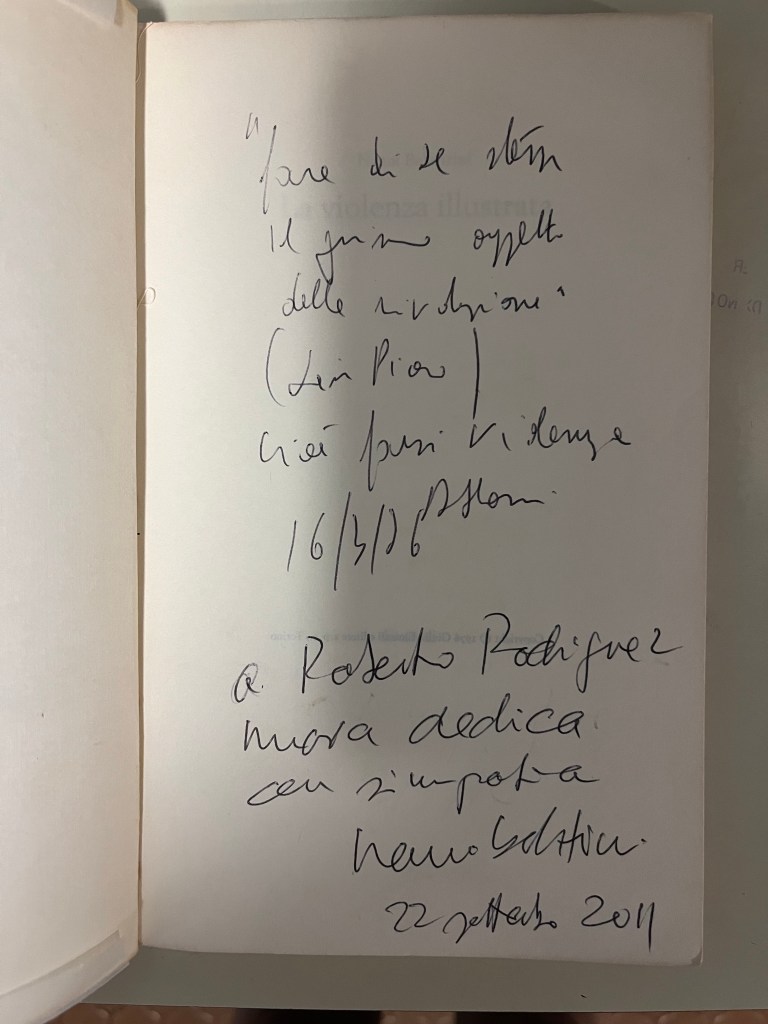
Nanni Balestrini, La Violenza Illustrata (1976), twice inscribed.

First edition of La Violenza Illustrata, the important third novel by brilliant Italian poet, novelist and militant, Nanni Balestrini, who passed away in 2019. To our knowledge the novel has not yet been translated into English.

First editions of the book, whose cover features the artwork of Pablo Echuarren, are common, but our copy is unique in that it was inscribed by Ballestrini twice – first in 1989 and again in 2011.

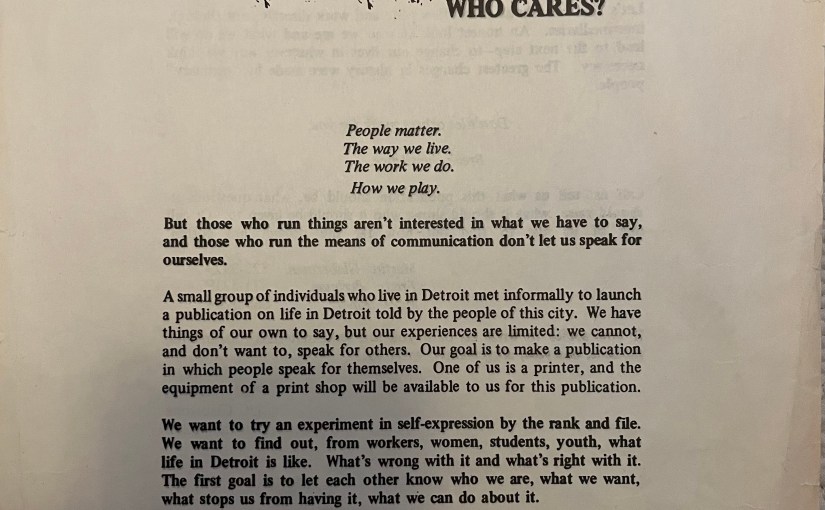
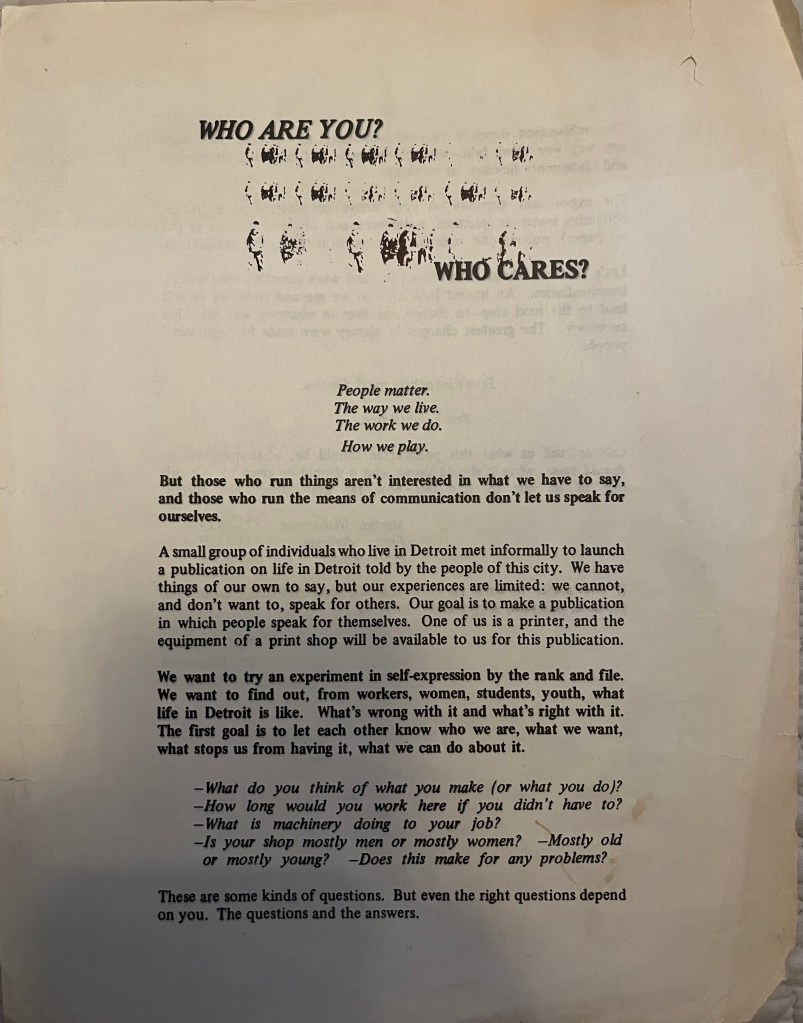
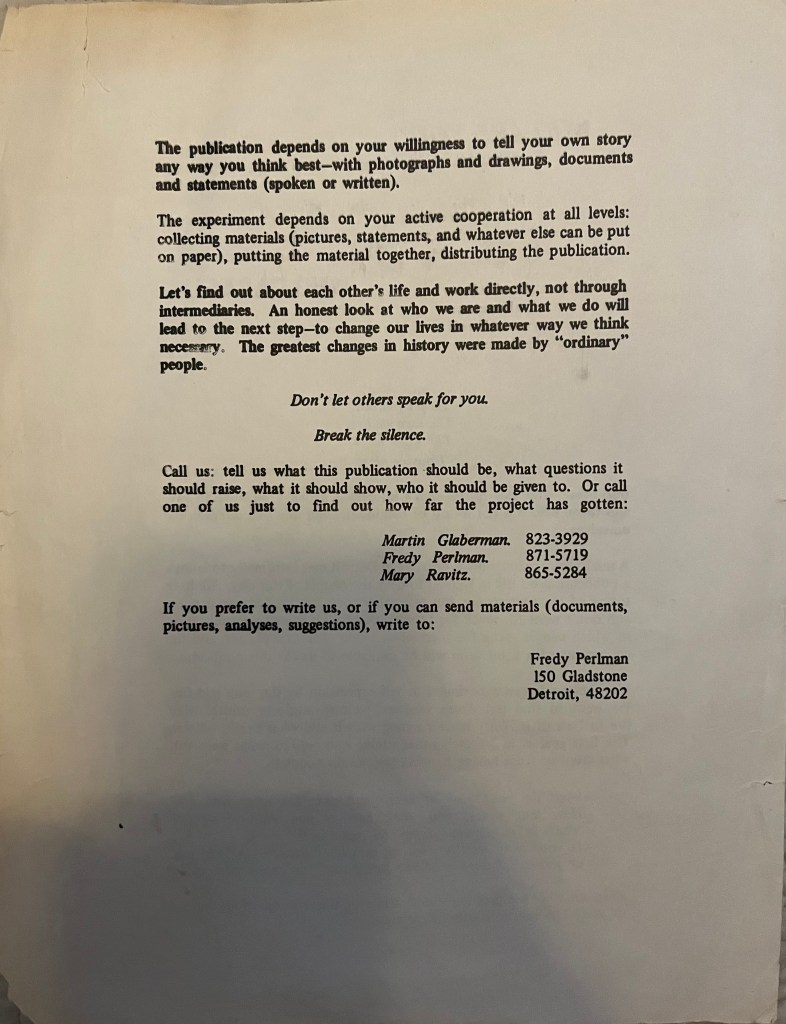
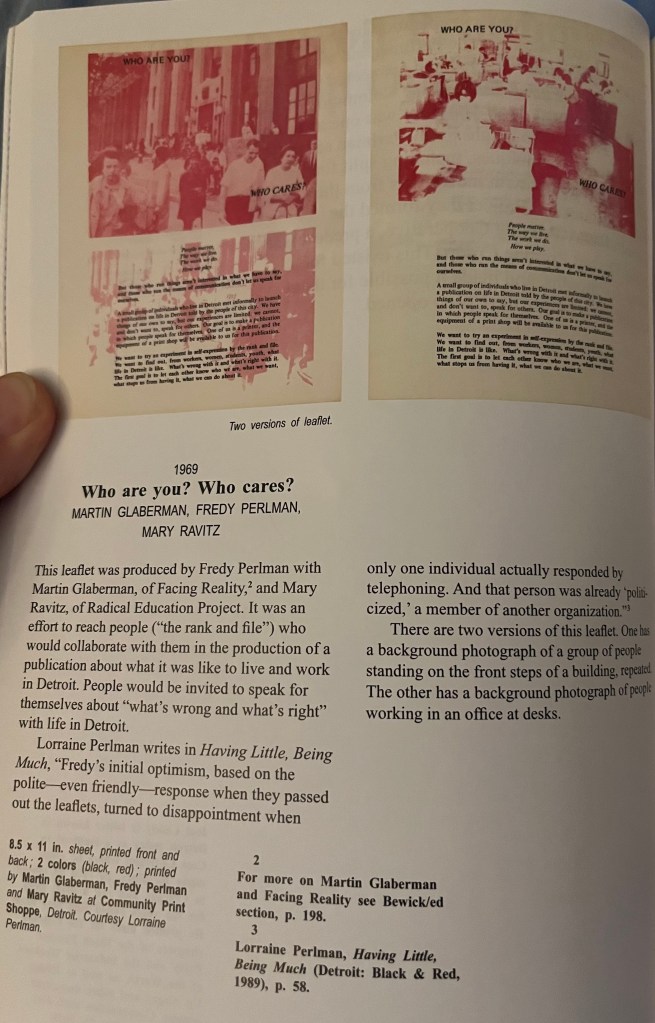
Martin Glaberman, Fredy Perlman, Mary Ravitz. “Who are you? Who cares?” (1969)

Flier produced at the Detroit Printing Co-Op in 1969 by Fredy Perlman, Marty Glaberman and Mary Ravitz. Glaberman will be well known to readers of this blog.

Danielle Aubert, in her wonderful book The Detroit Printing Co-op: The politics of Joy of Printing, gives a brief history of the document that we include below. Aubert notes that there are two versions of the flier, both of which have red photo’s in the background. Our unique copy, which has clearly had a dramatic life, differs from both of the fliers noted by Aubert – there is no picture and the spacing between “Who are you?” and “Who cares?” is reduced.

From Aubert’s book:

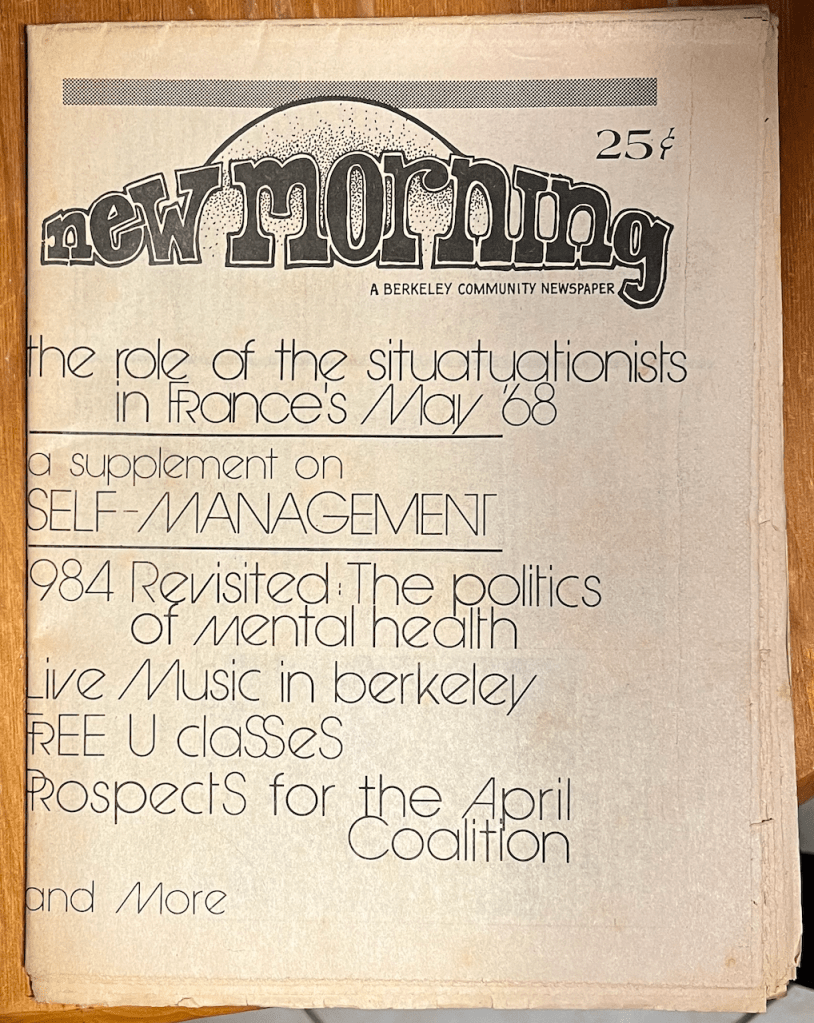
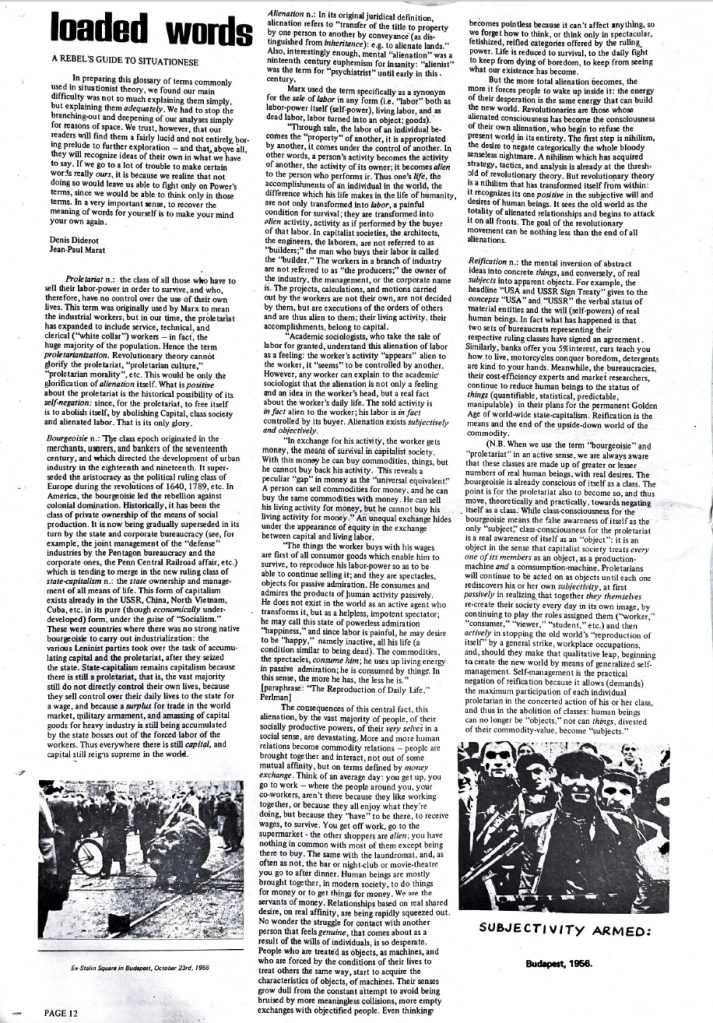
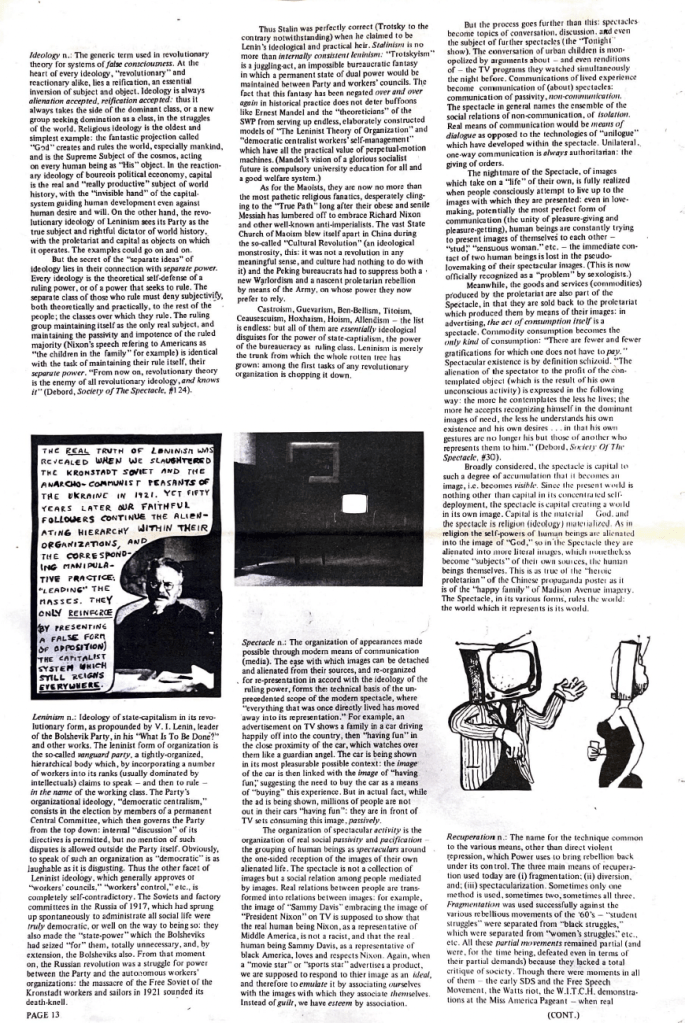
“Loaded Words: A Rebel’s Guide to Situationese,” by Denis Diderot and Jean-Paul Marat (pseud.) in New Morning: A Berkeley Community Newspaper. February, 1973.

Cover of New Morning, February, 1973.

We first heard of “Loaded Words” via the very useful bibliography of American pro-situationist publications that Not Bored! put together years ago and posted on their website (here). We were confused because they put Cleveland as the place of publication, where there was a newspaper by a collective also called “New Morning” (info here). But the piece was actually published in the Berkeley publication New Morning: A Berkeley Community Newspaper.

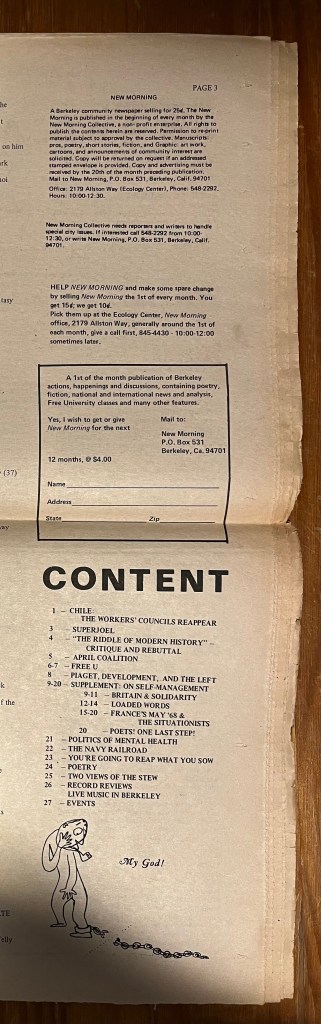
There is no online archive of New Morning issues and very little writing that mentions the publication from what we could find. (There must be a memoir that includes discussions of it somewhere, please let us know if you are aware of any!) There’s not much detail in the publication itself. Here’s the masthead from the February, 1973 issue:

Tom Woodhull, part of the pro-situ group Negation (as mentioned in his interview with Chomsky, here), had some involvement with New Morning for at least a couple of issues, as he was also involved in the preceding month’s issue that included an article on council communism. This issue was likely that mentioned by Ken Knabb in his essay “Remarks on Contradiction and its Failure,” when he cites “an underground paper trying to fill up the current ideological void will put out a special issue on situationism which simply lumps together everyone who is able to babble a few slogans about the spectacle, sacrifice, Leninism, etc., and publishes a “Dictionary of Situationese” for the edification of those who aren’t yet even capable of that.”

Yet, even given Knabb’s criticisms, “Loaded Words” is, in fact, a good, quick and dirty introductory guide to core situationist concepts. It seems reasonable to guess that Woodhull may have been one of the two pseudonymous authors. In 1975 the “Beni Memorial Library” in Ann Arbor published a very helpful book (available here) called A Bibliography of North American Situationist Texts, which included an entry on “Loaded Words”:

We see no reason to repeat the contents of that entry (anymore than we already have), since it does the bibliographic job quite well.

We were surprised that “Loaded Words” hadn’t been placed online yet, so we scanned it and put it on Libcom, here.

This issue of New Morning is uncommon, though available, it appears, in some microfilm collections of the underground press and in a handful of libraries.

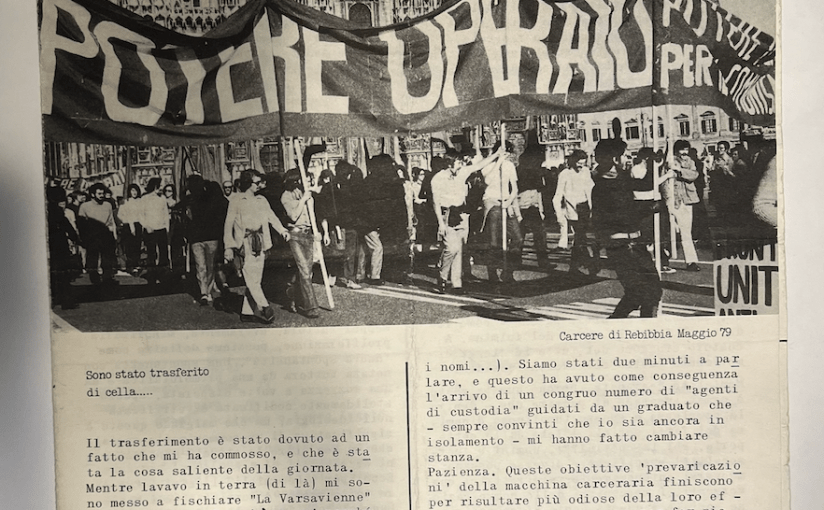
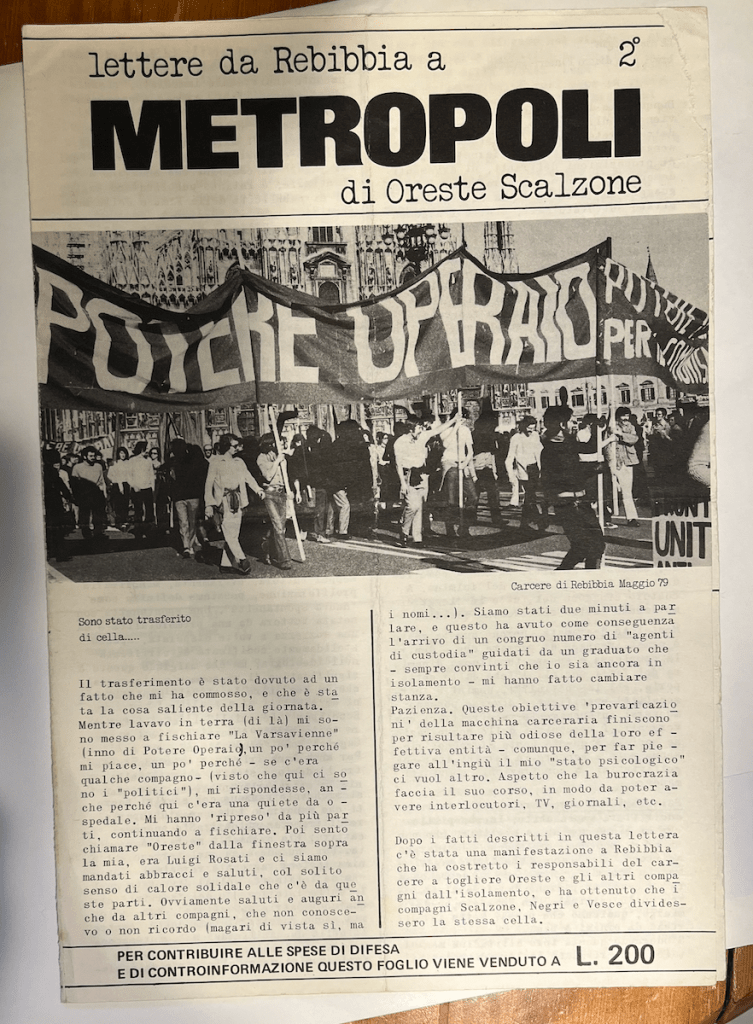
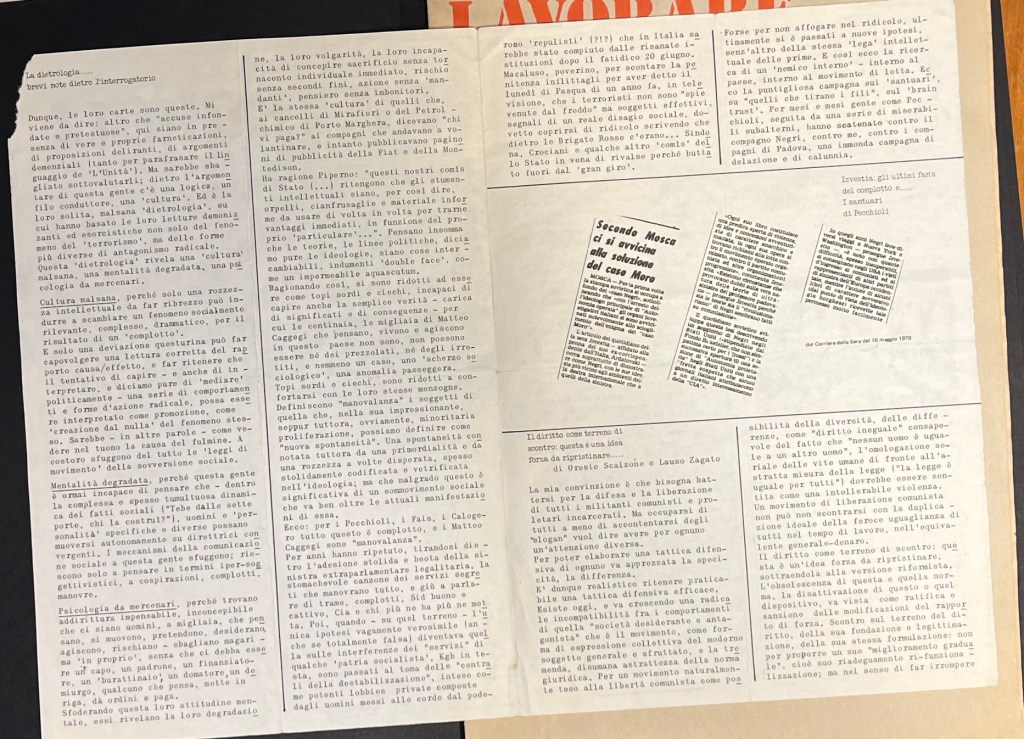
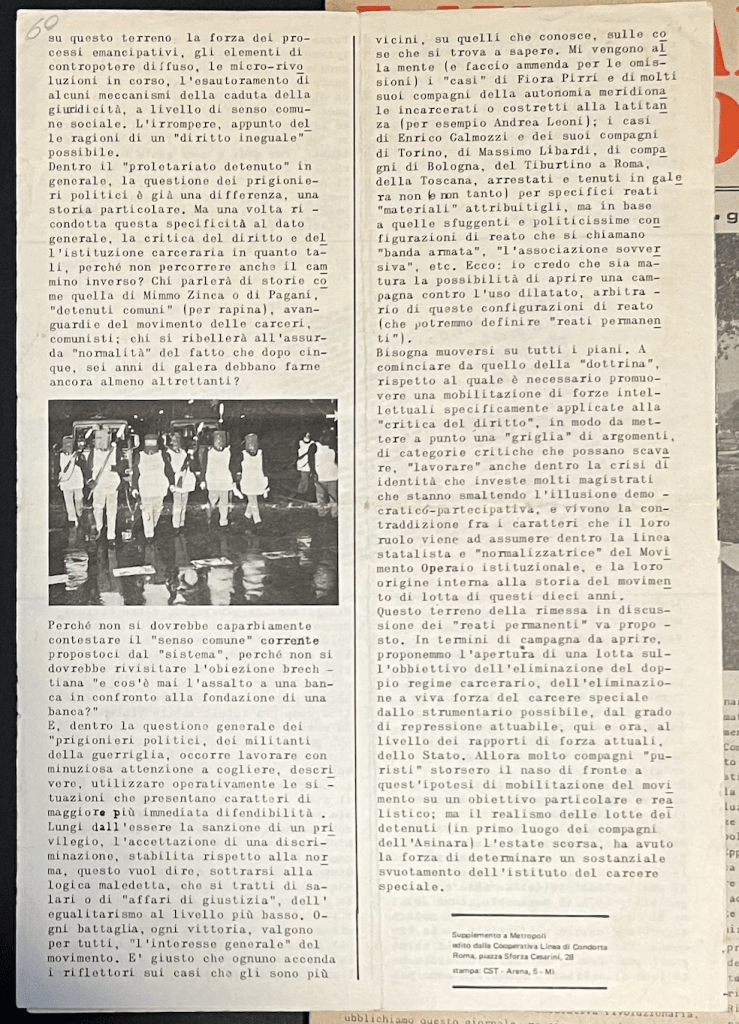
“Lettera da Rebibbia a Metropoli di Oreste Scalzone” (supplement to Metropoli) – May 1979

Following the mass arrests of April 7th, 1979, where militants and intellectuals were arrested on conspiracy, subversion and insurrection charges (tens of thousands would be arrested across the following years). Antonio Negri, famously, was part of the sweeping round-up, having been wrongly accused of being part of the Red Brigades and behind the killing of former prime minister and leader of the Democrazia Cristiana party, Aldo Moro. Many of the prisoners were incarcerated at Rebibbia Prison in Rome.

A May 1979 statement, signed by Mario Dalmaviva, Luciano Ferrari Bravo, Toni Negri, Oreste Scalzone, Emilio Vesce and Lauso Zagato, states:

“We are being tried for a decade of political struggle in Italy, from 1968 to 1979. With this prosecution, State power has spoken out loud and clear — a horrendous alibi for its incapacity to resolve the real underlying problems confronting Italian society in the crisis. This trial is aimed to outlaw the political movement of working class and proletariat autonomy. In order to succeed, State power has to state and prove that “the party of the new social strata of the proletariat” is the same thing as “the armed party” — i.e. the terrorist groups. They have to be made to appear as identical. All of us in the Movement know the motive behind this operation. The State “projects” onto these strata and onto the men and women who have lived the social struggles of the new proletariat, the accusation of being terrorists, “the armed party in Italy”, so that, by criminalizing the Movement, it can resolve its own inability to function. We are militants and intellectuals of the autonomous Left movement. In striking its blow at us, the State is attributing to us a power as “leaders”, a representative role, that we do not possess.”

Oreste Scalzone, a leading militant of Potere Operaio, and a founder of the important journal Metropoli, was one of those arrested (his arrest occurred two months before the publication of the first issue of the journal). This supplement to Metropoli was published before the printing of Metropoli’s first issue in June 1979. The second issue of the journal was published, nearly a year later, in April 1980.

The pamphlet is divided into 3 letters from Scalzone, with one co-written with militant prisoner Lauso Zagato. The first letter is a vivid description of camaraderie on the inside, with Scalzone finding other comrades in the prison before being forcibly transferred to another; the second is an analysis of his interrogation whereby the authorities can only see a conspiracy (and not a diffuse movement); and the third a brief analysis of, and call for struggle on, the terrain of prisons and law.

We were unable to locate a scan online so have uploaded on – here – to Libcom. The publication is rare, we locate only a single institutional holding, which is at Biblioteca Nazionale Centrale di Roma.

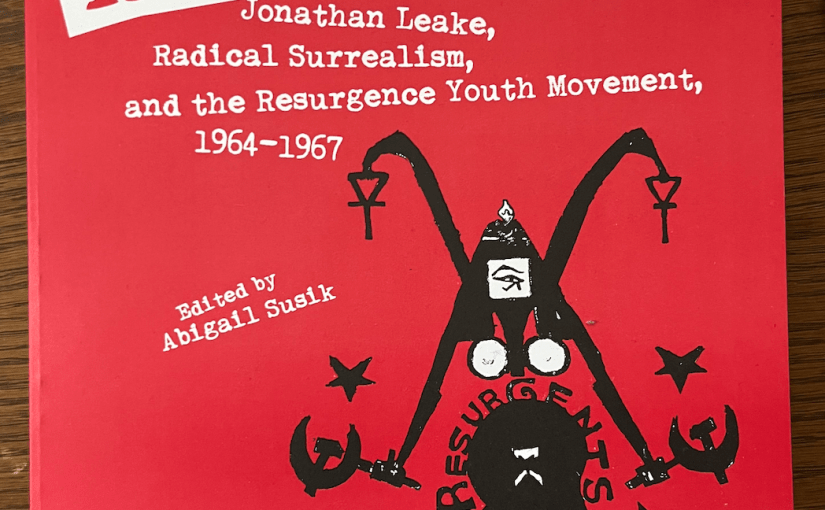
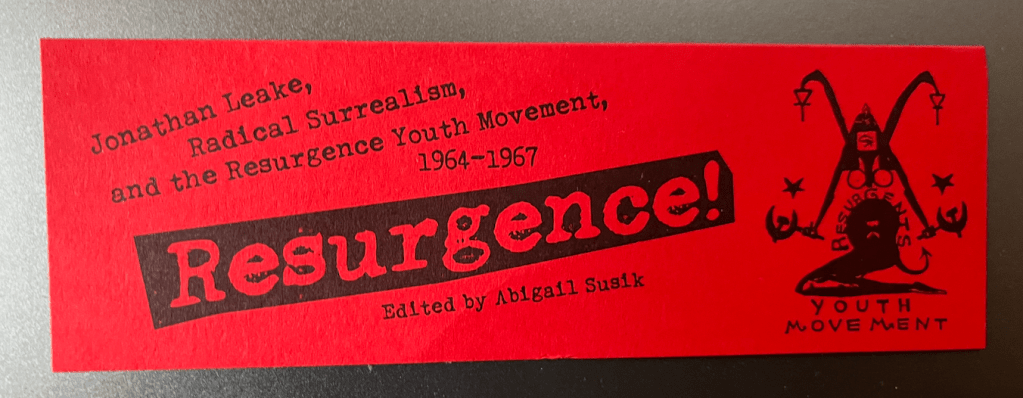
Resurgence! Jonathan Leake, Radical Surrealism, and the Resurgence Youth Movement 1964-1967 (ed. Abigail Susik, Eberhardt Press, 2023)

We are extremely excited about the publication of Resurgence: Jonathan Leake, Radical Surrealism, and the Resurgence Youth Movement, 1964-1967, printed in a limited edition of 500 copies by Eberhardt Press in Portland, Oregon.

The book helps to fill a significant gap in the literature available about the anti-authoritarian left in the US during the 1960s, as well as circulation of surrealist ideas during this period, and connections between the American ultraleft of the 1960s and the punk and squat scenes in New York City in ensuing decades.

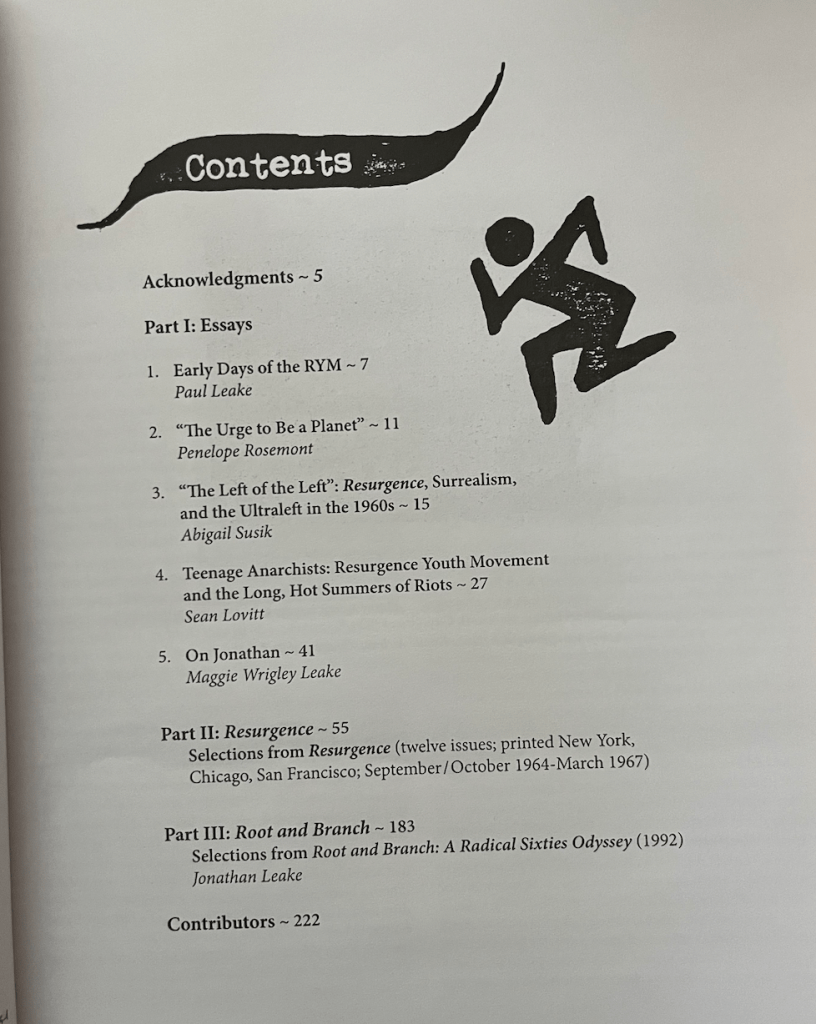
The book is divided into 3 major sections. The first consists of essays that contextualize the Resurgence Youth Movement. Perhaps most relevant and useful for readers of this little blog is scholar Abigail Susik’s essay on the anti-authoritarian left of the 1960s. It it is in Susik’s essay that we learn the neat factoid that the first issues of Resurgence were printed on a mimeograph machine provided to Jonathan Leake by Raya Dunayevskaya after a News and Letters convention (p. 17).

The second section of the book consists of selections from journal Resurgence, much of which was impossible to access up until the publication of this book. The third section of the book consists of selections from Jonathan Leake’s unpublished autobiography, Root and Branch.

The design of the book is simply breathtaking and is clearly a labor of love printed by Charles Overbeck, the person behind Eberhardt Press.

Ill Will has published some selections from the book, here. It is available for purchase, until the print run is gone, from Eberhardt’s website, here. We hold donor’s copy #19 in an edition of 150.

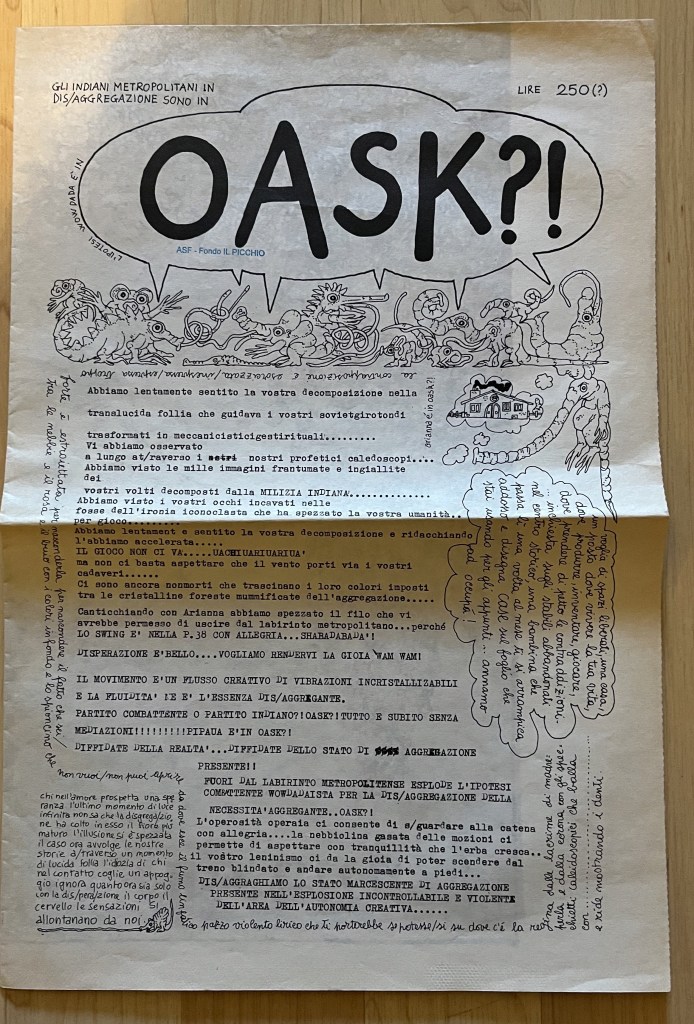
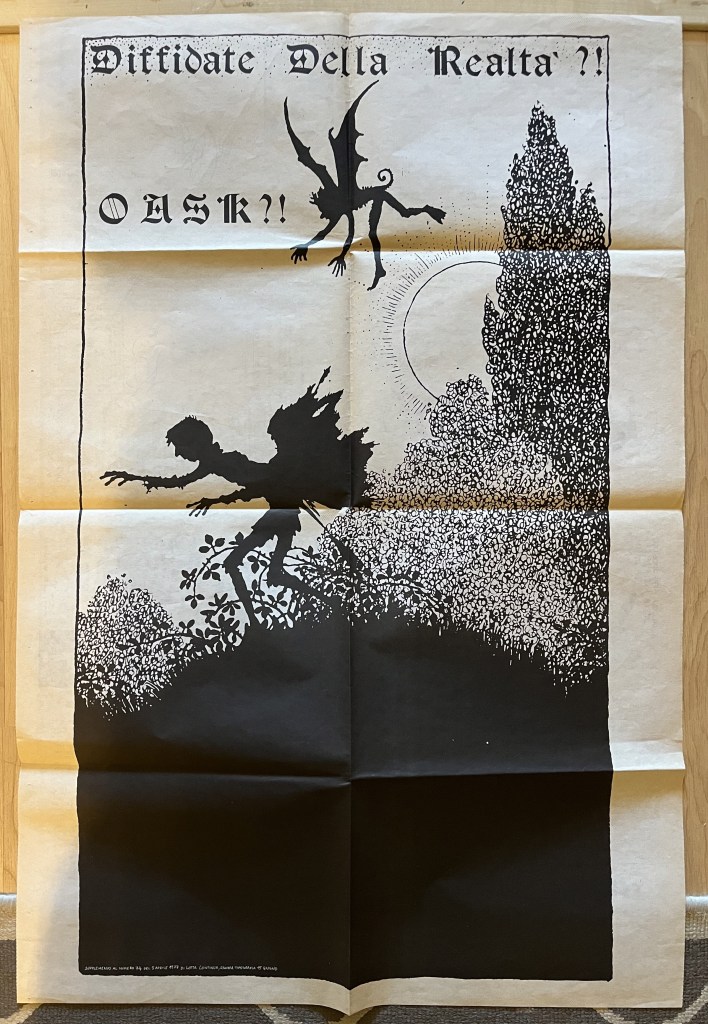
Oask?! – Unique issue, 1977 (Pablo Echaurren, w/ Maurizio Gabbianelli, Massimo Terracini, Pablo Echaurren, Gandalf, and Carlo Infante).

Oask?! cover

Oask?! (an anagram of “kaos”) was the first publication of the Metropolitan Indians. It was published as a supplement to issue 74 of Lotta Continua, and is primarily the work of famed Italian artist Pablo Echaurren. This was the only unique issue of Oask?! published, but Echaurren would use the nameplate in other collaborations (for example the publication of Abat/Jour). At the time, Echaurren worked full-time for Lotta Continua.

Jacopo Galimberti (2022) provides useful discussion of the context and publication of Oask?!,

“Apart from his work for Lotta Continua, Echaurren and some peers published a zine called Oask?! (an anagram of caos, meaning ‘caos’). Released in the aftermath of the March 1977 revolts, its graphic look took the inventions of A/traverso and Zut to the extreme” (p. 339-340).

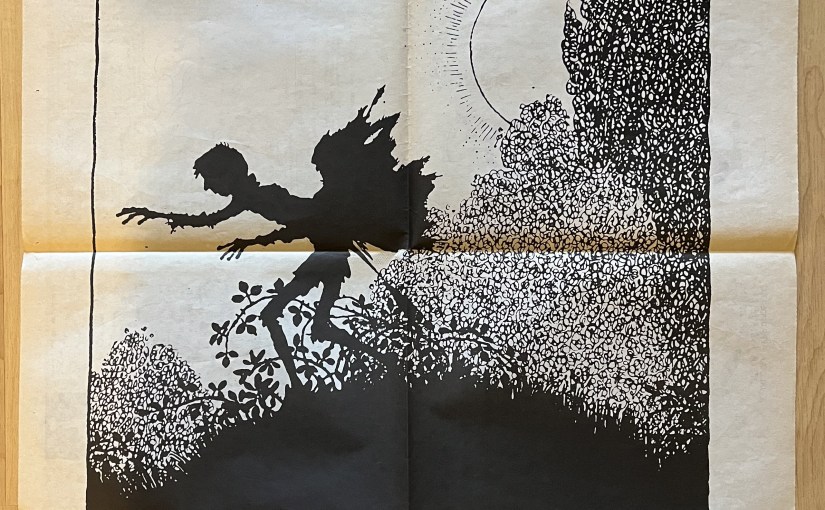
The publication is one large single piece of newsprint that folds out to a stunning poster, reading “Diffidate della realta?!” (“Do you trust reality?!).

We take the listing of authors from Echaurren’s digital archive at the Bibliotheca Hertziana (Max Planck Institut) in Rome, which hosts a high resolution scan of the initial version of Oask?! that they credit exclusively to Echaurran (here). We note that De Donna & Martegani (2019) list the authors as Echaurren, M. Gabbianelli, Carlo Infante, G. Malatesta, S. Pela, R. Di Reda, F. Saglio, M. Terracini, and O. Turquet (p. 332).

The publication is rare. Worldcat lists the Beinecke library at Yale as only institutional holding (they bought Echaurren’s archive some years ago), but we know others hold the publication.

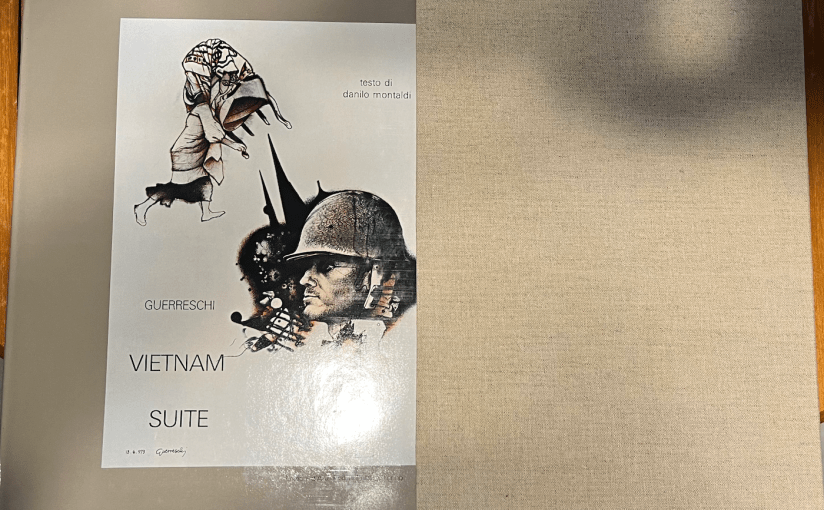
Giuseppe Guerreschi, Danilo Montaldi, Vietnam Suite, with etching (1974)

We hope to write more posts in the future about our holdings from the work of Danilo Montaldi, who is perhaps the father of workers inquiry in Italy (and whose conceptualization of the ‘working class’ encompassed those who American sociologists would derisively condemn as “the underclass”). Today’s post is about Montaldi’s remarkable project with Giuseppe Guerreschi, Vietnam Suite.

As Jacopo Galimberti documents in his newly published (and groundbreaking, for English-speaking audiences) work Images of Class: Operaismo, Autonomia and the Visual Arts (2022), Montaldi’s interests in art are an under-discussed part of his intellectual and political trajectory. His engagements with the Italian artist Guerreschi (collected in the book Lettere), including Vietnam Suite, were “intentionally or not, implemented an unusual type of co-research involving an artist” (p. 204).

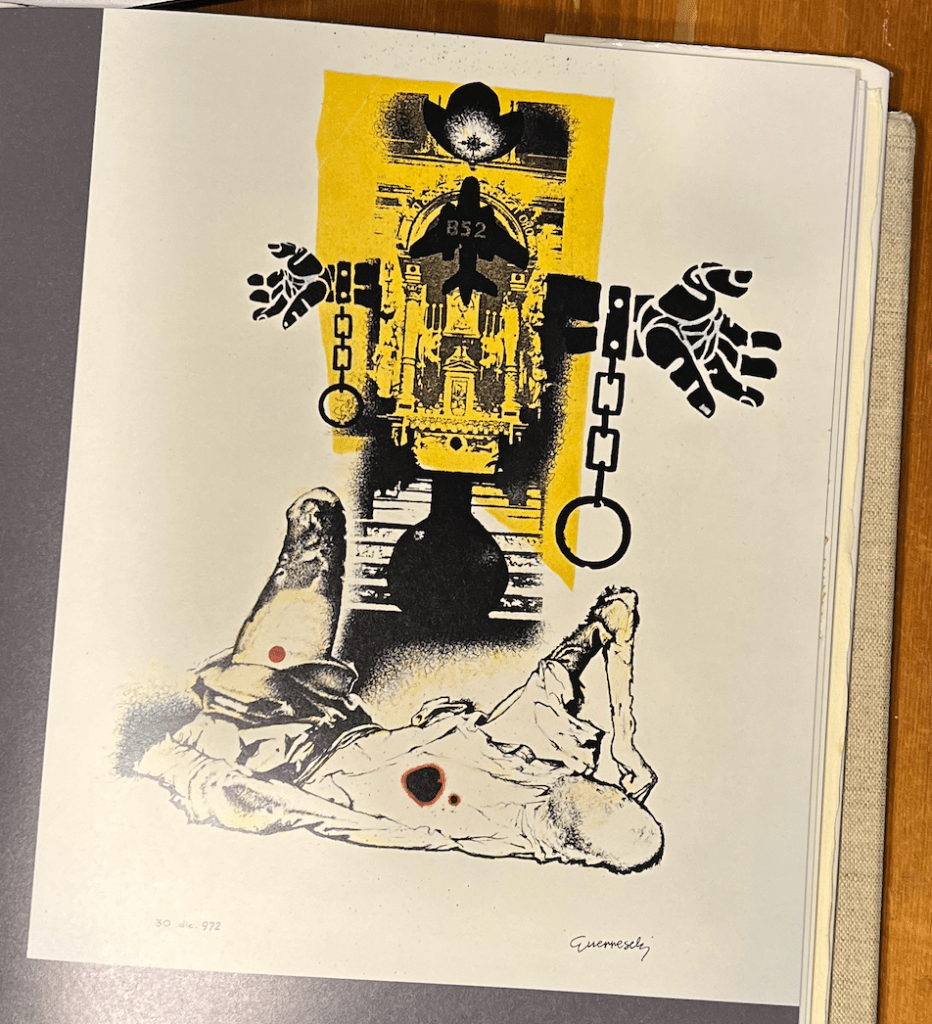
Vietnam Suite, as a collection of etchings by Giuseppe that portray often brutal images related to the Vietnam War, was published twice, but with different texts. The first publication was a catalogue for the 1973 exhibit at the Fanto de Spade gallery in Milan, which did not contain Montaldi’s adjoining text. This second version was published the following year, in 1974, by Fratelli Pozo in Turin. Montaldi’s essay is entitled “Sul Vietnam, Problemi, Date E Immagini” (“About Vietnam, Issues, Dates And Images. To Nikolaus, Diego, Max.”)

Montaldi’s essay begins by explaining that it was in the “summer of 1947 that, for the first time, we heard about Vietnam, about the war in Indochina.”

“We are only ten years away from the Spanish ’37, from those days of May that had revealed how necessary it was, in order to proceed along the path of workers’ power, to carry out a revolution within the revolution itself. And we were only two years into the Second World War. Still fresh were the images of the great revolutionary writings on the walls of the Nazi concentration camps of the liberated Spanish fighters; Spain had been the testing ground for the second imperialist war; with Vietnam there was almost the impression of a new Spanish war.”

He goes on to describe what would become Vietnam War as “the war, in no other terms, the war of horror, of obsession, of hate” (rough Deepl translation). Montaldi is unsparing with his analysis of Ho Chi Minh. Following the Ho-Sainteny agreement of 1946, he sees a counter-revolution.

Behind the movement that led Ho Chi Min to the agreement lay the whole Stalinist conception of revolution in stages, no matter how many defeats it had had to suffer from China to Spain. The Viet Minh, i.e. the Indochinese People’s Union (l’Unione popolare indocineseed.), had, in fact, renounced to take measures that could put it in conflict with the feudal bourgeoisie: it had respected the Banque de l’Indochine; it had not proceeded to any agrarian reform, except for giving land to some collaborators of the Japanese; it maintained and legalized the usury system, limiting itself to asking for a lowering of the rate. Nor did he decree the abolition of debts and mortgages. He made a pact with the bourgeoisie by asking its representatives for financial aid, while on the ideological level he tried to establish a sort of unanimity based on racial presuppositions. On the other hand, in February 1946, in order to prepare the ground for the compromise of March 6, the Viet Minh proceeded to the massacre of the leaders, non-nationalist internationalists, of the Trotskyist communist party and of many of its militants, thus practicing counter-revolution in the revolution.

Relying on a particular reading of Lenin and Trostky on the question of so-called ‘historical materialism’, Montaldi argues:

The theory adopted by Ho Chi Min, according to which the backward countries must catch up with the countries of mature capitalism by overcoming, time after time, the stages they have passed through at other times – as if there were an itinerary of history constantly identical with itself, regardless of the mode in which it takes place – is the least dialectical theory that can exist; and it can only lead to the sacrifice of the proletariat, to a series of defeats. 

Montaldi soon transitions to discussing the violence of the war into the early 1970s, and Guerrechi’s work directly. Guerrechi’s etchings are haunting:

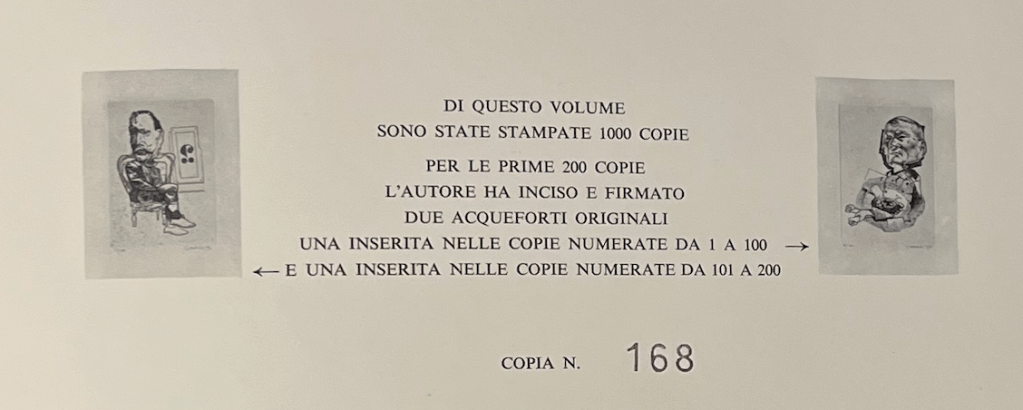
Vietnam Suite (1974) was published in an edition of 1000 books. The first 200 copies include original etchings, with 1-100 having one image, and 100-200 having another.

The book comes inside a gray slipcase. We hold book #168, with etching #68. The book is fairly common in the trade, but copies with the original etching are uncommon. We locate 6 institutionally-held editions internationally, via OCLC.

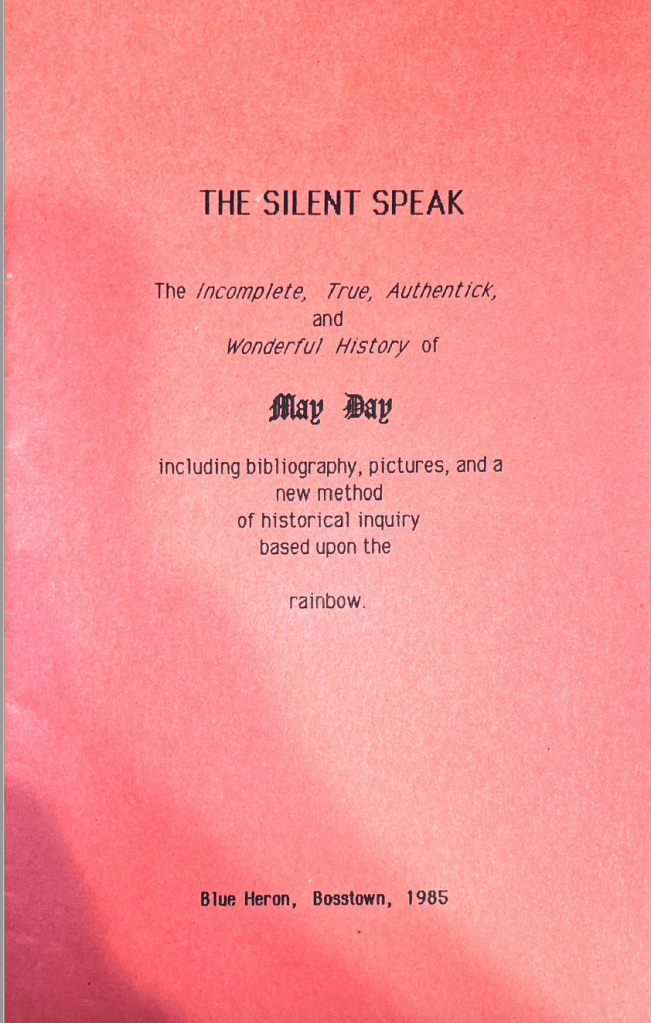
Blue Heron [Peter Linebaugh] – “The Silent Speak: The Incomplete, True, Authentick, and Wonderful History of May Day” (1985)

This remarkable pamphlet is the first published edition of Peter Linebaugh’s now-classic essay “The Incomplete, True, Authentic, and Wonderful History of May Day.”

“Blue Heron” was a pseudonym that Linebaugh used and the piece was written while he was living in the Boston area and teaching at Tufts (hence “Boss Town”). This beautiful essay has seen many editions since this 1985 publication. (It is of note that Linebaugh’s book on PM with the title “The Incomplete, True, Authentic and Wonderful History of May Day” states 1986 as its year of origin, whereas this pamphlet appeared in 1985).

A capture of the Midnight Notes website in 1999 included the following note from the 1986 edition of the pamphlet, which gives some useful background connecting “The Silent Speak” to the pamphlet’s 1986 version:

“The little history that you’re holding in your hand has grown from an earlier version published last year called “The Silent Speak.” There’s more information this year, thanks to conversations in Quincy with John Wilshire and Monty Neill and thanks to newspaper research by Jonathan Feldman and John Roosa. Bryn Clark made a portable Maypole last year which we capered around at the Bank of Boston. We were gratified by the interest shown by lunchtime workers but also struck by how widespread May Day amnesia had become. So, this year we have added some ‘how to’ sections, on games (p.5), on the Maypole (p. 11), and on getting to Merry Mount (p. 16), which we hope may make it more practical. Last year’s May Day demonstration against Kruggerand gold encouraged us to add (an incomplete) list (p. 16) of the many May Day events this year. We especially thank Gene Bruskin and Jim Green who have helped to plan the demo against apartheid and the centennial celebration at Faneuil Hall, respectively. Dana Moser helped with the graphics. Hohn Flym, DeAnn Burrows, Mike Ryan, and friends in Teas, Rochester, Nigeria, Big Indian, Somerville, Belize, and Tufnell Park have provided support and encouragement. And thanks to the workers at Copy Cop.

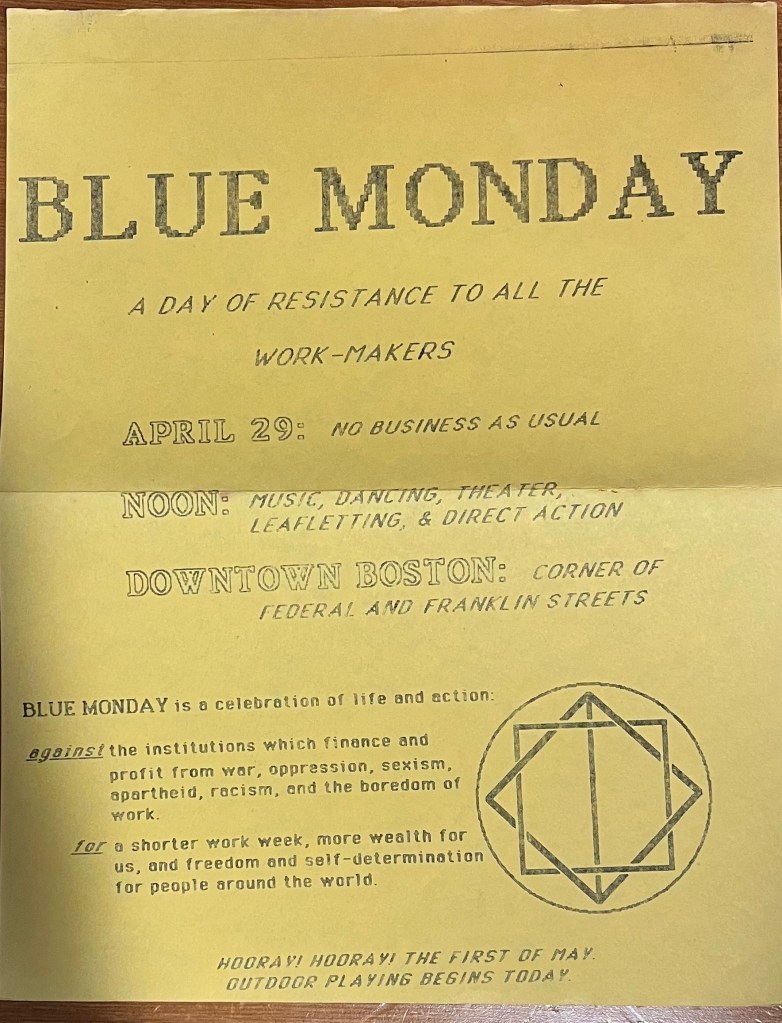
Our copy of the pamphlet came with a neat flier for “Blue Monday: A Day of Resistance to all the Work-Makers.” The anti-work sentiment is transparent. We cannot locate any additional details of the event or source the symbol on the bottom right (if you have any hints please reach out to us).

The “Silent Speak” pamphlet is rare. OCLC locates two institutionally-held copies – one at Harvard and the other at in the Senate House Library at the University of London. We locate no copies of the “Blue Monday” flier.

We have scanned a copy of the pamphlet and uploaded it to Libcom, here.

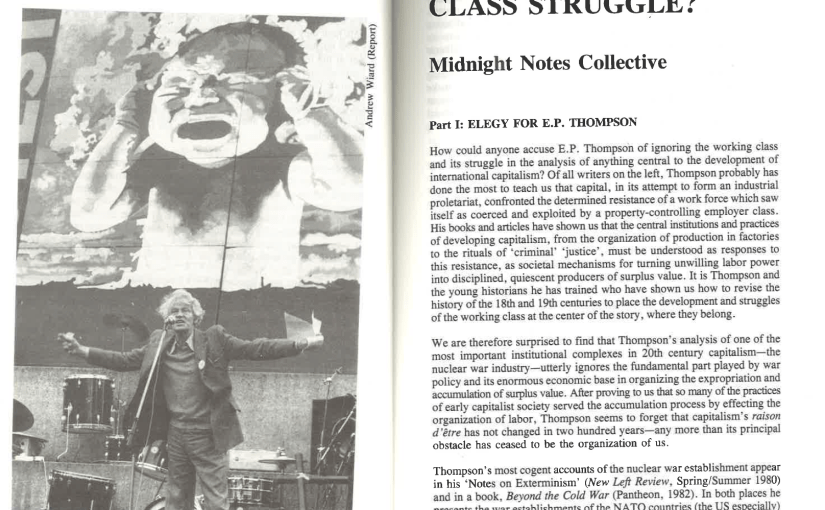
Midnight Notes Collective, ” ‘Exterminism’ or Class Struggle?” In Radical Science Journal 14 (1984)

A particularly timely piece, published in 1984. As noted at the end of the essay, much of this article appeared in issue #6 of Midnight Notes, which was entitled Posthumous Notes (available here). The essay picks up on themes found in Midnight Notes’ 1979 essay “Strange Victories,” particularly the critical eye toward radicals who claim to be acting on behalf of humanity and the classed meanings of such claims.

The section “Elegy for E.P. Thompson” provides a strong critique of his assessment of nuclear war, which is notable in part given that Midnight Notes Collective member Peter Linebaugh was his former student and mentee. (The brilliant and extensive essay he wrote for Left History following Thompson’s death in 1993 is very much worth reading).

The second section, “Marxist Theory of War,” was written specifically for this issue of Radical Science Journal. George Caffentzis later returned to this in “Freezing the Movement and the Marxist Theory of War,” in his 2013 collection In Letters of Blood and Fire (available here).

Radical Science Journal began in the 1970s and was part of the larger movement to dissect science from a left perspective. Helena Sheehan’s recent essay on that in Monthly Review is worth a read.

This issue of Radical Science Journal is readily available in the trade but, to our knowledge, not yet available to the public on the web.

We’ve scanned this article to Libcom, here, for those interested.

Silvia Federici, The IMF & the Debt, Africa and the New Enclosures, with an introductory essay by Mitchell Cohen. Red Balloon, n.d.

Cover of the pamphlet

This pamphlet is composed of an essay by Mitchell Cohen and an essay by Silvia Federici. The date of publication is unclear but it was printed after the Zapatista uprising at the end of 1994 and before Spring 1996 (see below).

The Federici essay is a slightly edited version of her important piece “The Debt Crisis, Africa and the New Enclosures,” printed in an issue of Midnight Notes in 1990. There are some shifts in paragraph structure, but the main difference is that this version of the essay does not contain the conclusory section of the 1990 version (“Jubilees, Moratoriums, and the End of the Debt Crisis”) and there are no citations. There is a note in the pamphlet that this is a later version of the piece in Midnight Notes.

Excerpts from this version of the essay were later printed in the Spring 1996 issue of Turning the Tide (the Anti-Racist Action journal). A longer version of the piece, with fuller endnotes, was included in Federici’s collection Re-Enchanting the World: Feminism and the Politics of the Commons (PM Press, 2019).

We locate two copies in OCLC of what appears to have been an earlier version of the pamphlet printed in 1992. We locate no institutional holdings of this printing. We’ve scanned and uploaded it to Libcom, here.

James Carr, Bad: The Autobiography of James Carr (ed. Dan Hammer & Isaac Cronin) – All editions

Picture of Carr from the 1975 review of Bad in the San Francisco Bay Guardian. Available online here.

James Carr’s Bad is an understudied classic that will leave a reader haunted. A PDF of the book is available for free at Libcom, here.

The bulk of the book is about surviving and navigating the decimating prisons and jails of the 1960s and early 1970s (these systems are still engines of demolition on communities and individuals). As has been said by others who have commented on the volume, it is a brutal portrait of the racist carceral system, first and foremost. It is also a portrait of a very complicated individual who found fucking with authority to be a worthwhile task.

From chapter 12

Bad is atypical of much post-prison writing in that, rather than tend toward a redemption arc, Carr’s narrative is unapologetic about the stories within. These stories are sometimes funny, heartbreaking, and often intensely violent (including repeated stories of rape), and are often told in a sort of matter-of-fact way that helps illustrate the violence of the prison system. The book also documents how support and movement communities developed during Carr’s time inside, and the myriad types of comradeship that got him and others through. Bad does not discuss Carr’s involvement with the Black Panther Party. Rather, it emphasizes, instead, autonomous activity within the prisons, and his efforts to find joy and build a family after being released.

Bad! was not written by Carr. Rather, Carr told his life in great detail to Dan Hammer (his brother-in-law) and Isaac Cronin, both of whom were immersed in the situationist/pro-situ projects of the 1970s. Hammer and Cronin then wrote the book using Carr’s narrative. Hammer, in his forward to the book, recalls the process:

In a detailed and very informative interview with The Brilliant podcast, Isaac Cronin gave a great deal of detail into the context of the writing of the book, the process of it, and some of the movement and personal dynamics that are relevant to understanding how it came to be. For those who are interested that podcast can be found here. It is of note that Cronin claims there were “ten printings in five editions” in France, but we have only been able to locate two editions (three if one counts the initial paperback and hardcover printings; the third, from 1994, is not in our holdings). Cronin also states there was a Spanish translation of the book, but we haven’t been able to locate it (if anyone who has information about it please reach out!)

This short blog entry will not discuss the specifics of Carr’s life that have been written, or the theories of who murdered him. For those interested in those discussions we recommend David Hilliard’s This Side of Glory (Little, Brown 1993, p. 302 & 381) and Jo Durden-Smith’s Who Killed George Jackson (Knopf 1976, some of which is here). We also recommend this entry on the newafrikan77 blog and reading the penetrating essay by his daughter, Gea Carr, entitled “Remembering my Father” which is available online, here.

This short entry will focus specifically on a discussion of the different editions of Bad and some of their context. For those interested in a critical reading of the text and the writing of it, we recommend Simon Rolston’s article entitled “Prison Life Writing, African American Narrative Strategies, and Bad: The Autobiography of James Carr,” published in 2013 and freely available, here.

Inside title page of the first edition

First English Edition (U.S.) – 1975, Herman Graf Associates
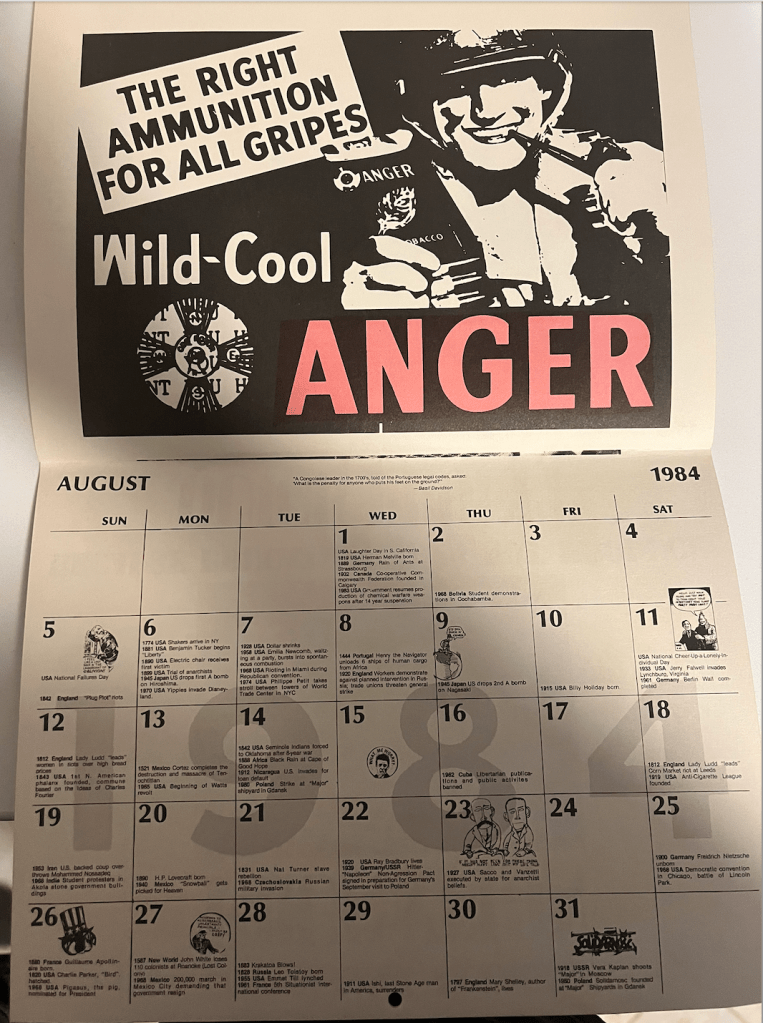
The first edition of Bad was published by Herman Graf Associates – named after publisher Herman Graf, here’s a sort of introduction – and, interestingly, published in mass market form, without a barcode. The book contains Hammer’s forward (which can be found online here) and Betsy Cronin’s afterward (which can be found online here at p. 199). Little has been written about how the book ended up on Herman Graf and how the publisher marketed/distributed it. However, Simon Rolston has provided a very useful note about the publication of the book:
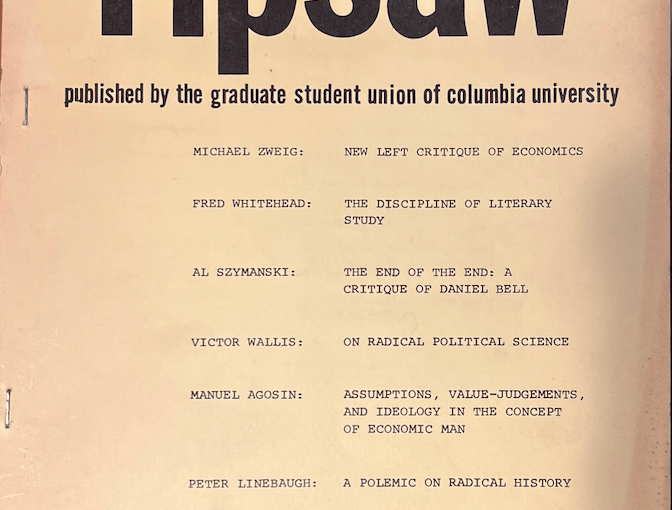
In his interview with The Brilliant podcast, Cronin provides additional detail on the first edition:

Edited portion of The Brilliant interview with Cronin

The View from the End of the World: Live Interviews from Life in Prison with James Carr by Isaac Cronin and Dan Hammer – LP issued by Folkways Recordings – 1975

Cover and back cover of LP

The same year that Bad was published by Herman Graf Associates, Folkways Records issued a recording of three portions of the taped interviews:

  1. “Jimmy describes two incidents involving Muslim leaders which he witnessed when he was a 16-year-old juvenile illegally incarcerated at San Quentin”
  2. “The Wolf Pack, a black gang started by George Jackson, Jimmy Carr and a few close friends at Tracy when they were all teenagers, formed the basis for all militant black groups in the California prisons after the Muslims. The following story is from the Pack’s younger days – at Soledad in 1960 – and shows how dangerous prison officials considered a few brash black kids having fun.”
  3. “After a round of ‘bus therapy,’ being shuttled around the state while the authorities tried to figure out what to do with him, Jimmy was sent back to San Quentin. What follows is his overview of how a rebel convict feels in that giant man-trap at the end of the world.”

The LP contains a booklet with excerpts from the book and a short biography of Carr – a scan of the front and back of the LP as well as the accompanying booklet can be downloaded as PDF, here. Folkways Records is now owned by the Smithsonian Institution who have digitized the recordings and made them available online here.

German Edition -1977 (Editions Nautilus)
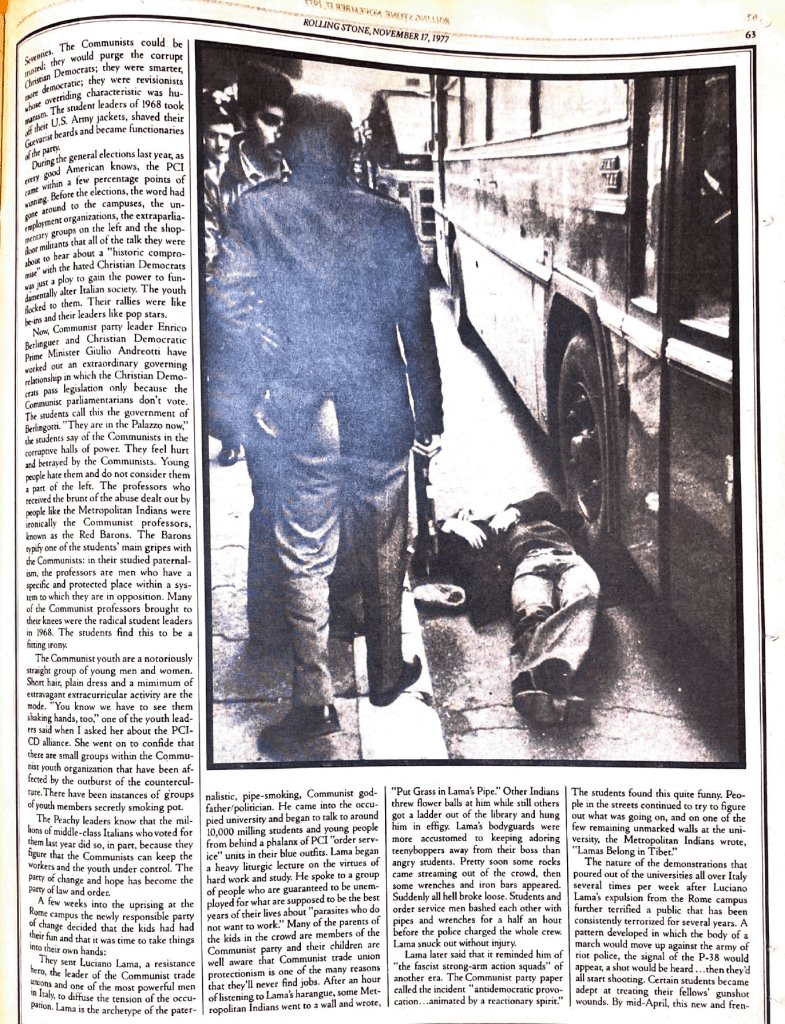
To the best of our knowledge, the first non-English language edition of Bad was published by the german anarchist press Editions Nautilus in 1977 under the title Die Feuer der Freiheit: Eine Autobiographie (“The Fires of Freedom: An Autobiography”). The edition includes the introduction by Dan Hammer and the afterword by Betsy Carr. The German translation was done by a person named Pamela Creegan who we have not been able to find any other information about.

German edition, Editions Nautilus 1977

First French editions – 1978 (paperback [Stock 2] and hardcover [Hachette])

In 1978 Creve! was published in French, first in paperback (by Stock 2) and then in hardcover (by Hachette). The two 1978 printings of Creve! do not provide additional details as to the context of their publishing, except that the text translated by Daniel Mauroc. Given the situationist involvements of Cronin, it’s our best guess that he would have coordinated this with contacts there. The 1978 hardcover edition is the only time the book has been published in hardbound format.

First French paperback edition
First French hardcover edition

Second English-language Editions (U.S.) – 1994, Carrol & Graf

The second English-language U.S. edition was published in 1994 by Carrol & Graf. This edition contains a new three page forward by Isaac Cronin, which we have scanned and posted to Libcom, here.

Front and rear cover of the 1994 edition

Second French Edition – Editions Ivrea (formerly Champ Libre), 1994

Cover the 1994 Editions Ivrea printing

In 1994 Editions Ivrea published a second French edition of the book. We do not hold this edition so do not have much information on it. Some information is available from the publisher, here.

Third English-language Edition (U.K.) – 1989, Unpopular Books & News From Everywhere*

The third English-language edition was a joint publication by Unpopular Books and News From Everywhere in the U.K. This edition is photocopied and comb bound. News From Everywhere was an important and influential publisher of anarchist, autonomist and situationist materials in UK during the 1980s. Unpopular Books, based in London, was also an important publisher of situationist, pro-situ and left-communist materials, and produced pamphlets and books through at least 2012. We do not hold this copy, and a search of OCLC finds that there are no institutionally-held copies of it, either. (We suspect an anarchist library in the UK probably has a copy, but those, perhaps regrettably, don’t make it into OCLC).

Fourth English-language Edition (U.K.) – 1995, Pelagian Press

1995 Pelagian Press edition

The 1995 edition was published in the U.K. by Pelagian Press, which was run by some of the folks involved with Here & Now, the UK post-situationist/autonomist magazine (archived here). According to a note inside the book there were plans by AK Press to publish a new edition in 1992 but tensions arose and they did not publish it, so Pelagian did a few years later. Here is the note:

Note inside the 1995 edition explaining the context of its publication

This edition also contains an important afterward written by David and Stuart Wise (BM Blob) and the person who ran the small but important UK anarchist journal/publisher News from Everywhere, which was written in 1993. It is available online, here.

Fifth English-language Edition (US/UK) – AK Press, 2002

Cover of the 2002 AK Press edition

In 2002 AK Press finally did publish an edition of Bad on their Nabat imprint. This edition contains Cronin’s 1994 forward but not the BM Blob afterward that was found in the ’95 Pelagian edition.

Sixth English-language Edition (US/UK) – Three Rooms Press, 2016

Cover of the 2016 Three Rooms Press edition

The 2016 edition by Three Rooms Press is, by far, the most professional and mainstream of the editions. The first two pages consist of blurbs about the book. This edition has a powerful forward by Carr’s daughter, Gea Carr, entitled “Remembering My Father: A Personal Essay,” which can be found online, here, as well as a couple of beautiful family photos. The website published by Three Rooms Press for the release of the book also contains some useful information, and is here.

The Three Rooms Press edition does not contain Cronin’s 1994 forward or Dan Hammer’s 1975 introduction.

*Post updated 12/20/2022. We are thankful to Nick Thoburn for sending us images of the Unpopular/News From Everywhere edition.

Artie Cuts Out – by Arthur Bauman as told to Paul Wallis. Jaguar Press (1953).

Cover of the pamphlet

It struck us as odd that this important pamphlet has somehow never made its way online. A dear friend of ours who is doing research on the history of some of the Correspondence pamphlets recently acquired a scan and we have uploaded it to Libcom, here.

Artie Cuts Out was an early piece of inquiry and essay – what Raya Dunayevskaya called the “full fountain pen” method – by members of Correspondence. Nothing has been published about the authors. Kent Worcester, in his biography of James, when noting authorship, placed “Arthur Bauman” in quotes (p. 125). Harry Cleaver stated that Marty Glaberman was an author in the syllabus to his course on autonomist Marxism (here).

In an oral history interview with in the early 1990s with Jim Monk, Ron Baxter and Martin Deck (members of the New Tendency in Canada), Glaberman gives some further background to the author*:

In his introduction to Marxism for Our Times (p. xix), Glaberman contextualizes the pamphlet:

Jaguar Press appears to have been a one-off publisher ; we have no records of other publications from them and no other publications appear in OCLC.

Back cover of the pamphlet

Copies of the pamphlet rarely show up in the trade. Our copy is tight with tears to the edges of the back cover. We locate 9 copies held by libraries in OCLC, all in the United States.

*Updated 12/18/22. We are deeply indebted to Dylan Davis for sharing his copy of the Glaberman Oral History interview with us. The interview can be located at Columbia and in the Martin and Jessie Glaberman Papers at Wayne State.

Donald Katz, “Tribes: Italy’s Metropolitan Indians Signal the Violent Passage of a New Culture and the First Rebellion of ‘Irregulars’ in Modern Times,” Rolling Stone #252 (1977)

Image from the article

Italy’s ‘Metropolitan Indians’ (Indiani Metropolitani) have only more recently become the subject of English-language scholarship, notably barely getting a mention in Robert Lumley’s important volume States of Emergency: Cultures of Revolt in Italy from 1968 to 1978. Patrick Cuninghame has written a very helpful piece contextualizing and discussing the group(s) (here), and there are other research projects in development. For example, Martina Caruso’s project (here), in which she notes: “In Rome, an extreme left-wing political faction, the Indiani Metropolitani (Metropolitan Indians) sought to imitate Native People’s dress and ways of life as a form of protest. With twenty-first century decolonial hindsight, the imitation of Native Cultures can be considered an unrefined form of cultural appropriation.”

Lumley does a does a good job contextualizing the faction, which we quote at length:

“The novelty the new [youth] movement sprang from its assertion of a ‘youth identity’, which had been repressed or displaced the student and worker politics of the late sixties and early seventies. But that identity was not perceived exclusively in terms of a youth experience or situation; rather it was taken to be emblematic of a situation typical of the modern metropolis. Youth was made to signify exclusion, marginality, and deviance. To be young and working class in a city like Milan meant living in the housing estates of the outskirts and making a living on the margins of the labour market. In official discourse, this situation was described as a ‘social problem’ and a ‘sickness’ that needed to be cured (once, that is, young people began to protest). But, in the language of the movement itself, the identity associated with deviance and marginality was claimed and appropriated by its participants. The ‘Metropolitan Indian’, who wore warpaint and uttered transgressive chants, did not ask to be ‘integrated’; s/he mocked Western ‘civilization’ and its values. The unemployed asked not for the right to work, but for the right to develop their individual capacities to enjoy themselves” (p. 296).

The instant article was published in 1977 in Rolling Stone. We couldn’t locate it online, so we scanned it. Much of the article provides a rather intense depiction of the years of lead, the strategy of tension in real-time, and a contemporaneous account geared toward an English-speaking audience. Emotionally, it is a difficult article to read. As an introduction to the Movement of ’77 and its context, and the Metropolitan Indians, it is recommended. We have uploaded it as a PDF to Libcom, here. The remaining pages are also posted below.

Barbarians for Socialism (Bruce Elwell) – “Caged Heat” (1979)

Cover of Just Another Asshole #3

Following the dissolution of the U.S. section of the Situationist International, Bruce Elwell, one of its founding members, published many writings under the pseudonym “Barbarians for Socialism” (obviously a play on ‘socialism or barbarism’). To the best of our knowledge, many (probably most) of these writings were not actually published (Bill Brown of NOT BORED! has a listing of some of them on his bibliography of American SI writings, here). OCLC locates two holdings: a folder held by MoMA (here and also mentioned in the book Dark Matter, p. 53, here) and this 1979 piece, which is held by just a handful of institutions internationally.

Little has been written about Elwell’s publications following the dissolution of the American branch of the SI. The Wise brothers (BM Blob) in their classic pamphlet A Summer with a Thousand July’s mentioned that Elwell had written “one of the best leaflets” on the Brixton riots of ’81 (here). But we’ve been able to find little else.

The piece by Elwell is entitled “Caged Heat” ands refers to the former site of the Brooklyn House of Women’s Detention. The prison was built on the location of a former prison and courthouse. It was demolished in 1974. Here is a piece from the January 9th edition of the Daily News that illustrates its transformation:

From the New York Daily News 01/09/1974
Listing of participants/pieces in JAH #3

Just Another Asshole was a No Wave zine that was an important piece of the Lower East Side artist and underground scene of the late 1970s/early 1980s. Issue #3 was unique to the publication in that it was a graphic arts issue, and there were over a hundred contributors. It’s really a beautiful publication that we got lost in for a couple of hours.

The Barbarians for Socialism piece, written in “cooperation” with the “Anti-Stupefactionist League” is on a page split with artist Dan Graham. It is on the right side of the page.

We reproduce “Caged Heat” below, as it is not otherwise found online:

“Caged Heat” by Barbarians for Socialism

RIP – James C. Scott

According to a Tweet by Columbia University Historian Karl Jacoby, James C. Scott has passed away. His is a major loss in so many ways.

Scott’s opus is stunning in breadth and quantity. Readers of this blog are very likely familiar with his books Weapons of the Weak: Everyday Forms of Peasant Resistance (1985) and Domination and the Arts of Resistance: Hidden Transcripts (1990). These two volumes gave a very helpful vocabulary for everyday forms of “self-activity” (ala Rawick) and struggle, and under the radar power struggles that, contrary to tendencies that poo-poo struggles without flags, have very significant impacts. Scott’s work influenced countless scholars and activists; his theories of everyday resistance and “infrapolitics” took on particularly brilliant interpretations, in this writer’s view, in books like Robin D.G. Kelley’s indispensable volume Race Rebels: Culture, Politics, and the Black Working Class (1996). Scott was author of many other books, with perhaps his work The Art of Not Being Governed: An Anarchist History of Southeast Asia (2009) functioning as a sort of magnum opus.

In 2010 a dear friend and I who had been very influenced by Scott’s work reached out to him to inquire about doing an interview. We spent the day with Scott at Yale and he was warm, kind, and generous. That interview was published in Upping the Anti #10 and is reproduced below. Scott was a true genius and he offered a great deal for anarchists, autonomists, and researchers to learn from. He gave the world many gifts and he will truly be missed.

Points of Resistance and Departure: An interview with James C. Scott

BENJAMIN HOLTZMAN AND CRAIG HUGHES   /   ISSUE 11Upping the Anti (link: here)   /   11/20/2010

James C. Scott is among the foremost experts on the struggles of subaltern people in Southeast Asia and throughout the world. He is the Sterling Professor of Political Science and Professor of Anthropology as well as the Director of the Agrarian Studies Program at Yale University. Scott’s books have included The Moral Economy of the Peasant: Rebellion and Subsistence in Southeast Asia(1977); Weapons of the Weak: Everyday Forms of Peasant Resistance(1987); Domination and the Arts of Resistance: Hidden Transcripts(1992); Seeing Like a State: How Certain Schemes to Better the Human Condition Have Failed(1999); and The Art of Not Being Governed: An Anarchist History of Upland Southeast Asia (2009). In this interview, Scott discusses his own political development, elaborates on some of the major contributions of his work, and offers significant insights into understanding the intricacies of recent worldwide struggles. This interview was conducted in New Haven, Connecticut by Benjamin Holtzman and Craig Hughes in July 2010.

Can you discuss your upbringing, particularly with respect to how your earlier years may have contributed to your political beliefs and research interests?

I was sent to a Quaker school and it had a huge impact on me. I don’t think I noticed it at the time. But people in this Quaker school had been conscientious objectors during the Second World War. These people were still alive and kicking. And they had paid a heavy price for their opposition. I’m sure at the time I didn’t agree with them at all. But I was faced with people who would stand up in a crowd of a hundred and be a minority of one. It made a deep impression on me. They made me the kind of person I am, actually. It wasn’t in me to begin with.

The Quakers also had these weeklong work camps in Philadelphia. Those were the days were we would work with a black family for a day or two, repainting their apartment. We went to Moyamensing prison for part of the day. We went to Byberry, the state mental institution. We ate in settlement houses. We went to communist dockworker meetings. We went to mission churches. We went to see Father Devine, a charismatic black leader who fed the homeless.

I grew up in New Jersey, maybe 15 miles from Philadelphia, and the Quakers showed me a part of Philadelphia and its underclass that I never would have seen – that most people didn’t see. They did this without any particular preaching. They also held a weeklong work camp in Washington, DC. And this was in 1955, the height of the Cold War. All the people who had come from little Quaker schools (there probably were about twenty of us) marched into the Soviet Embassy to talk about peace. We were being filmed, by the FBI I presume, from the house across the street. We met with people like the Marxist author William Hinton, who wrote Fanshen,1and became acquainted with a kind of political fringe internationally. I never would have done this without the Quakers. There was a kind of intrepid bravery: go anywhere, talk to anyone.

The Quaker belief in “the light of god in every man” led them to a social gospel vision that made a big impact on me. My book, Domination and Arts of Resistance is actually dedicated to Moorestown Friends’ School, which was the tiny Quaker school that I attended. I was part of its biggest class in history, which was comprised of 39 people.

Later, my colleague Ed Friedman played a big role in my political education when I was at the University of Wisconsin at Madison. We were teaching this course on peasant revolution and Ed said, “once the revolution becomes a state, it becomes my enemy.” What’s striking is that every successful progressive revolution has tended to produce a state that’s even more tenacious and oppressive than the one it replaced. The results of revolution make pretty melancholy reading when you consider how they’ve created stronger and more oppressive states.

Long ago, when people would ask, I would always tell them that I was “a crude Marxist” with the emphasis on “crude.” By that, I meant that the first questions I would ask would be about the material base. These questions don’t get you all the way, but you want to start there. When I was working on Weapons of the Weak and beginning to work on Domination and the Arts of Resistance, I would find myself saying something and then, in my mind, I would say to myself, “that sounds like what an anarchist would say.” And it happened with enough frequency I decided that I needed to teach a course on anarchism.

Through the process, I learned a tremendous amount. I also realized the degree to which I took a certain distance from anarchism. A lot of the anarchists believed that the technological advances of science were such that we wouldn’t need politics anymore – that everything could become a matter of administration. Giving a course on anarchism without writing specifically about anarchism helped me figure out where I belonged. Anarchist Fragments, a book I’m working on now, is an effort to refine that a little bit.

How did you become interested in studying what you refer to as the “infrapolitics” of powerless groups?

I had this book, The Moral Economy of the Peasant, and people used to ask me where I did my fieldwork. I had to tell them that I hadn’t done any. I didn’t do fieldwork. I had done archival work. This was way back in Madison, when I was studying wars of peasant liberation. I had read so many things that I admired but realized that I knew very little about any particular peasantry. So I decided that I wanted to study one peasantry so well that I knew it like the back of my hand. Afterward, whenever I was tempted to make a generalization, I would know enough about a particular peasantry to ask “does it make sense here?”

One of the contributions of Weapons of the Weak was to take things like Gramsci’s idea of hegemony and to try to figure out how it would actually work on the ground in a small community. I’ve never been able to understand abstractions very well unless I could see them operate. So I spent two years in this village. It was completely formative. People were not murdering one another and the militia was not coming in and beating up peasants. Nevertheless, there was this low-level conflict that I didn’t quite know how to make sense of. Although there was a lot of politics going on, it was nothing that someone like the late social movement theorist Charles Tilly would have recognized. There was no banner, there was no formal organization, and there was no social movement in the conventional sense.

It became clear to me that this kind of politics was the politics that most people historically lived. “Infrapolitics” tries to capture what goes on in systems in which people aren’t free to organize openly. This is politics for those that have no other alternatives. It’s no big news to historians, I don’t think. Eric Hobsbawm noted a similar thing in his book Primitive Rebels. But for political scientists who study the formal political system, I thought it ought to be news. In any organization and in any department, this kind of politics is going on all the time. We learn a lot by realizing that politics doesn’t stop once we leave the realm of formal organizations and manifestos.

Prior to Weapons of the Weak, most writing on peasant resistance had focused almost entirely on large-scale, organized protest movements. As you note, however, “subordinate classes … have rarely been afforded the luxury of open, organized, political activity.” You therefore called attention to the “ordinary weapons” used by poor and powerless groups to resist the rich and powerful. What are these “weapons of the weak” and what effects can they have?

Between 1650 and 1850, poaching was the most common crime in England in terms of frequency and in terms of how much it was loathed. However, there was never a banner that said “the woods are ours.” And there were no efforts to reform the crown or curtail aristocratic rights to woodland. Nevertheless, ordinary villagers and peasantry took rabbits, firewood, and fish from this property even though there are all these laws to prevent them. If you stepped back from this and widened the lens even a little bit, you could see that this was a formative struggle over property rights. It was conducted not at the level of Parliament or formal politics but at the level of the everyday.

One of Marx’s earlier essays concerns the theft of wood in the Rhineland. He pointed out how, when employment rates decreased, prosecutions for taking firewood from the crown lands increased. One of the reasons that people have difficulty seeing these acts as a kind of politics is because they’re based on theft. The thief gets to have rabbit stew and it doesn’t look like a collective act of resistance. It looks like “I’d like rabbit stew tonight, thank you very much. I’ll just take my rabbit and run.” But when you put it all together, you realize that – for decades – no one can get villagers to give evidence against one another. No prosecutions are brought because those in power can’t get anyone to testify. Meanwhile, the game wardens are systematically killed or intimidated and frightened.

Even though it’s hard to get all the details, it’s clear that there’s a collective conspiracy of silence, that the whole pattern relies on tacit cooperation and shared norms and values. And so, if it’s just stealing a rabbit, it doesn’t count. But if you can show that there’s a normative belief that prevents aristocrats from calling woods and fish and rabbits their property, and you can establish that these norms enable a corresponding pattern of violating aristocratic claims in the popular culture, then you put your hands on something extremely political that never speaks its name.

The job of peasants is to stay out of the archives. When you find the peasants in the archives, it means that something has gone terribly wrong. Their resistance is more like a desertion than a mutiny, which is a public confrontation with political power. It’s the difference between squatting and a public land invasion with banners. What’s important analytically is that all of this activity is politics and, if we don’t pay attention to the realm of infrapolitics, then we miss how most people struggle over property, work, labour, and their day.

The peasants of the Malaysian village you studied for Weapons of the Weak faced proletarianization and a loss of access to work and income. Nevertheless, as you describe it, there were “no riots, no demonstrations, no arson, no organized social banditry, no open violence,” and no organized political movements. The absence of these conditions seems to confirm many of Gramsci’s conclusions about hegemony. However, by examining what was taking place beneath the surface of village life, your analysis complicates how Gramscians have depicted the capacity of those in power to shape the actions and beliefs of subordinates.

I’ve been accused – with some justice – of misusing the word hegemony. For Gramsci, hegemony requires a kind of liberal political order of citizenship and elections. In contrast, domination applies to the non-democratic political systems. Strictly speaking then, the situation I described in Malaysia is domination, because there wasn’t a parliamentary system in any real sense of the word. What I tried to figure out was how hegemony and domination worked in a situation like that. How did the poor and disadvantaged of the village create a kind of discourse that was not known among the rich, and how did this create a way of talking about things, a set of reputations, and a set of norms about what decent people do? Although there was nothing grandiose about them, these practices served as a sort of criticism of the existing order.

What I try to establish is that there was a kind of community discourse and practice among the village poor that could enable connection to a larger scale social movement. From there, village concerns could connect with other people who shared similar sources of pain and worry and similar values. Even today, there’s a kind of opposition to the ruling party in Malaysia that’s based in just that kind of populist dislike of the Malay landed elites.

Many on the radical Left believe that the working class must be “conscious” in order to struggle successfully. Consequently, their strategies emphasize building “class consciousness.” How do forms of everyday resistance like the ones you’ve described complicate this picture?

In TheMaking of the English Working Class,E.P. Thompson argued that consciousness is an effect of struggle rather than a cause of struggle. It’s not about a working class that develops its consciousness and then looks around ruling classes to beat up on. In the course of struggle, people develop consciousness. If there’s any mistake that the intelligentsia makes, it’s to vastly overstate the force of ideas as ideas. In contrast, Thompson highlighted how ideas – when they are grounded in actual struggle – have a kind of force behind them.

I don’t know if you know the village of Chambon in France that saved 6,000 Jews in the Second World War. Because it was a Huguenot village, they knew something about persecution historically. So they were sympathetic. The two pastors in this village went around trying to organize the village so that it would save Jews who were fleeing persecution.

The two pastors were arrested for their efforts and sent to a concentration camp but their wives took up the effort to save Jews. The two women went from house to house, farm to farm, and said: “there are Jews who are going to be coming. They’re on the lam, they’re persecuted. Would you take in a Jewish family and hide them in your barn? Would you take in a Jewish kid and pretend they’re your child?” And people said, “I’ve got nothing against Jews, I’d like to save them, but I’ve got a wife and family and once they find out that I’m doing this, they’re going to take us all away and kill us. I can’t risk my family, so good luck to you. I’m sympathetic but I can’t risk this.”

But the Jews actually came. And the pastor’s wives found that when they came with an elderly, shivering Jewish man without an overcoat and said, “would you feed this man a meal and have him stay in your barn,” the response was totally different. When the villagers had to look a real human being in the face, they couldn’t say no. Most of them said, “yeah, I’ll do that,” reluctantly. After they did that once or twice, they became committed to saving Jews for the rest of the war. They weren’t moved at the level of ideas but, when they were faced with a concrete situation, most of them were unwilling to turn their backs. The ideas didn’t work. But the practical situation did.

You’ve noted that – for most of the world – public assembly, forming political organizations, and democratically challenging the state are essentially impossible and that actions like foot-dragging and pilfering should be seen as “political” because they are the only means by which people can engage in political acts. But what about contexts like the present-day United States, Canada, and other representative democracies? Can we read the worker who spits in the food at a fast food place, or the refusal to vote, or the worker who punches in her colleague’s time card in the same way?

Frances Fox Piven, Richard Cloward, and John Zerzan make an argument that I’m quasi-sympathetic to. I think Piven and Cloward make it about truancy from school: increasing rates of truancy tell us something about the confidence and normative power of the institution. Pissing in the soup does the same. As a social scientist, I can’t presume to know what’s going through someone’s mind when they spit in the hamburger. Maybe it was a bad day and the dog bit them or their lover smashed up their car. Only the person knows. And so these things aren’t of interest to me until they become a kind of shared culture. Even if it’s only at one McDonald’s franchise where people are looking back and forth at one another and then spitting in the burgers – at that point, there’s a certain shared, public, normative, subaltern contempt that is a real thing in the world. Or when people give their boss the finger when he turns his back and chuckle to one another.

It’s a real thing in the world. For people who are interested in politics, it’s something we can tap into should the occasion arise. Twenty years ago, there was this famous Italian restaurant in New Haven. It was very popular and the wait staff could make a lot in tips. The two brothers who ran it often demanded sexual favours from the women who waited there. In exchange, the women would be given the best stations and make a lot of money. Most women played ball. There was this culture among all the waitresses who knew these two brothers were vicious. Some played ball and some didn’t. Those who didn’t and had an attitude were fired.

One evening a waitress who had previously played ball but was no longer desirable to the brothers and no longer got the best stations was delivering a pile of food to her table. It was very early in the dining hours. One of the brothers said, “put that down and do this.” And she said, “I’ll just deliver it first” or something like that. And he said “no, you cunt. Put it down and do what I told you.” And she – you have to read this long history into it – she just dropped the whole tray on the floor and went back to the kitchen and huddled with the other waitresses who all hated these brothers. Within five minutes, they were all outside picketing the restaurant. And then they went looking for a trade union organizer who would represent them.

Because they had waited at the restaurant for a long time, many of the patrons knew them well. When they drove up, the women on the picket line said, “don’t eat here, they treat us like dirt.” They finished the restaurant; the brothers had to move the restaurant to another place. I tell the story because it’s a case in which this pervasive atmosphere must have lasted for a decade or more and, at this particular moment, it allowed for a kind of crystallization. Women who, at 7:01, had never thought of being on strike found themselves on a picket line at 7:05. They were there because they were like the other woman, they were all friends, they all worked together. So that’s the kind of logic I’m pointing to. And often it doesn’t happen at all, right? The only reason I can tell the story about the norms is because they were crystallized in a strike action.

What’s the connection, then, between everyday forms of resistance and more collective forms of political mobilization?

The circumstances under which subterranean resistance cultures become connected are usually exogenous. They come from somewhere else. Take the Solidarity movement in Poland, which had no central committee. Martial law in Poland brought together cultures of resistance that first formed in one tiny little plant or even around the kitchen table – within a family or amongst very close friends who trusted one another. These cultures of resistance were relatively homogenous in terms of the troubles and tribulations that people faced. People hated the regime, and the party hacks, and the lack of meat and decent medical services.

Although the critiques were highly developed, they existed in fragmented little circles because people were afraid to share them in public. What Solidarity did by a few very brave strike actions was to somehow crystallize this. People then realized not only that their neighbours shared the same beefs as they did, but that it was actually possible under some circumstances to manifest them in a public way. The reason Solidarity didn’t need a central committee to tell everyone what to do was because the regime, while it was atomizing people, was also homogenizing them in terms of its effects on their daily life. When it became possible to connect these people and to act publicly, there was an infrastructure that was already present. By standing up to martial law, Solidarity was able to crystallize a kind of political capital that had been created in tiny units throughout the society.

In reading your work, it’s difficult not to draw connections to the present and to regions closer to home, even though you caution against this. With concepts like “everyday resistance,” drawing these connections is sometimes fairly easy. But with others, like “illegibility” and “state evasion,” which you discuss in The Art of Not Being Governed, it can be a bit more difficult. One could make the argument, for example, that some parts of the UShave been abandoned by the state and capital, such as parts of Appalachia or parts of the Gulf Coast. Do you think these concepts have any resonance in the contemporary USor for other “first world” nations?

I think that Appalachia is a fairly significant non-state space, even today. So, if you wanted to do a map of illegal distilling or of marijuana production, it would coincide with those mountainous areas of Appalachia. Historically, one of the really interesting things is that desertion from the Confederacy correlates brilliantly with altitude. That’s because the people up at the highest elevations had tiny farms and no slaves.

It wasn’t that they loved black people; they just weren’t going to die for a social order based on the plantations that the lowlands depended upon. So they deserted in huge numbers. In the Civil War, people were recruited by county and served in units filled with their neighbours. When they deserted, they all left together. They took their weapons, went back into Appalachia, and could not be recruited again. They defended themselves against re-enlistment or re-conscription. If you do a map of Republican voting in the South – this is back when the Democrats were racist Dixicrats – it correlates perfectly with altitude too. All of the Republicans are at the tops of the hills. It was an area where runaways from other parts – people running from the law, and a certain number of free blacks who wanted an independent life – could find reprieve. This lasted until the region became an enormous site of coal and mountaintop removal. Today, the coal companies own West Virginia from one side to the other.

The reservation system was a formal effort by the state to create areas of indirect rule that didn’t have to be administered directly. Consequently, they became a particular form of non-state space. Non-state spaces are social creations and not merely geographical phenomena. A lot of people who appear to be stateless or between states are not people who were never part of the state but rather people who have managed to distance themselves from the state. It’s just that Zomia is such a huge area of a non-state space that it represents such a large zone that one doesn’t have here.2

In closing The Art of Not Being Governed, you write, “In the contemporary world, the future of our freedom lies in the daunting task of taming Leviathan, not evading it.” Current debates on the libertarian left struggle with this issue. If representative democracy is “the only frail instrument we have for taming Leviathan,” how do we end our status as “state-subjects”?

People like Richard Day have argued that the point is not to tame Leviathan. Once you start taming Leviathan, you’re involved in all sorts of regulatory policy fiddling. You become stuck in that politics. You become complicit. Consequently, Day has emphasized creating autonomous zones of political action based on affinity. I’m sympathetic to that.

In Europe, the Greens argued about whether they would enter coalitions or remain outside and create intentional communities and forms of action that were independent of the state. In the end, of course, they split; some of them formed coalition governments and some of them remained independent. I’m a little more sympathetic to these autonomous initiatives than the quote you cited indicates. I’m cognizant of the fact that, once you become a reformist, a whole series of options become closed to you. A whole series of assumptions about the way you have to operate and the way you have to dress up for the dance come into play.

Consequently, I’m pretty sympathetic to the idea that creating structures of independence, contaminated though they may be, is more productive right now. I don’t know. I realize it’s a key question, and I’m also not immune to the idea that, when faced with an Obama or a John McCain, it seems fairly irresponsible to say “fuck you both” when you know that – for all the disappointments that Obama represents – his election held the promise of millions of tangible benefits for millions of people. And even though not much has been done by the Obama administration, one could still argue that the people running agencies are at least more humane, sympathetic, and attentive.

I’ve got nothing against people who choose to work at that level. But when you think about what can be done in that field, it seems kind of minimal. I don’t know if you’ve heard of Christiania. It started out as a squatter movement but ended up being a long lasting autonomous zone in Copenhagen. The liberal Danish state just decided that it wasn’t worth the trouble to crush. It became a kind of self-governing little place, and I have a lot of respect for that. In a sense, Copenhagen bicyclists have created the same thing through a whole series of little struggles that are cumulatively very powerful. The result has been that, today, whenever a motorist hits a bicyclist, they are prima facieguilty until proven innocent. Similarly, a bicyclist who hits a pedestrian is prima facie guilty until proven innocent. The idea is that the more protection you have, the more you’re to blame unless you can prove otherwise.

It would be worthwhile to study the history of the various non-state spaces that have opened up within modern democracies. What is their meaning and what have their implications been? Such a study would involve all the utopian communities that American religions formed in the 19th and 20th centuries. The Amish and Mennonites.

Do you consider yourself an anarchist at this point? Is that a label you’ve taken on?

In a way, no other label works as well. It doesn’t work very well but it works better than anything else. If I had a pistol put to my temple and had to answer “what are you?” I’d say “anarchist” probably. It’s just a point of departure.

Notes

1William Hinton, Fanshen: A Documentary of Revolution in a Chinese Village(Republished many times, most recently by Monthly Review Press, 2008).

2 Zomia, the subject of The Art of Not Being Governed, is a region the size of Europe in Southeast Asia that Scott describes as “one of the largest remaining non-state spaces in the world, if not the largest.” For centuries its residents have fled surrounding state societies in order to intentionally evade state control.