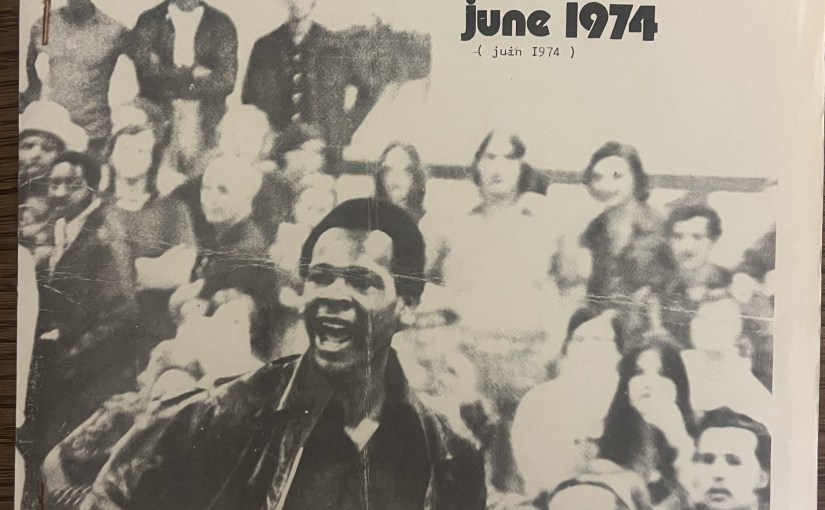
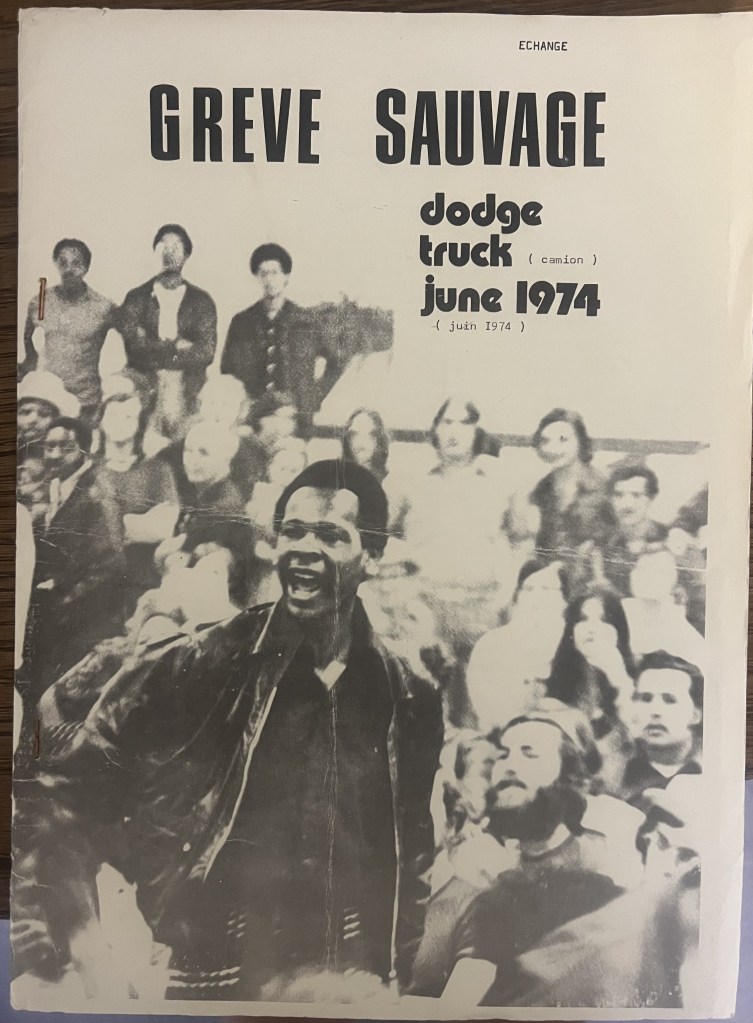
This is the French translation of Wildcat: Dodge Truck June 1974 written by Millard Berry, Ralph Franklin, Alan Franklin, Cathy Kauflin, Marilyn Werbe, Richard Wieske, and Peter Werbe. The booklet, according to the 30-year retrospective piece, was “written and produced by several of the people who became the core of the Fifth Estate collective the next year when it was transformed into an overtly council communist, and then, anarchist publication.” The initial pamphlet was printed via the Detroit Print Co-Op distributed by Black and Red (Lorraine and Fredy Perlman’s publishing project). The photos throughout – which are universally stunning – were taken by Millard Berry.

In the late 1990s when I first got involved in anarchist politics, the English version of pamphlet was common to find in any given infoshop, but nowadays this seems less common (in no small part because there are fewer explicitly anarchist infoshops than there were decades ago).
Wildcat is a reflection on a worker wildcat strike in June 1974 (hence the title), but is also a very concise strategic analysis of working class power from an autonomous and, at points, situationist-influenced lens. The wildcat took place in context of increasing militant actions at auto plants in Detroit, and in context of widespread militancy in the the first half of the 1970s.
There are many useful observations in the essay, but in re-reading it I was struck by the very insightful observations about the role of groups associated with the New Communist Movement (NCM) particularly the Revolutionary Union. In an increasingly well-known story, hundreds and probably thousands of Leninist and Maoist militants moved into traditional working class positions during the 1970s in order to move the class toward more militant confrontations. This pamphlet offers a reflection in which the Leninist model of organizing conflicted with the revolt against work by workers themselves in an auto plant in the midwest US during the early 1970s. The essay reflects on the strategy of wildcat walkouts versus taking over and holding the shop floor during strikes: “In addition, by holding the production process hostage, the natural organization and informal communication networks are still intact. One of the most significant advantages to resistance inside the factory is that it leaves the workers on the inside and the company, union, or any others seeking to destroy or dominate the struggle for their own ends, on the outside, where they all belong.”
The French edition of the pamphlet was published a couple of years after the English edition by Echanges et Mouvement. Readers of this blog are probably familiar with Echanges – it was started in 1975 by militants associated with Solidarity (UK), Informations et Correspondance Ouvrieres (FR), Daad en Gedachte (NL), and the Belgium group who published Liasions. Henri Simon, who recently passed away, carried on its work for decades. The French edition mirrors the English edition almost page for page but (obviously) with French text instead of English text.

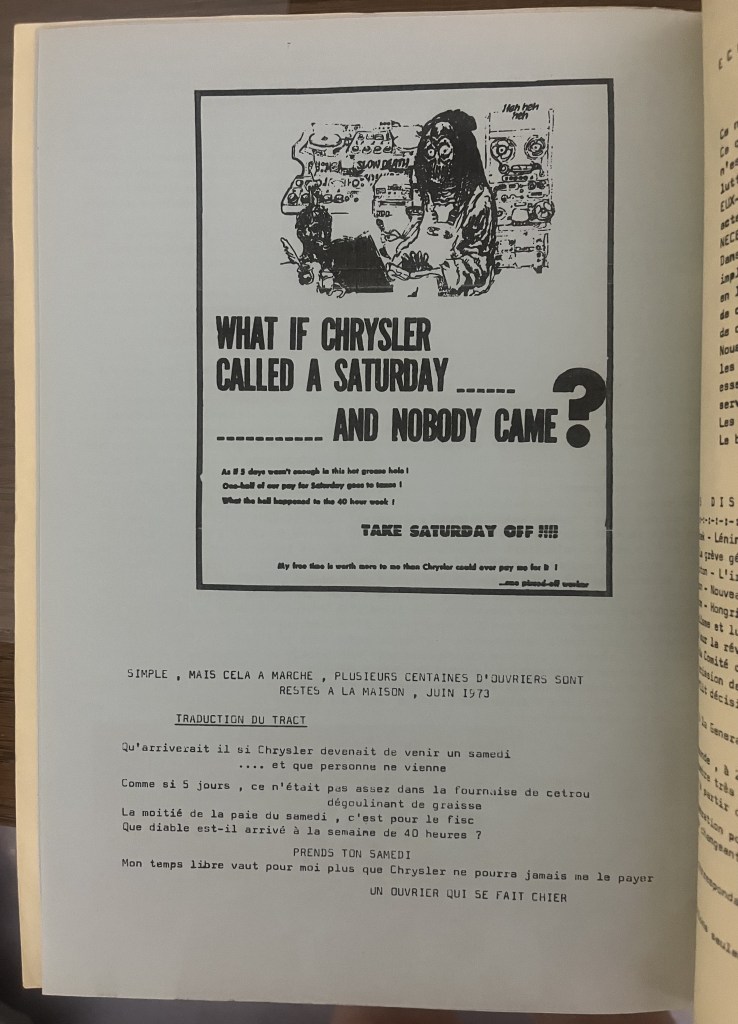
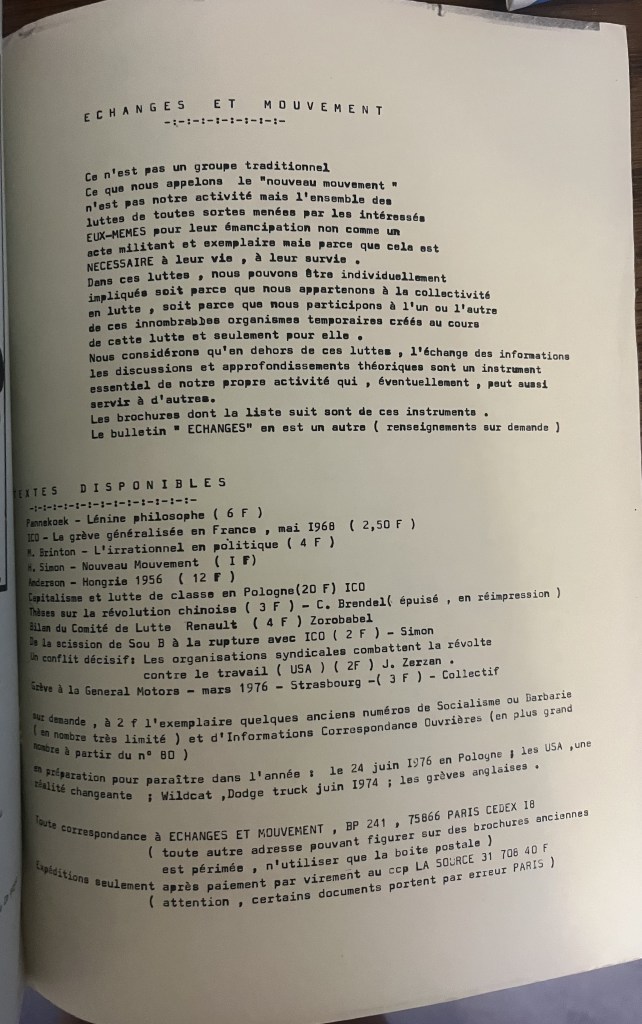
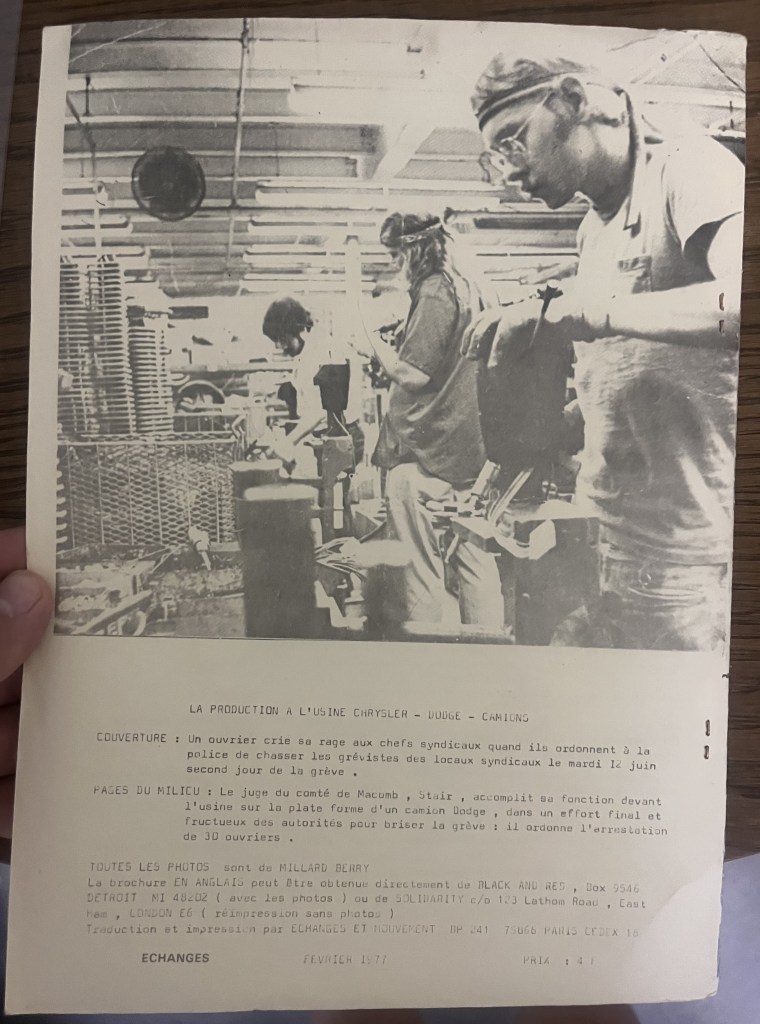
Activists in France have scanned a PDF of the French edition, here. The booklet is rare – I’ve seen only one copy for sale in recent years. OCLC locates one copy of the Echanges edition and four copies of the Echanges edition as distributed by Spartacus.
 New York Archives of Autonomist Marxism