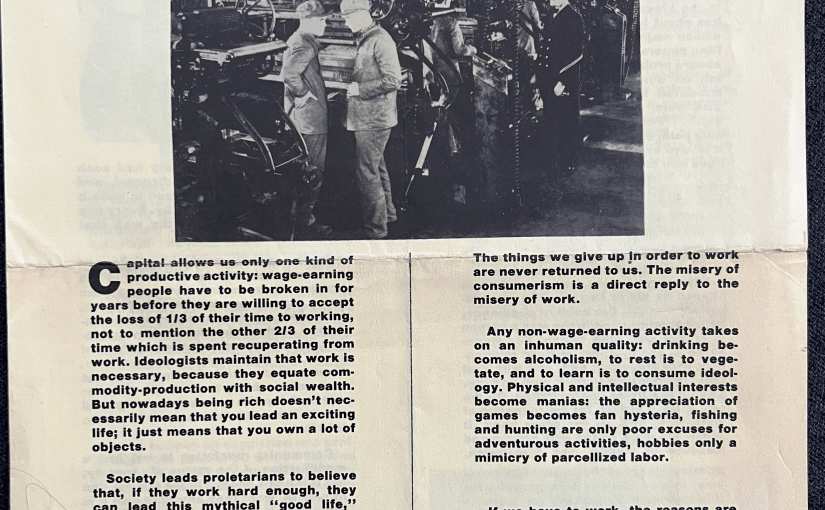
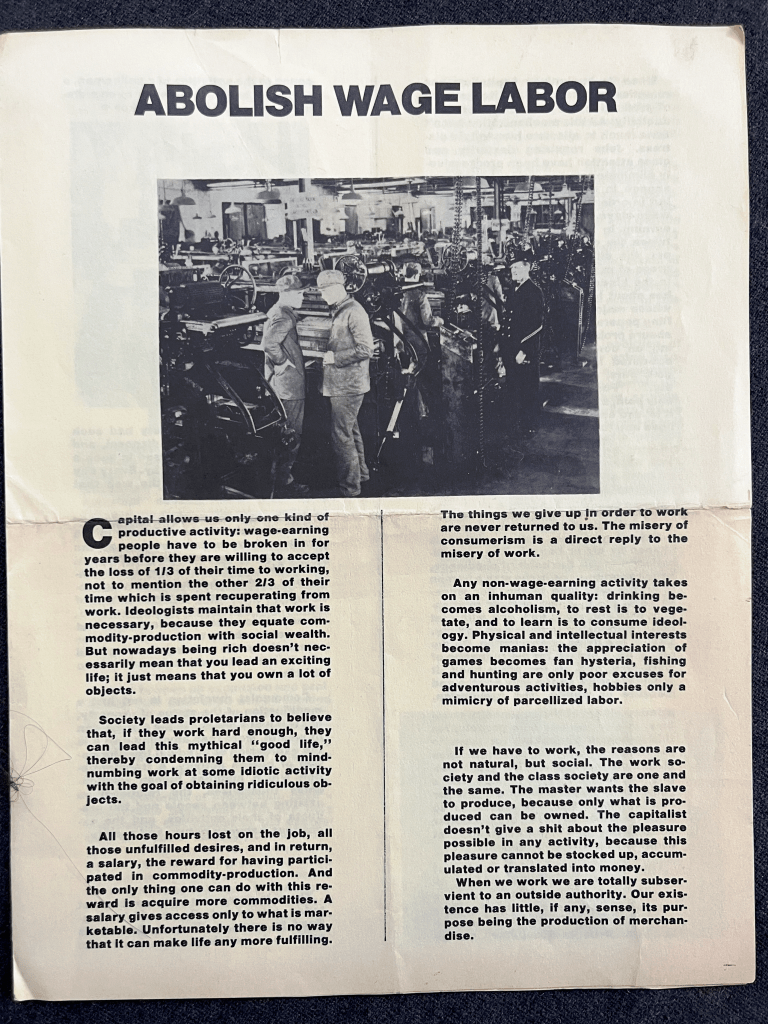
Short 4-page pamphlet against work issued by “Workers Against Work for Social Warfare.” Apparently a one-off of this group (or individual) who do not seem to have published otherwise under the moniker. OCLC states that it was published in 1980 which seems reasonable given this paragraph:
“When we demand the abolition of wage-slavery, we are only using theoretical terms to express a movement that is already materializing before our very eyes, in wild-cat strikes, or riots, when American factory workers foul up assembly lines, and Polish workers loot state stores, when the effort is justified by passion, when wage earners disobey the mummies that govern them.”
For an anti-work pamphlet it is perhaps more reliant on orthodox Marxism than is often found in these kinds of writings (e.g. “This movement is not a product of chance or a surprising historical coincidence. It’s the point of development of the productive forces at which the order of the day is the refusal of work […] Historical possibilities, trapped within the commodity-economy, are preparing the ground for the last revolution: the result will be an international proletarian struggle against wage-slavery and all those who defend it.”)
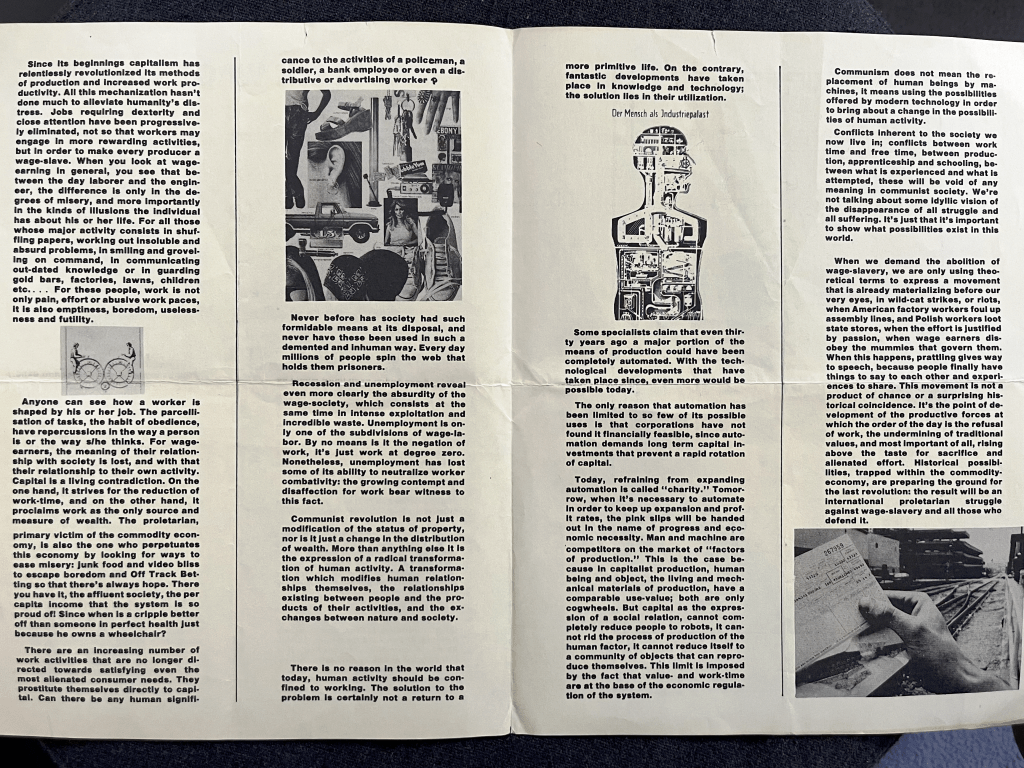
The pamphlet is a mishmash of the situ-inspired anarchism that increasingly circulated in the 1970s and early 1980s, along with the more orthodox Marxism noted above. There is a somewhat anomalous embrace of technology as liberatory that was less common in some of this anarchism (e.g. “There is no reason in the world that today, human activity should be confined to working. The solution to the problem is certainly not a return to a more primitive life. On the contrary, fantastic developments have taken place in knowledge and technology; the solution lies in their utilization”). It’s a bit theoretically confused, perhaps, but the anger is real, and it comes through.
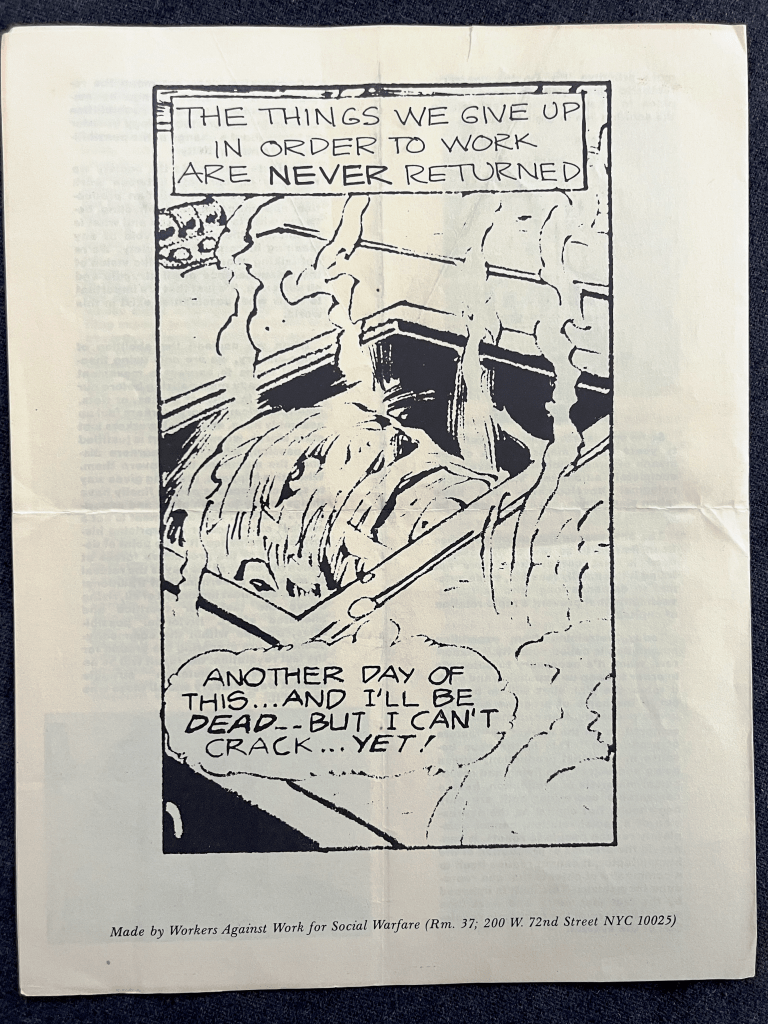
We located almost nothing about the authors, so if you know background info please write! The address in the pamphlet for correspondence is Room 37 at 200 w. 72nd Street. That building was razed earlier this century, but in the 1970s it was home to offices of Amnesty International and some solidarity groups, though not that specific room.
OCLC locates a couple of holdings. We couldn’t find a full scan online so uploaded it to Libcom, here.
 New York Archives of Autonomist Marxism