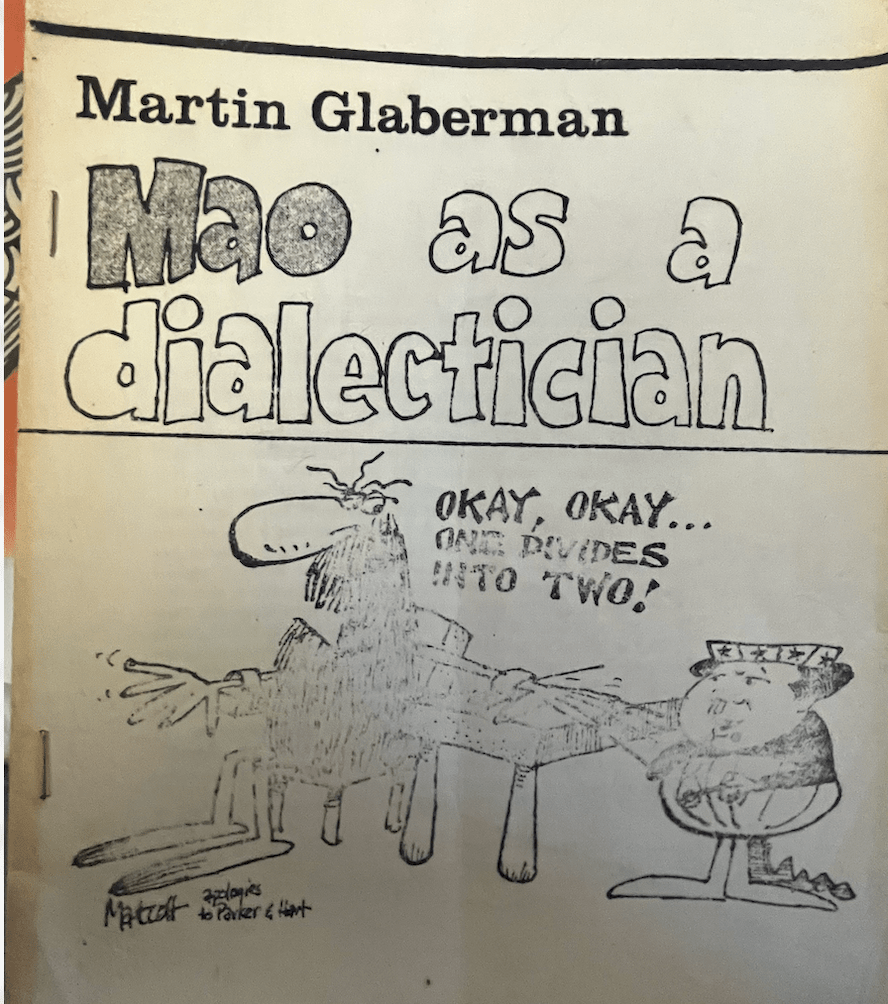
Marty Glaberman will likely be well-known to readers of this humble blog. Of his many publications, “Mao as a Dialectician” is perhaps one of the least well known but a notably important contribution. The piece, original published in an article in Fordham University’s International Philosophical Quarterly amounts to a takedown of Mao’s dialectics. In sum, per Glaberman:
“It is impossible to say that Mao Tse-tung in any way continues dialectical materialism. The departures from the philosophical method of Marx and of Lenin are much too great to be accepted as incompetent popularization on the one hand, or striking originality on the other. It is, of course, true that Mao, like most people, has a philosophy. A positive presentation of what that philosophy is is beyond the scope of this paper. But what is most apparent is that his philosophy is servant to his politics. It is not the source of whatever contribution he has made to history. That Mao has made original contributions to the modern world cannot be denied. What must be denied is that they have anything to do with philosophy.”
Glaberman accurately points out that concretely defining a methodology of “dialectical materialism” is hard for a specific reason: “Marx used dialectical materialism but was unable to find the time to write an exposition of his philosophy, or, rather, his method.” He thus devises an approach: “I have attempted, therefore to use as a guide a kind of synthesis of Hegel and Marx and Lenin which seems to me to correspond with a reasonable view of dialectical materialism. This will have to stand or fall on the measure of fruitfulness it provides in the analysis of Mao.” (Folks interested in a critical approach to diamats may want to look at Harry Cleaver’s works Reading Capital Politically (2000 [1979]) and The Fragile Juggernaut (2025)).
The entire text of “Mao as a Dialectician” is readily available online (here, for example).
After its publication in the Fordham philosophical journal, Glaberman, in 1971, published an edition of it himself via his Bewick Editions press.
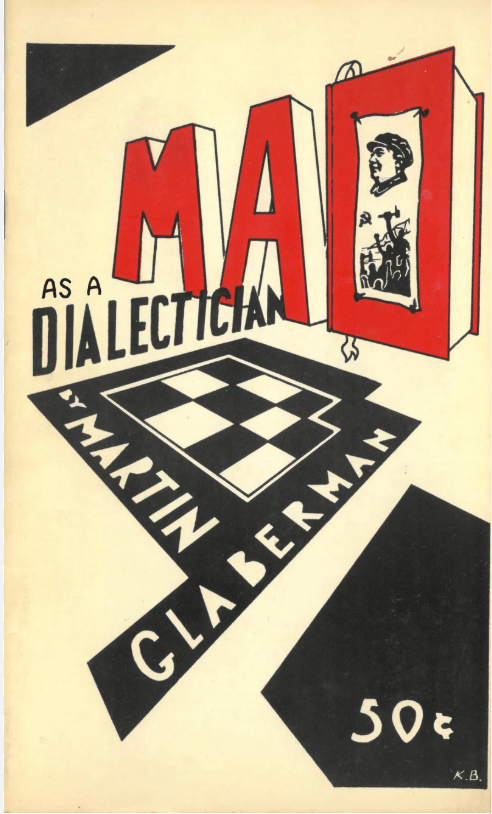
While the Bewick Editions version of the pamphlet is common, we’ve only seen the instant version once (our copy). It was published by a small Australian Trotskyist group called Socialist Workers’ Action Group (SWAG), which existed for three years between 1972 and 1975. The inside text of the pamphlet is just mimeo’d directly from the Fordham journal, but the cover and backside have original drawings and text. Here is the back cover:
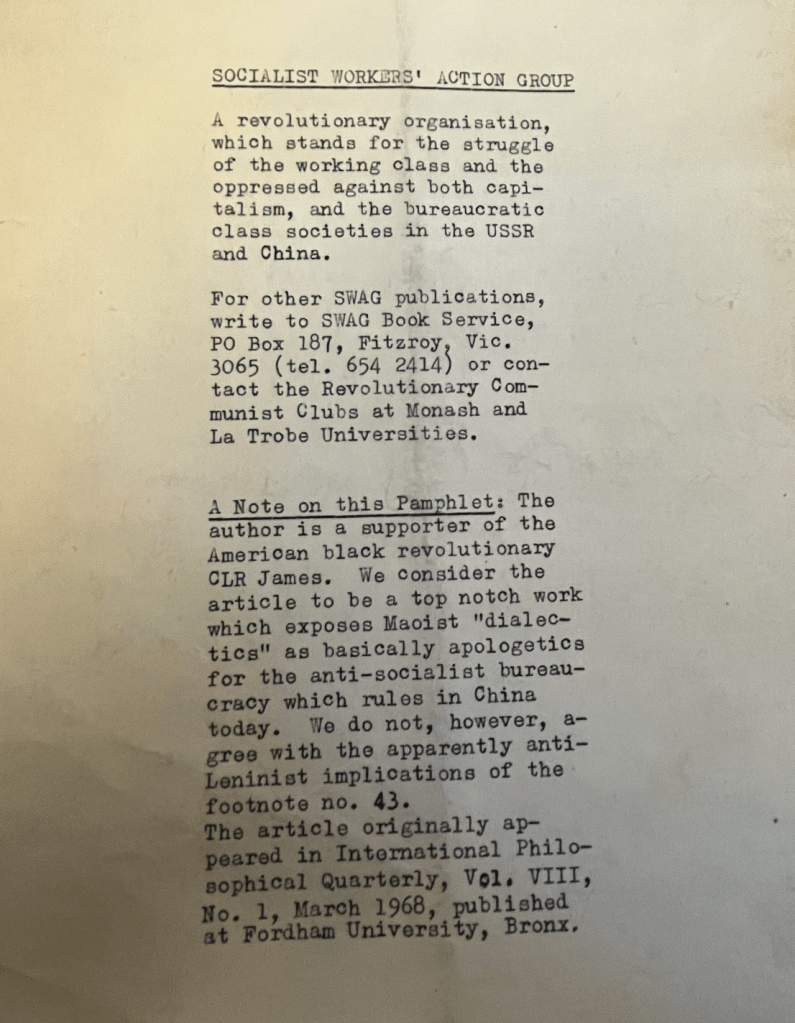
The “note” makes sense in a context of intra-Marxist splits and factions and the ongoing wars around both the class nature of the Communist states as well as the virtual deification of Communist leaders and dictators.
We locate no holdings of this edition of the pamphlet. Our copy contains a former owner’s handwritten notes, so not in great shape but certainly a great piece of Glaberman and Marxist ephemera.
 New York Archives of Autonomist Marxism