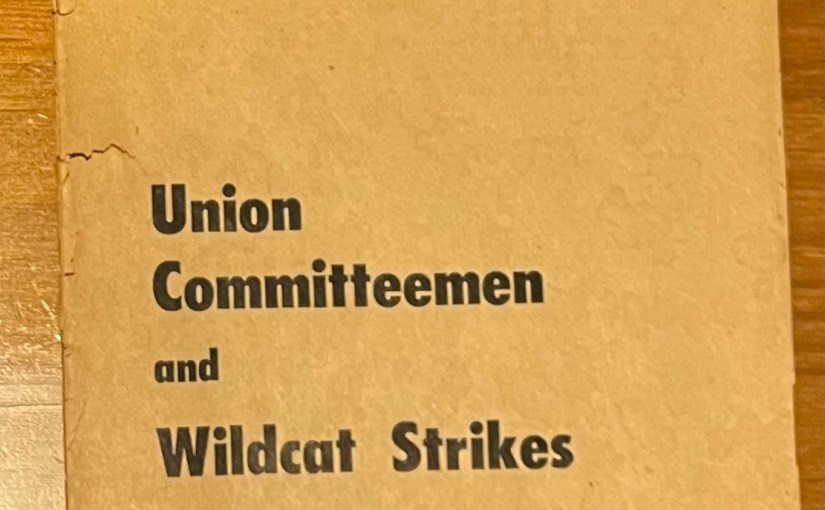

I have written about Marty Glaberman a few times on this blog and still have many more publications of his I could write about (and hopefully will, one day).
After he died, if I understand correctly, his archives got split up. Wayne State took a substantial amount of it (see here), and what they didn’t take ended up in the hands of the Portland IWW chapter, after some of their activists organized a vehicle to pick up and drive the boxes from Michigan to Oregon. Those boxes were then organized in the basement of a building that was called Liberty Hall, now closed, which was home to the offices of a number of left groups. Liberty Hall went through at least one major flood, which caused damage to a lot of the documents, but most remained in fine shape. The PDX Wobblies setup bookshelves, and one could peruse Glaberman’s notes in Gramsci or Marx volumes, some informal correspondence with other radicals, and so on.
I spent much of the summer of 2006 sorting through the archives, trying to create some order out of file cabinets worth of pamphlets and journals, and scanning pieces here or there. What happened to the archives thereafter is not entirely clearly to me. Rumor has it that after the library at Liberty Hall closed, they were then stored in a garage or a basement, and then eventually set back up elsewhere, but subsequently “lent” out in ways the substantially reduced the collection. More recently, I heard that much of the collection remains viewable via the Portland wobs. I am not entirely clear. In any case, going through the collection that summer really helped me to grasp Glaberman’s work, and get some sense of various key points in the autonomist left between the 1970s and 1990s.
This pamphlet is composed of two essays that are classic Glaberman, along with a brief introduction. Both essays had been published in Vol. 2 #9 of Correspondence (copies of which are exceptionally rare), and this pamphlet is a reprint of them in pamphlet form.
The first essay, The Nationwide Auto Workers’ Wildcat looks at the wildcat cycle in context of auto contract negotiations, and particularly how union leadership (under Walter Reuther) sought to control workers (in this case, via a Guaranteed Annual Wage) and how workers struggled against that control and against the boss’s control on the factory floor. One can certainly see significant foreshadowing of Glaberman’s later dissertation and then, even later, his book, Wartime strikes: The struggle against the no-strike pledge in the UAW during World War II, in the piece. Unsurprisingly, the last paragraph of the piece ends with this hopeful commentary:

The second essay in the pamphlet, “The Left Wing Union Committeeman,” is a critical reflection on the role of “enlightened” radicals in the class struggle. In this case, Glaberman writes about former Correspondence editor, Johnny Zupan, who left the paper out of a fundamental political disagreement. For Glaberman, Zupan’s role as a full-time committeeman made him into a bureaucrat, whether or not Zupan was a good person or perceived himself to be a dedicated militant. He explains:
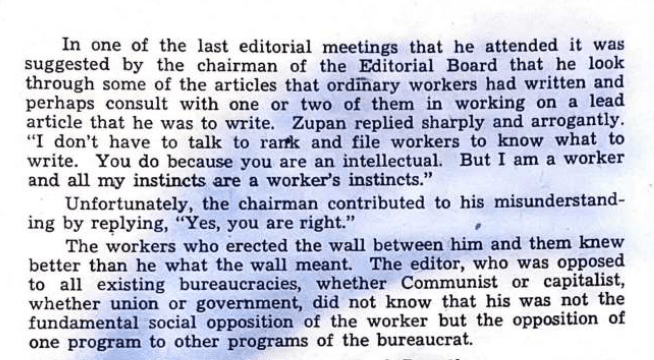
This essay is a powerful analysis of the often contradictory role of radicals in the unions and a classic document of the “working class as autonomous from the unions” perspective. It is also a helpful (and evergreen) analysis of how vanguardism appears in the political work of people who may otherwise say they are against vanguardism. This essay later appeared in Lynd’s collection of Glaberman’s work, Punching Out.
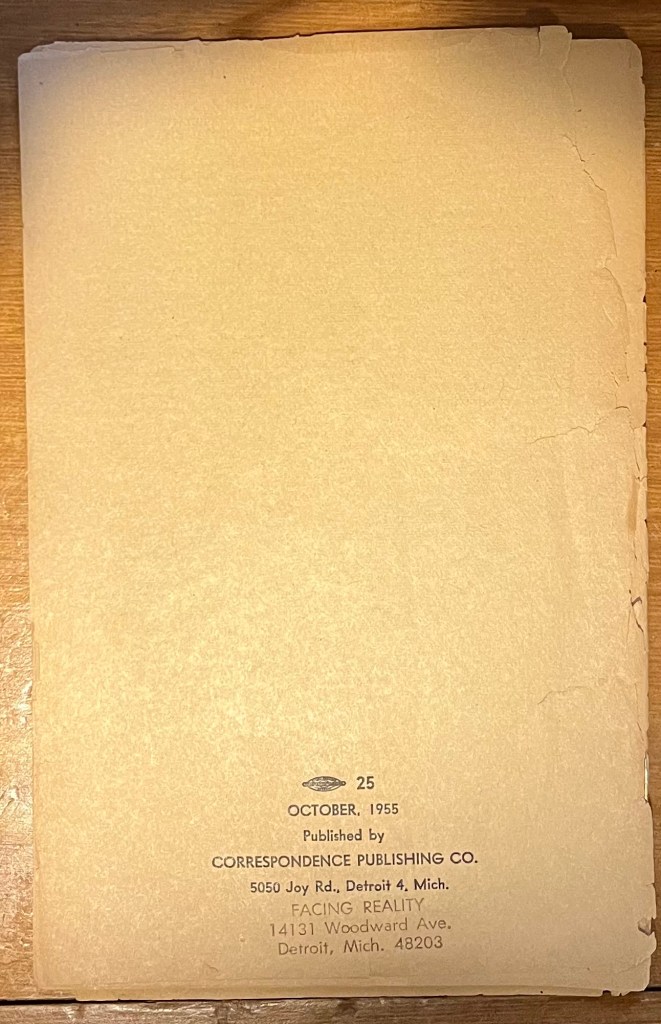
We could not locate a scan of this pamphlet online, and we couldn’t locate the first essay online, so we scanned it and placed it on Libcom, here. (Apologies for the pretty poor quality, but it’s readable). Our copy of the pamphlet is in bad shape – the covers are separated from the booklet and the paper (newsprint) has become frail and frayed. This pamphlet is rare but OCLC locates 18 copies, though many of them are of the later 1971 Bewick Editions reprint. – Craig
 New York Archives of Autonomist Marxism