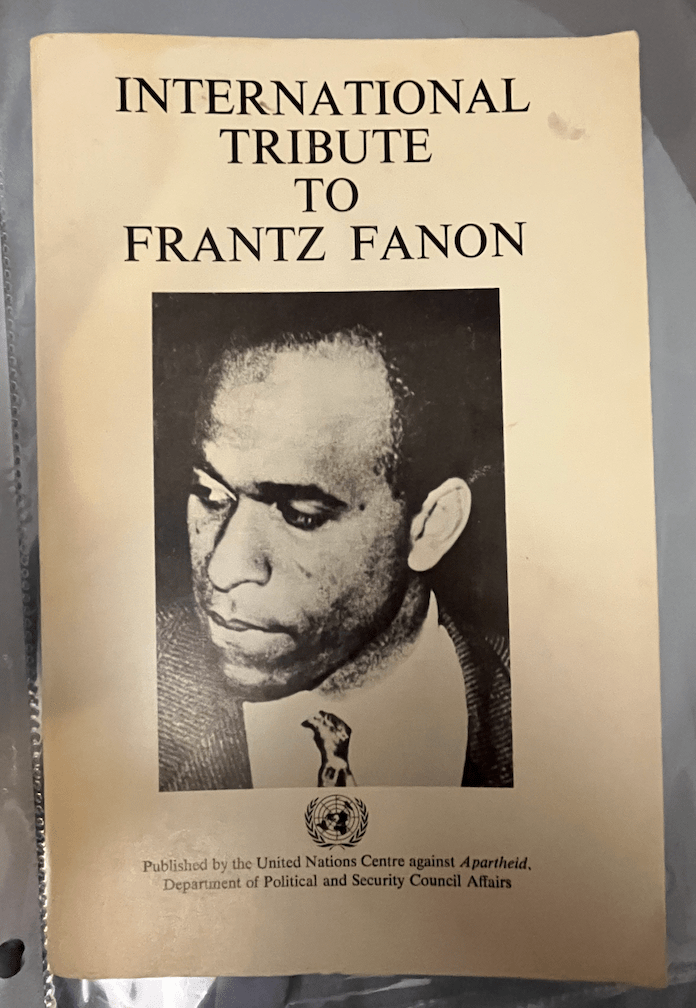
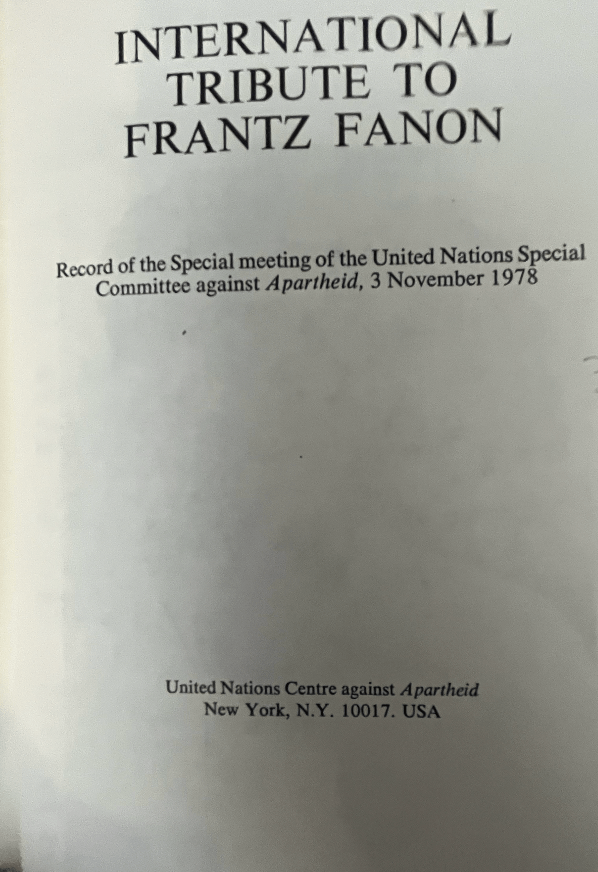
In November 1978, nearly 17 years after his death, the United Nations Centre Against Apartheid held a day-long conference in tribute to Frantz Fanon. Fanon died young at just 36 years old, but the incredible impact of his writing and life have only seemed to grow year over year. The day-long event was part of a series put together by the UN Special Committee Against Apartheid, as Committee Chairman (and Nigerian ambassador to the UN) Leslie O. Harriman explained in his introduction to the instant pamphlet,
"The tribute that is being paid today to the late Fanon is part of a series of observances which the Special Committee has sponsored during the International Anti-Apartheid Year to honour outstanding people of African descent such as W.E.B. DuBois, the Reverend Dr. Martin Luther king and Paul Robeson, who have done so much to reestablish the black man in his pride, dignity and rights; to muster international support for the abolition of colonial and racist domination; and to bring the weight and influence of the African diaspora within the fold of African unity and solidarity" (p. 1).
Following the conference the Department of Political and Security Council Affairs of the UN Centre Against Apartheid published the proceedings in this pamphlet.
Here is the table of contents:
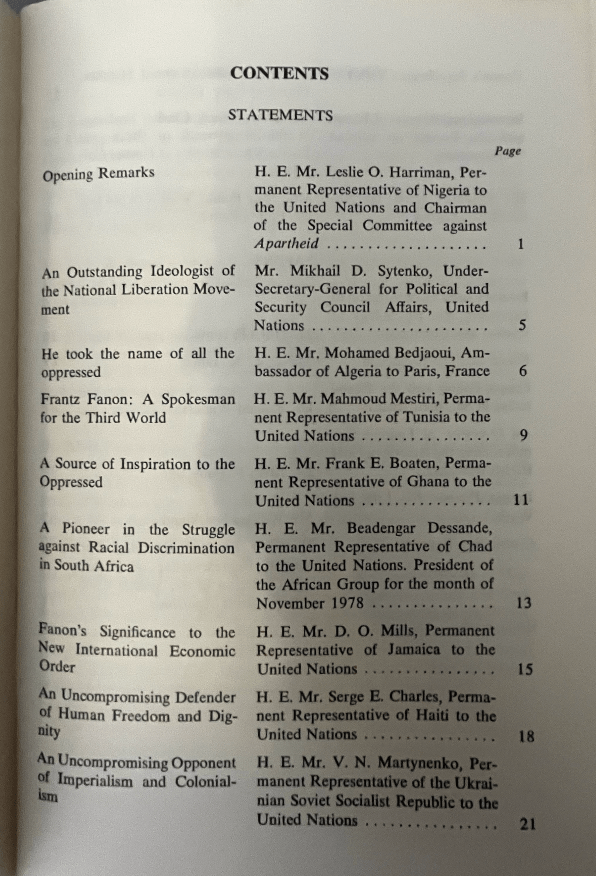
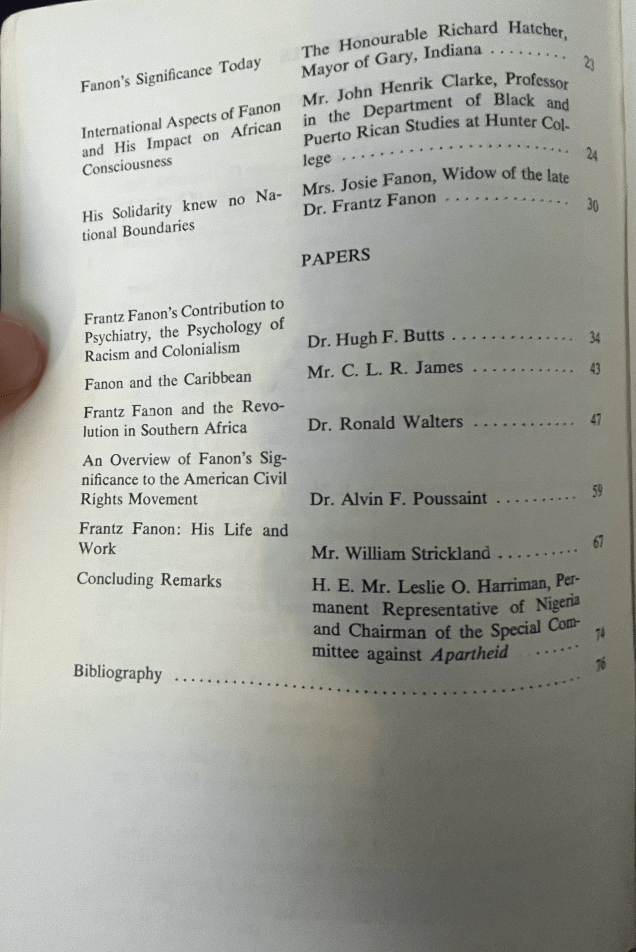
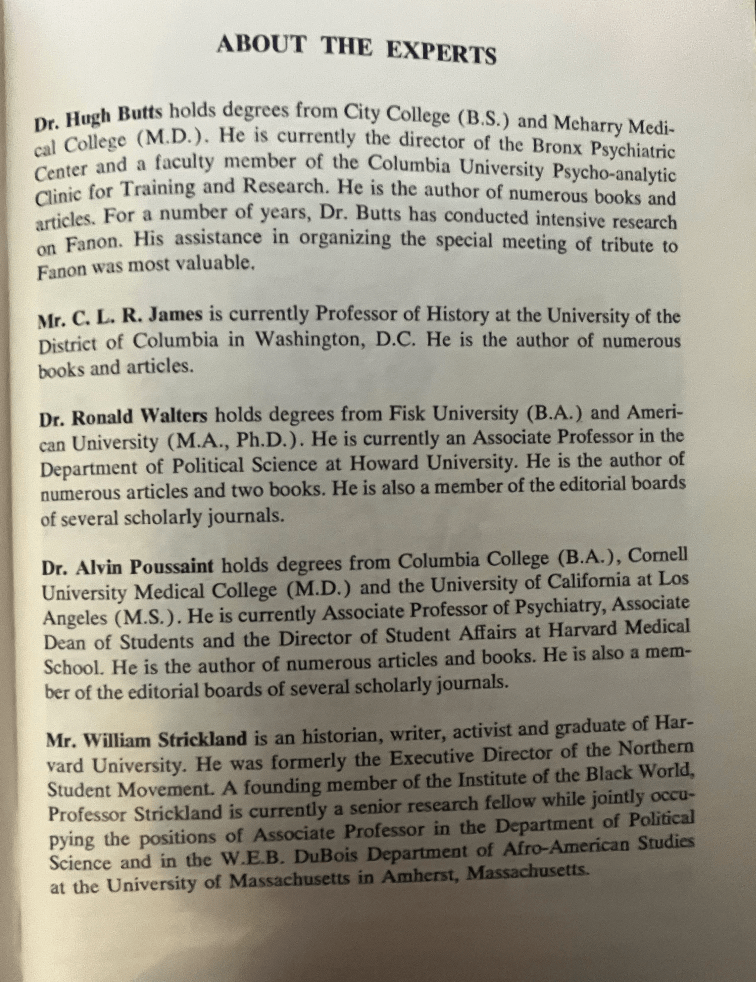
James was invited to participate as an expert along with several other academics. His bio for the pamphlet is notably modest given his own participation in a variety of relevant struggles and the remarkable amount of writing, much of it groundbreaking, that he had published:
In his short contribution to the pamphlet, “Fanon and the Caribbean” (available here), James begins by expressing some bewilderment and dismay about the composition of the conference participants:
"When I was asked to speak, I was invited to submit a paper. I said that in 60 years of public speaking I had not done that and I was not prepared to start here, because I really did not know who was speaking with me and who would be listening. It is not possible to present a paper under those circumstances. As I look around, I notice that on the platform there are lots of heads of departments or members of Governments. Most of the other speakers are professors from universities. I find this combination a rather unusual one. I would have liked to hear from the platform a Portuguese voice. The voice would have been translated and we would have understood a little more about Fanon. I would have liked to hear from among the audience a man like Wole Soyinka from Africa and another man from the Caribbean called Walter Rodney. I am sure we would have immensely benefitted by what they would have had to say about Fanon. That was the reason why as a habit I do not present papers but I am going to say more or less what I have to say now and I will tell you the outline of it."
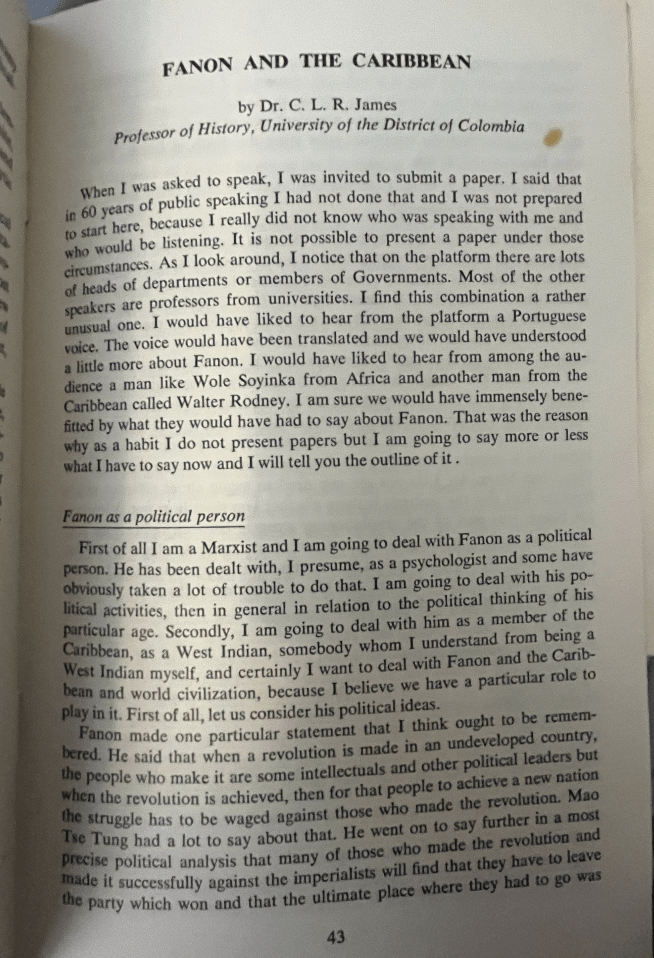
James reads Fanon’s life politically in this short essay, in the process noting that Fanon was a pupil of Aimé Césaire, who James had a relationship with. For this reader the portion of James’s essay that I found to stand out most, perhaps in relation to current times, was this:
"Secondly, there is a lot of talk about violence. I can not understand how people in the world that we have lived in for so many centuries argue about violence. When was there no violence? Fanon’s violence was a profoundly philosophical conception. It came originally from Hegel and Hegel has a wonderful passage where he analyzes the relation between the master and the slave.The master incorporates what the slave produces, but the slave by having to work on the material develops himself and becomes a personality and ultimately the struggle is a struggle to the death between the master and the new slave who has developed himself by working on the material for his master. That is a famous passage in Hegel. Marx took it over and it is one of the most powerful themes in Das Kapital. When Fanon develops this theme he is merely elaborating on that profound political conception of Hegel and Marx. So, I do not see any need to argue about violence apart from the fact that the violence is there whether you want it or not. Violence for Fanon was part of the revolutionary struggle between oppressors and oppressed; and if he thought that violence meant some development of the person who was using it against those who were oppressing him, he was merely in the tradition of Hegel and Marx, in my mind the most powerful political tradition in the Modern World."
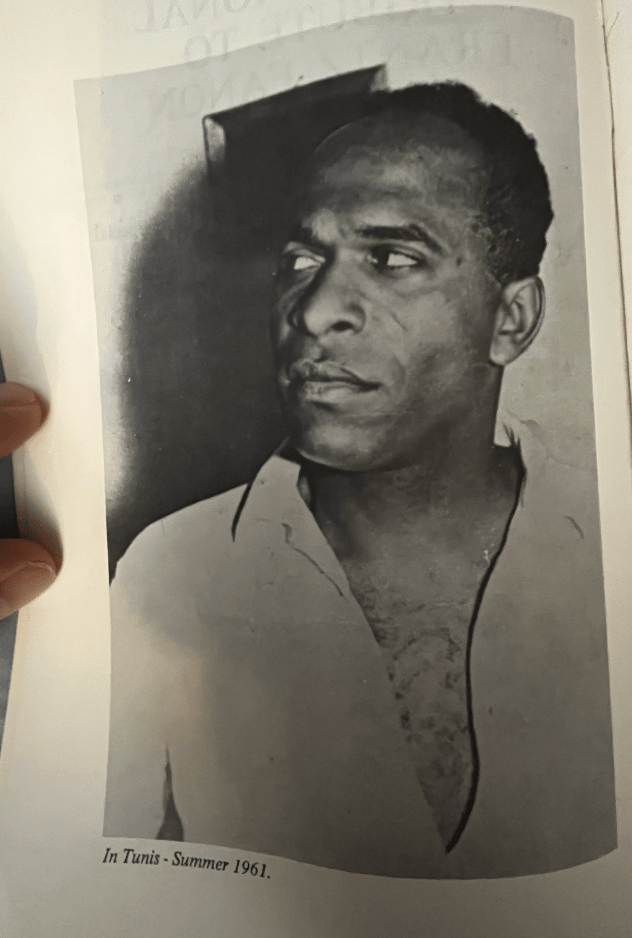
This pamphlet is surprisingly scarce in the book trade and it is not fully available online, but the James essay is available at the Marxists Internet Archive, here. OCLC lists nearly one-hundred holdings worldwide, which makes sense given this is a UN publication. Our copy is in good shape though has had a tough run-in with a cigarette and maybe a splash of coffee it seems.

