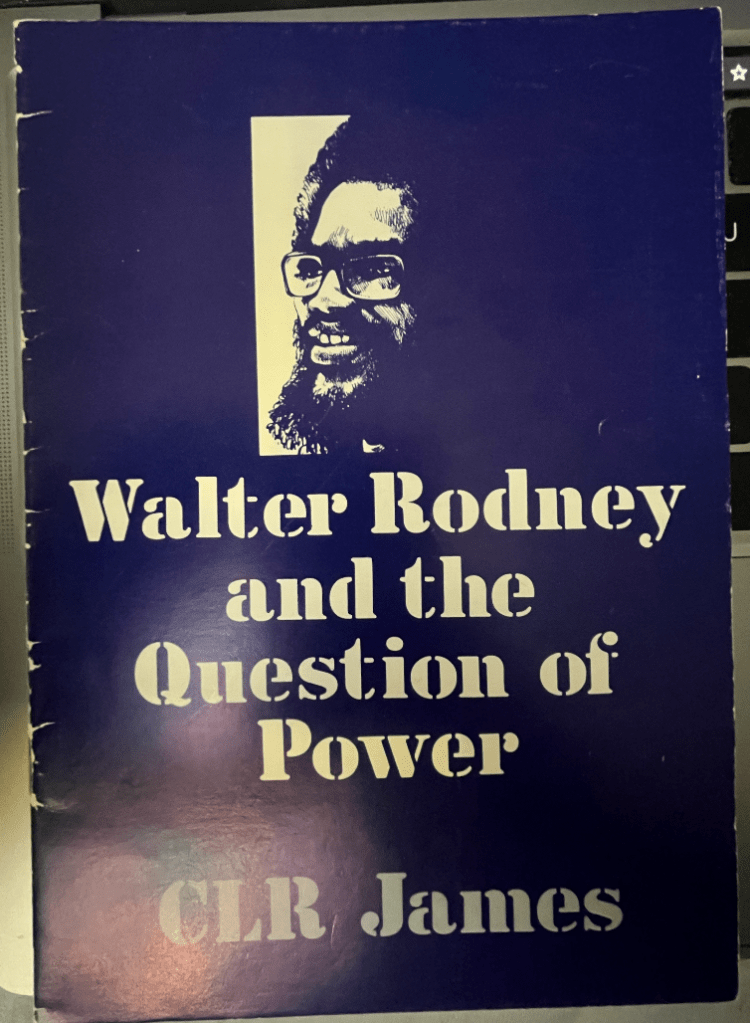
I’ve been reading through a lot of old C.L.R. James pamphlets recently. In his vast bibliography one finds many pamphlets amidst a remarkable number of articles, transcribed speeches, and books James produced during his time. Collecting his work has been a focus here for decades and one interesting piece of that has been tracing back the context of the specific publishers who reprinted the pamphlets and their political contexts. James’s pamphlets tend to be republished by radical projects immersed in struggles of their locale and time. The instant pamphlet is no different.
The murder of Walter Rodney, historian, Marxist, and revolutionary, likely won’t be a foreign piece of history to readers of this blog, though for those new to the subject and interested the documentary Walter Rodney: What They Don’t Want You to Know is a good starting point.
Months after his murder in the fall of 1980, the Center for Afro-American Studies at UCLA convened a conference in tribute to Rodney entitled “Walter Rodney, Revolutionary and Scholar: A Tribute,” that included speakers (all men, I believe) such as Robert Hill, Pierre-Michel Fontaine, and C.L.R. James, among others. This pamphlet is a a transcript of James’s talk, entitled “Walter Rodney and the Question of Power.” (A book of the conference talks was published by the University of California Press in 1981 and and is scarcely findable in the book trade, but is available for download here).
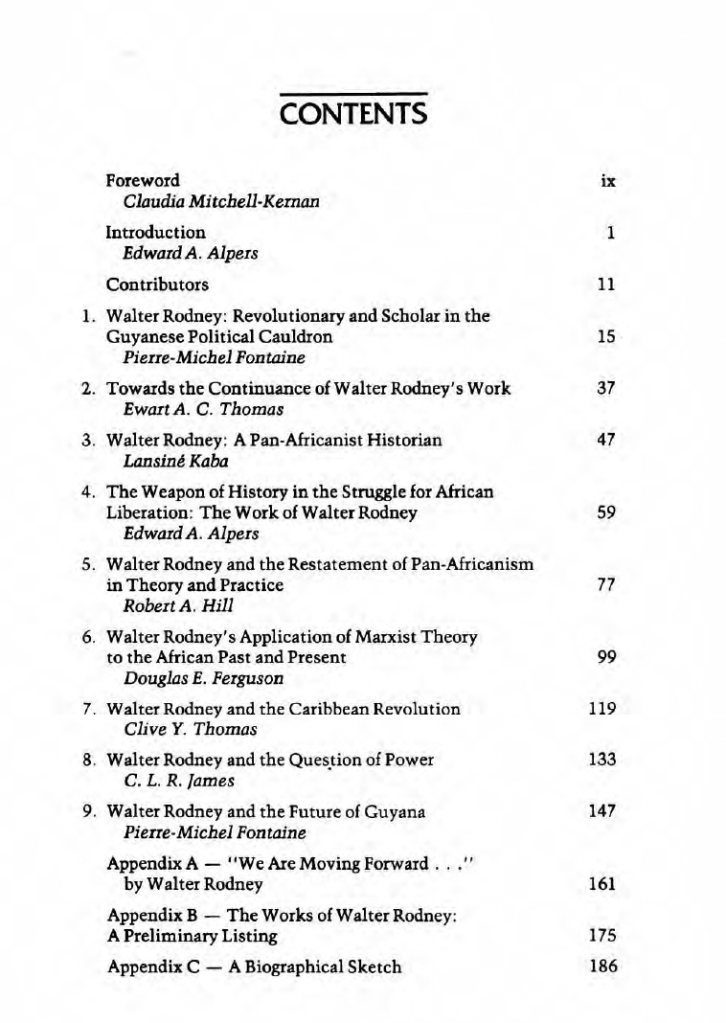
To my knowledge, the instant pamphlet is the first and only time the Question of Power talk was published again as a standalone piece.
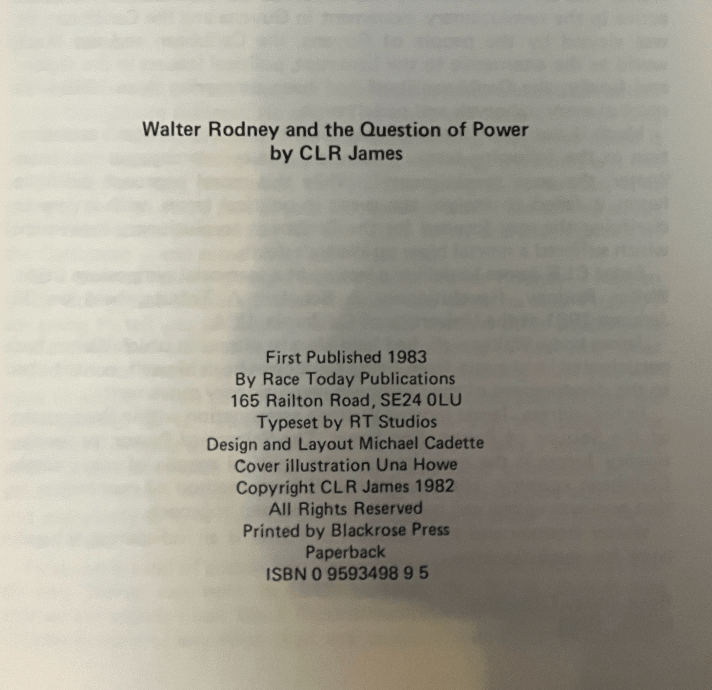
The publisher, Race Today Publications, was a critically important Black marxist project out of England that began at the tail end of the 1960s. Race Today’s leading theorist was Darcus Howe, who was James’s cousin and acolyte, as well as an activist known for being part of the Mangrove 9, and a prolific writer. (For those interested in the relationship between Howe and James it’s worth reading Paul Field and Robin Bunce’s 2013 work Darcus Howe: A Political Biography generally, and specifically Ch. 1 fn 1, p. 14. That work was published again, in 2017, as Renegade: The Life and Times of Darcus Howe. Both editions by Bloomsbury). Race Today Publications was, as is obvious, the publishing arm of Race Today aside from the magazine of the same name that they produced into the 1980s.
In trying to understand the history of this pamphlet I found it very helpful to read the transcript of an October, 1980 talk that James gave just a week after Rodney’s assassination, at a memorial organized by the Committee Against Repression in Guyana. The transcript of the talk has its title as simply “C.L.R. James on Walter Rodney.” In that talk one can understand the personal relationship between these two towering figures, and also understand how concerned James had been that Rodney would be assassinated, and how he had tried to sound alarms beforehand.
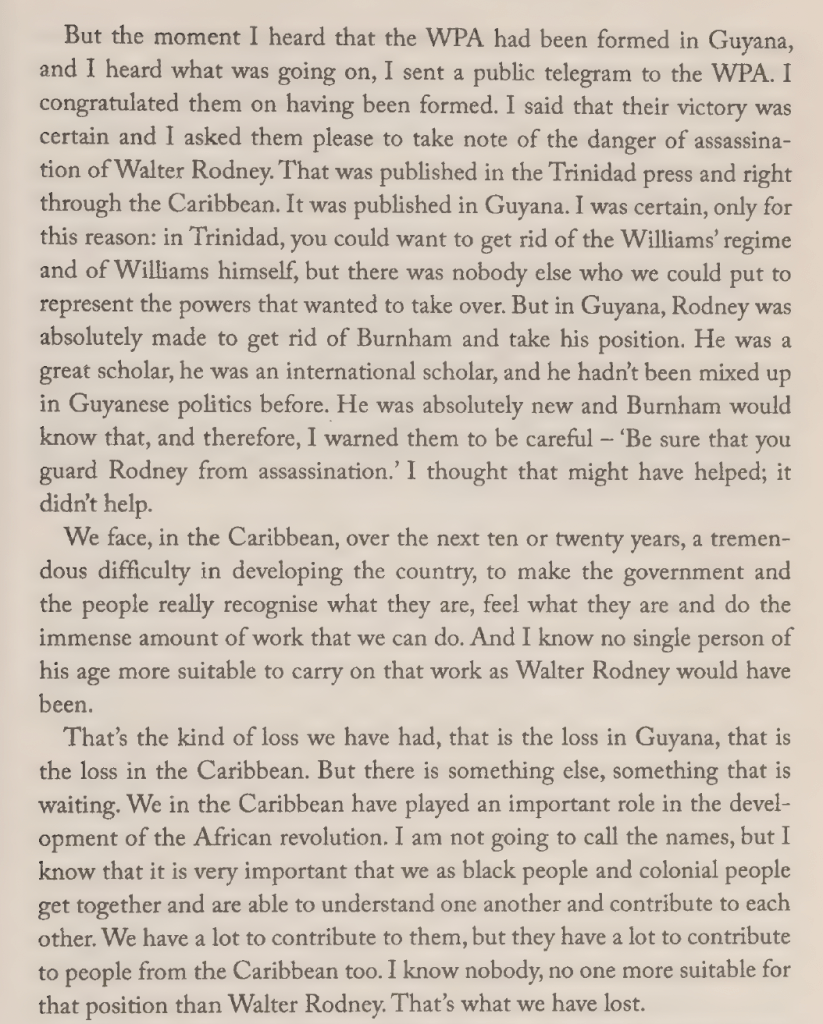
James’s essay Walter Rodney and the Question of Power is a somewhat less personal and more theoretical reflection on Rodney’s role in political struggle. Here, James is reading Rodney’s life through the lens of Lenin. But in the talk James is clearly trying to deliver the painful political lessons he took from Rodney’s assassination: “I am going to deal with what Walter did not know and what he should have known and what you will have to know; if you do not pay the proper attention, you will pay the consequences for it. Then…I will show that this catastrophe took place because of what Walter did not know. Finally, I will tell you what to do henceforth so that you will never find yourselves in the situation in which Walter found himself, so that you prepare yourselves and everybody around you for similar situations in order to be able to handle them.”
Reading Rodney through Lenin, specifically his 1905 lecture “Marxism and Insurrection,” James argues that Rodney had failed to “study exactly the taking of power,” and failed to analyze adequately grasp the political moment:
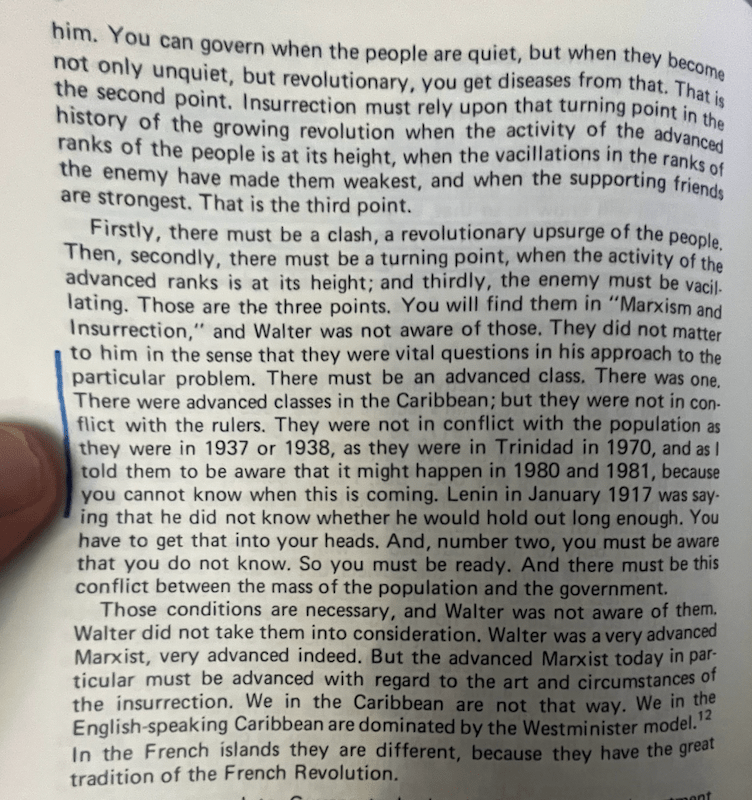
Look specifically at Rodney’s actions with the Working People’s Association, James asserts: “A revolution is made with arms, but a revolution is made by the revolutionary spirit of the great mass of the population. And you have to wait for that […] There is no calculation. It comes, as Marx says, like a thief in the night. So you had better be ready. […] Walter became too nervous, too anxious about it. He did not wait for the revolutionary people and the revolutionary class to be in conflict with the government before he could start question of insurrection.” James goes on:
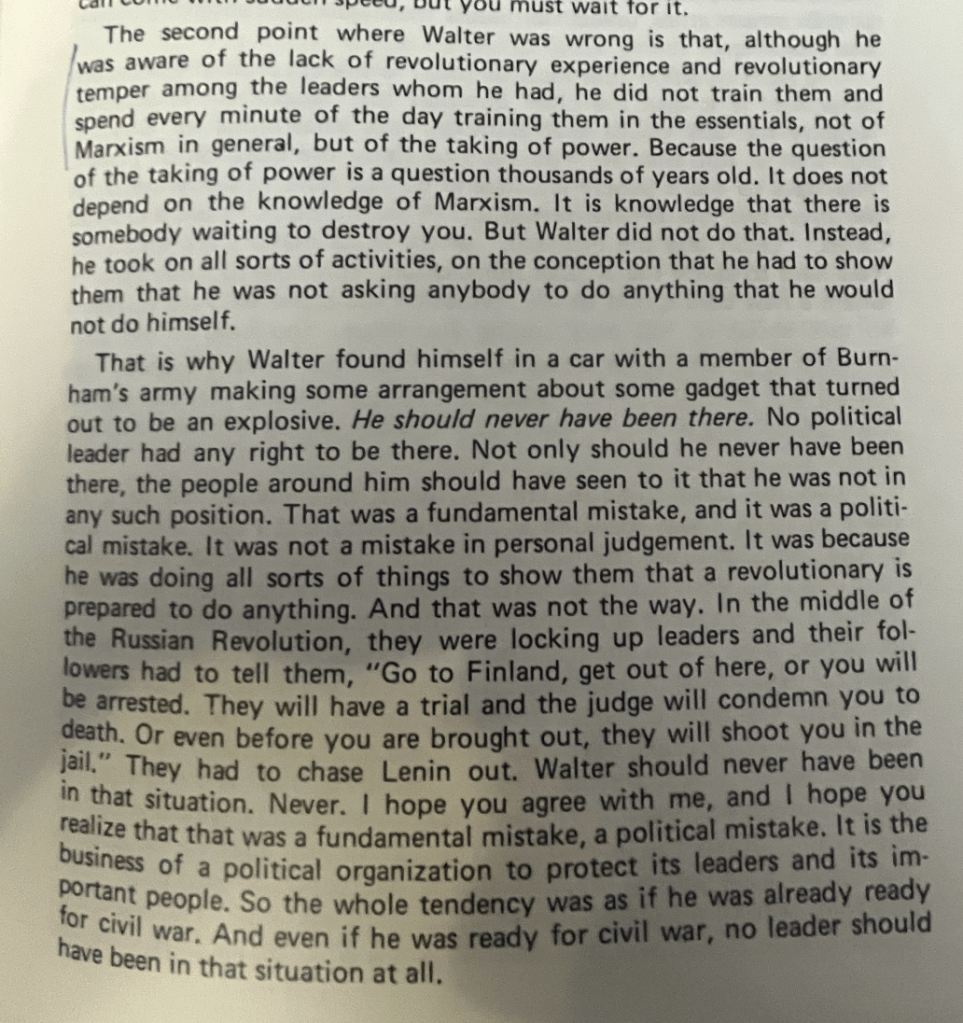
Ultimately, this essay is an analysis by James of how to assess a revolutionary moment or lack there of. It is also a strong example of how James is able to use his close readings of Lenin and Marx in ways that can contradict more common readings (for example he argues at some length here, using Lenin, that a party is not critical for a revolution).
This pamphlet is surprisingly uncommon in the used book trade. Our copy is marked up from a previous owner and, at best, a reading copy. But it’s also the only copy I’ve seen sold for some years. OCLC locates 45 institutionally held copies.
(Note: Thanks to Conor C. for reading this pamphlet and discussing it with me in the process of putting this little post together).
 New York Archives of Autonomist Marxism